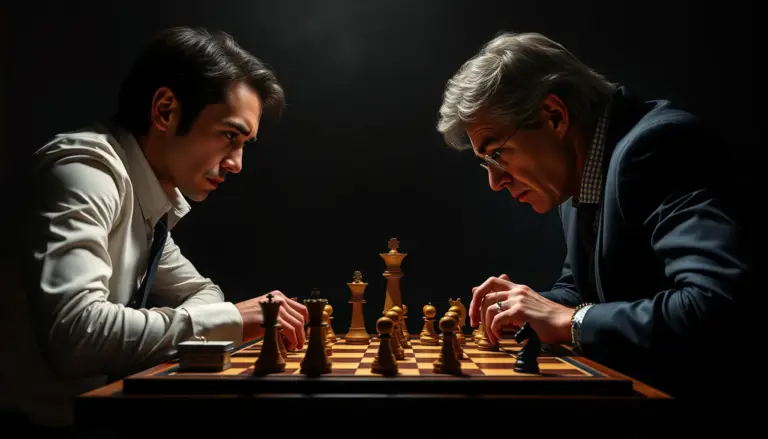
chess, in its essence, It has been for centuries a battlefield where poetry and science waged a silent war. Before 1886, the game was a canvas for romanticism, a scene where spectacular sacrifices and daring attacks eclipsed any cold calculations. but that year, in a historic duel in the United States, Wilhelm Steinitz was not only crowned the first official world champion, but it redefined chess forever. His victory over Johannes Zukertort was not just a personal triumph; was the birth of the positional theory, a paradigm shift that transformed the board into a laboratory of pure logic. How did Steinitz turn chess from an ephemeral art to an exact science??
Chess romanticism: when the board was a scene of passion
To understand the Steinitz revolution, It is necessary to go back to a time where chess was synonymous with spectacle and overflowing emotion.. He romantic chess, that flourished in the 19th century, prioritized attack over defense, sacrifice over caution. Matches like “The Immortal”, played by Adolf Anderssen in 1851, encapsulate this spirit: a bishop sacrificed here, an abandoned tower there, all in the name of a brilliant checkmate. But behind this ephemeral beauty there was a fundamental problem: the lack of a method. Romantic chess was, in many ways, a game of intuition, where individual genius eclipsed any attempt at systematization.
This approach, however, had a clear limit. The most talented players could shine in isolated games, but they lacked a theoretical framework that would allow them to reproduce their success consistently.. chess, in the hands of the romantics, It was like a poem without structure: beautiful, but ephemeral. The question that arose was inevitable: Could chess evolve beyond momentary inspiration to become a discipline with universal principles??
Steinitz and the science of chess: the board as an equation
Wilhelm Steinitz was not just another player on the chess scene of the 19th century. Born in Prague in 1836, His approach to the game was radically different from that of his contemporaries. While others sought the attack at all costs, Steinitz became obsessed with understanding the hidden laws of the board. His great contribution was the formulation of the positional theory, a system that prioritized the pawn structure, control of space and the accumulation of small advantages over tactical fireworks.
Para Steinitz, chess was not a duel of egos, but a mathematical problem. Each movement had to respond to an internal logic, to an objective evaluation of the position. In his famous match against Zukertort in 1886, showed that positional superiority could defeat even the brightest talent. Zukertort, a master of attack, was overcome by Steinitz's patience and precision, who, like a scientist in his laboratory, dismantled every attempt at counterplay with calculated coldness. This approach not only gave him victory, but it laid the foundations for modern chess.
But, Where did this obsession with logic come from?? Steinitz lived in a time where science and technology were transforming the world.. The Industrial Revolution, Advances in mathematics and the growing influence of the scientific method influenced his thinking.. for him, chess could not be an exception: If nature followed predictable laws, why shouldn't the board do it? His legacy, however, It wasn't just theoretical.. Steinitz was also a pioneer in psychological preparation, understanding that chess was as much a game of minds as of pieces. This duality between science and psychology would become a pillar of contemporary chess.
From sacrifice to structure: how chess became predictable
Steinitz's positional theory not only changed the way of playing, but also the way of thinking about chess. before him, players evaluated a position based on subjective factors: “Does this attack seem strong?” o “Is this sacrifice brilliant?”. Steinitz introduced an objective framework: “Who controls the most boxes??”, “What pieces are best located?”, “Are there weaknesses in the pawn structure?”. This change in perspective transformed chess into a discipline where long-term planning replaced improvisation..
A clear example of this evolution is the comparison between the king's gambit, a romantic opening where white sacrifices a pawn to gain initiative, and the king indian defense, a positional opening where Black gives up space and then counterattacks. While the king's gambit seeks to unbalance the game from the first move, King's Indian defense prioritizes solidity and patience. This contrast is not accidental.: reflects the passage from an era where chess was an art to another where it became a science.
However, This approach also had its critics. many players, especially those raised in the romantic tradition, They saw positional theory as a threat to creativity.. Wasn't chess, after all, a game of imagination? Steinitz responded to these criticisms with a phrase that has become a mantra for positional players.: “Chess is a game of ideas, but ideas must be supported by logic”. In other words, creativity without a foundation was as useless as a building without a foundation.
Steinitz's legacy: when chess became a mirror of the human mind
Steinitz's impact transcended the board. His scientific approach laid the foundation for generations of players who, like José Raúl Capablanca or Anatoly Karpov, would take positional theory to new heights. But beyond the openings and endings, Steinitz showed that chess could be a reflection of the human mind in its purest state.: a field where logic, creativity and psychology intertwine.
Hoy, when artificial intelligence dominates elite chess, It's easy to forget that there was a time when gaming was uncharted territory. Steinitz was the first to map that territory, in turning chaos into order. His victory in 1886 It was not just the start of a world championship; It was the moment when chess stopped being a hobby and became a discipline with rules., principles and, above all, a future.
But, What remains of romantic chess in the positional era? More than it seems. Although the modern game prioritizes precision over spectacle, the essence of chess remains the same: a duel between two minds. The difference is that, thanks to Steinitz, We now have the tools to understand why some minds succeed and others fail.. In that sense, His legacy is not just a theory, but an invitation to look at the board with new eyes: not like a battlefield, but as a laboratory where science and art meet.
Conclusion: chess as a metaphor for human evolution
The match of 1886 between Steinitz and Zukertort was much more than a championship. It was a turning point in the history of chess., a moment when the game stopped being a reflection of romanticism and became a mirror of reason. Steinitz not only won one game; showed that chess, like science, could be systematized, studied and mastered. His victory was the victory of logic over intuition, of patience over impulsivity, of science over art.
But, Does this mean that chess lost its magic? At all. Positional theory did not eliminate creativity; the redefinition. Hoy, grandmasters don't just look for brilliant attacks, but elegant solutions within a logical framework. chess, in the hands of Steinitz, became a game where beauty and precision can coexist. And perhaps that is your greatest lesson: that even in a world governed by rules, there is always room for genius.
If chess is, as the writer Stefan Zweig said, “the purest of arts”, then Steinitz was its first scientist. His legacy reminds us that, on the board as in life, the balance between reason and passion is what makes us human. And, in the end, the real checkmate is not just winning a game, but to understand why it was won.