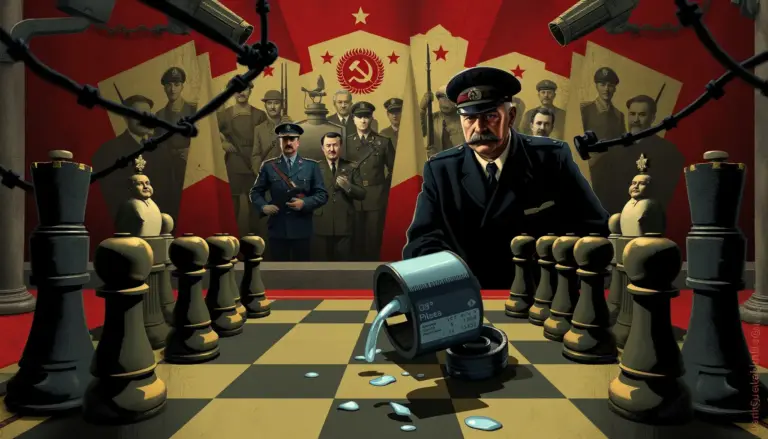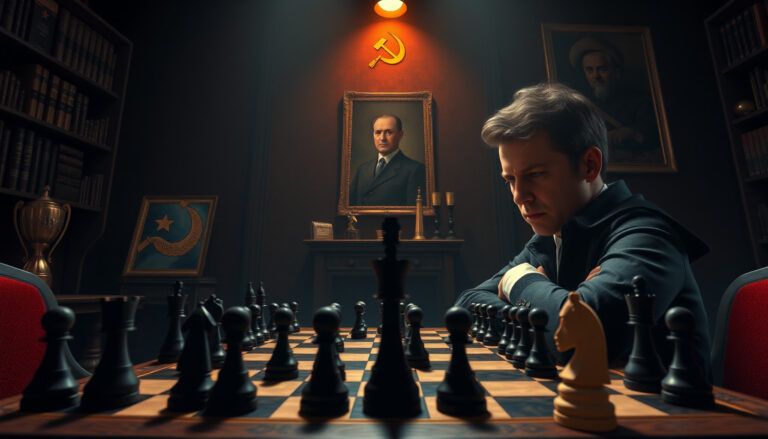
In the depths of one of Africa's longest and least known conflicts, an image emerges that challenges stereotypes of war: Eritrean soldiers playing chess in the trenches during their mandatory military service. this scene, apparently contradictory, reflects not only human resilience in extreme conditions, but also the complexities of a country marked by decades of conflict, international isolation and a conscription system that has redefined life for generations. Eritrea, a nation in the Horn of Africa with a history of fighting for independence and an opaque political reality, offers a scenario where war and everyday life intertwine in unexpected ways. How is it possible that in the middle of a military service that many describe as endless, chess becomes a symbol of resistance and normality? This article explores the historical roots, the social implications and contradictions of a phenomenon that goes beyond a simple hobby, revealing the hidden layers of a country that remains an enigma to the world.
The historical context: Eritrea and its fight for independence
To understand why Eritrean soldiers play chess in the trenches, It is essential to go back in time and analyze the path that led Eritrea to its current situation. The country's history is deeply linked to that of its neighbor Ethiopia, with which it maintained a relationship of domination and resistance for more than a century. After being annexed by Ethiopia in 1962, Eritrea began a war of independence that lasted for 30 years, until 1991, when he finally achieved his sovereignty. However, peace was short-lived: in 1998, A border conflict with Ethiopia triggered a new war that lasted until 2000 and left tens of thousands dead.
This conflict, although technically ended with the Algiers Agreement in 2000, left an open wound. Eritrea, under the authoritarian government of Isaias Afwerki, maintained a state of permanent mobilization, justifying indefinite military conscription as a necessary measure to protect national sovereignty. The lack of a definitive agreement with Ethiopia—until the surprise reconciliation in 2018—allowed the Eritrean regime to maintain a discourse of “not war, not peace”, perpetuating a militarized system that has shaped the lives of its citizens. In this context, chess in the trenches is not just a game, but a reflection of how the population adapts to a reality of chronic conflict.
Military conscription in Eritrea: between obligation and oppression
Military service in Eritrea is one of the longest and most controversial in the world. Officially, conscription lasts 18 months, but in practice, many recruits remain in the military for decades, without a clear horizon of liberation. This system, established in 1995, It was initially justified as a temporary measure to consolidate national security after independence. However, with the outbreak of war with Ethiopia in 1998, It became a tool of social and economic control.
The recruits, both men and women, They are sent to training camps where conditions are harsh: exhausting days, insufficient rations and a harsh disciplinary regime. Many describe the service as a form of modern slavery, where soldiers are used not only for national defense, but also for construction and agriculture projects under the program “War for Development”. In this scenario, Chess emerges as a psychological escape mechanism. Playing in the trenches is not just a hobby, but a way to maintain sanity in a dehumanizing environment. Besides, chess, with its clear rules and logical structure, contrasts with the chaos and uncertainty that dominate the lives of the recruits.
Chess as a symbol of resistance and normality
Chess in Eritrea is not an isolated phenomenon. The country has a notable chess tradition, with an active federation and players who have competed at international level. However, his practice in the trenches takes on a deeper meaning. In an environment where individual freedom is almost non-existent, chess becomes an act of silent resistance. Each game is an affirmation of humanity, a reminder that, even in the most adverse circumstances, the mind can transcend oppression.
Besides, chess in the trenches fulfills a social function. In a system where recruits come from different regions and ethnic groups, The game acts as a universal language that fosters camaraderie and reduces tensions. The soldiers, many of whom are young people with no prior chess experience, they learn to play with each other, creating an informal support network that mitigates isolation. This dynamic contrasts with the official narrative of the regime, that presents military service as a unifying and patriotic experience. Actually, chess reveals the cracks in a system that, despite its rigidity, cannot fully control the creativity and resilience of its citizens.
On the other hand, Chess also reflects the contradictions of the Eritrean regime. While the government promotes sport as a development tool, The reality is that many talented players have fled the country to escape the draft.. This has weakened Eritrea's chess potential., which at the time became a regional power. The paradox is clear: The same system that forces young people to serve indefinitely in the military also deprives them of the opportunity to develop their skills in an area that could benefit the country..
The social impact and the voices of the recruits
Stories of Eritrean recruits playing chess in the trenches rarely transcend the country's borders. However, The testimonies of those who have managed to escape or complete their service offer a harrowing view of what it means to live under this system. Many describe chess as one of the few activities that allowed them to maintain a sense of normality.. “when we played, for a moment we forgot that we were in a trench”, says a former recruit in an interview with an international media. “It was as if the outside world existed again”.
However, chess is also a reminder of what they have lost. Many recruits are young people who were torn from their studies or jobs to serve in the army. for them, the game is not only an escape, but also a symbol of what their lives could have been in other circumstances. This duality—between hope and despair—is a constant in the narratives of Eritreans who have experienced conscription..
The social impact of this system is devastating. Indefinite conscription has caused a massive flight of young people, many of whom risk their lives crossing the Mediterranean in search of asylum in Europe. According to UN data, Eritrea is one of the countries with the highest number of refugees per capita in the world. Those who remain in the country live in a constant state of fear, where denunciation and repression are common currency. In this context, chess in the trenches takes on an even deeper meaning: It is an act of rebellion, but also survival.
Conclusions: beyond the board
The image of Eritrean soldiers playing chess in the trenches is much more than a curious anecdote. It is a symbol of human resilience in the face of oppression., but also a reminder of the contradictions of a system that, in the name of national security, has sacrificed the freedoms and future of entire generations. Eritrea remains a country trapped in a cycle of conflict and isolation, where indefinite military conscription has redefined the lives of its citizens.
chess, in this context, it's not just a game, but an act of silent resistance. Every game played in the trenches is an affirmation of humanity, a way to maintain sanity in a dehumanizing environment. However, It is also a reflection of what the Eritrean regime has destroyed: the possibility of a normal life, of a future without fear. While the world watches with indifference, Thousands of young people remain trapped in a system that condemns them to an existence of servitude and hopelessness.
The story of Eritrea and its chess-playing soldiers invites us to reflect on the limits of human resistance and the consequences of a conflict that, although officially finished, continues to define the lives of millions. Beyond the board, What is at stake is the freedom of a people who, yet, keep finding ways to dream, even in the trenches.