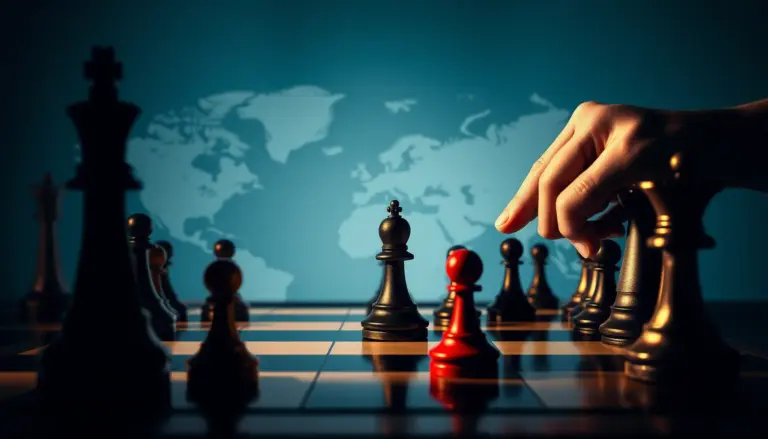
chess, more than just a strategy game, It is a fertile field where science and logical thinking intertwine in fascinating ways.. Since its invention in India more than fifteen hundred years ago, This mental sport has evolved not only as an entertainment tool, but also as a living laboratory for disciplines such as mathematics, psychology, computer science and even neuroscience. Its structure, based on precise rules and calculated movements, makes it an ideal model for studying patterns, Algorithms and human behavior under pressure. But, How exactly have sciences influenced chess and vice versa?? What lessons can scientists draw from this ancient game?, and how modern technology has transformed our understanding of it? In this article, We will explore the deep connections between chess and various branches of knowledge, revealing how a board 64 Casillas can be a mirror of the human mind, a challenge for machines and an inexhaustible source of inspiration for innovation.
Chess as a mathematical model and its impact on game theory
chess is, in essence, a complex mathematical problem. Each game can be represented as a decision tree where each move generates new branches, and the total number of possible board configurations—known as the Shannon number— exceeds 10120, an astronomical figure that even exceeds the number of atoms in the observable universe. This level of complexity makes it a privileged object of study for the game theory, a branch of applied mathematics that analyzes situations of conflict and cooperation between rational agents.
One of the most significant contributions of chess to this discipline was the formalization of the concept of Nash equilibrium, developed by mathematician John Nash. Although this concept mainly applies to games with incomplete information, Chess—a game of perfect information—has served as a test bed for algorithms that seek optimal solutions in finite environments.. For example, he minimax algorithm, used in chess programs such as Stockfish o Leela Chess Zero, It is based on the idea that each player will try to maximize his advantage while minimizing that of the opponent, a logic that is also applied in economics and political science.
Besides, Chess has inspired advances in graph theory, where the board can be modeled as a directed graph in which each position is a node and each move is an edge. This representation has made it possible to optimize search engines for plays, reducing the solution space through techniques such as alpha-beta pruning, which removes branches from the decision tree that will not affect the final result. These developments have not only improved the performance of chess programs, but they have also found applications in the optimization of logistics routes, project planning and even artificial intelligence.
The psychology behind the board: How chess reveals the mechanisms of the mind
Beyond the numbers, Chess is a scenario where human psychology unfolds in all its complexity. Players like Garry Kasparov o Magnus Carlsen They not only dominate openings and endings, They also understand how to exploit their opponents' cognitive weaknesses.. The chess psychology studies phenomena such as blindness to change, where players miss obvious moves due to information overload, or the efecto setting, which describes how previous experience can limit creativity when looking for solutions.
One of the most interesting findings in this field is the relationship between chess and working memory, a key component of fluid intelligence. Studies with functional magnetic resonance imaging (fMRI) have shown that chess masters activate brain areas such as the parietal lobe and the hippocampus more efficiently than beginners, allowing them to recognize patterns in milliseconds. This ability, known as chunking, allows them to store thousands of positions in their long-term memory, grouping them into “blocks” significant. For example, a great teacher can remember a complex position after seeing it for just a few seconds, while an amateur would need minutes.
Chess has also been used as a tool to study the stress and decision making under pressure. Research in neuroscience has found that, during high level games, players experience an increase in cortisol levels, the stress hormone, which can lead to tactical errors. However, More experienced players develop emotional self-regulation strategies, such as breathing techniques or short pauses, to maintain mental clarity. These findings have practical applications in fields such as aviation, emergency medicine and business leadership, where the ability to make quick and accurate decisions under pressure is crucial.
The artificial intelligence revolution: when machines surpassed humans
Chess has been for decades the Drosophila melanogaster of artificial intelligence (IA), that is to say, a model organism to test and refine algorithms. The most famous milestone in this relationship was the victory of Deep Blue, the IBM supercomputer, about Garry Kasparov in 1997. This event not only marked a before and after in the history of chess, It also showed that machines could outperform humans at tasks requiring abstract thinking and long-term planning..
However, Deep Blue's approach—based on brute force and evaluating millions of positions per second—was limited. The real revolution came with the development of neural networks and the deep learning. Programs like AlphaZero, created by DeepMind, They do not depend on opening databases or human evaluations, but they learn to play through reinforcement learning, playing millions of games against himself and adjusting his parameters based on the results. This approach has led to surprising discoveries, as moves that challenge centuries of chess theory, proving that even in a game with fixed rules, creativity has no limits.
AI applied to chess has had an impact beyond the board. For example, the techniques of heuristic search developed for chess engines are used today in medical diagnostic systems, where the ability to evaluate multiple scenarios in real time is vital. Besides, Chess has served as a test bed for algorithms. explainability in AI, an emerging field that seeks to make the decisions of artificial intelligence systems understandable. This is crucial in areas such as criminal justice or banking., where automated decisions must be transparent and auditable.
Neuroscience and chess: how play shapes the brain
Chess not only challenges the mind, but also transforms it. Longitudinal studies have shown that chess players develop structural changes in the brain, similar to those observed in musicians or high-performance athletes. For example, It has been found that chess players have a greater gray matter density in regions associated with planning and memory, like the prefrontal cortex and the temporal lobe. Besides, Constant practice of chess improves functional connectivity between different brain areas, which results in greater cognitive efficiency.
One of the most fascinating aspects of this relationship is the effect of chess on brain aging. Research carried out in nursing homes has shown that playing chess regularly can delay the cognitive decline associated with diseases such as Alzheimer's.. This is because the game stimulates neuroplasticidad, the brain's ability to reorganize itself and form new neural connections. Besides, Chess promotes skills such as sustained attention and inhibition of impulsive responses, that are key to maintaining mental health in old age.
But chess has also been used as a therapeutic tool.. In patients with autism spectrum disorder (TEA), Play has been found to improve the ability to recognize patterns and follow rules., skills that are often difficult for these people. In addition, in children with attention deficit hyperactivity disorder (ADHD), Chess has been shown to be effective in increasing concentration and reducing impulsivity, thanks to its clear structure and focus on long-term planning.
chess, in its apparent simplicity, It is a microcosm where some of the most advanced disciplines of human knowledge converge.. From mathematics to neuroscience, going through artificial intelligence and psychology, This game has served as a laboratory to explore the limits of the mind, both human and artificial. What began as a hobby in ancient India has become an invaluable tool for understanding how we make decisions., how we learn and how our brain adapts to challenges.
Hoy, chess continues to evolve, driven by technological advances and new scientific research. Artificial intelligence engines not only compete with humans, but they also collaborate with them, offering real-time analysis that enriches the gaming experience. Meanwhile, Neuroscientists continue to discover how this ancient game can shape our brain, improving cognitive skills and protecting against mental decline. In a world increasingly dominated by technology, chess reminds us that, in the end, the real battle is not between humans and machines, but between creativity and rigidity, between intuition and calculation. And in that battle, we all have something to learn.