Chess is a game of strategy, patience and, above all, psychology. Although the pieces move in silence and the rules are mathematical, Each game is also a duel of minds where the ability to read your opponent without saying a word can make the difference between victory and defeat.. It's not just about calculating variants or memorizing openings; It is a subtle art that combines observation, intuition and understanding of human behavior. From the most imperceptible gestures to repetitive play patterns, the board becomes a mirror of the opponent's emotions and intentions. In this article, We will explore how to develop this skill, unraveling the keys to decipher the rival before he himself knows what he will do. Because in chess, like in life, Whoever best interprets silent signals usually has the advantage.
Observation as a first tool
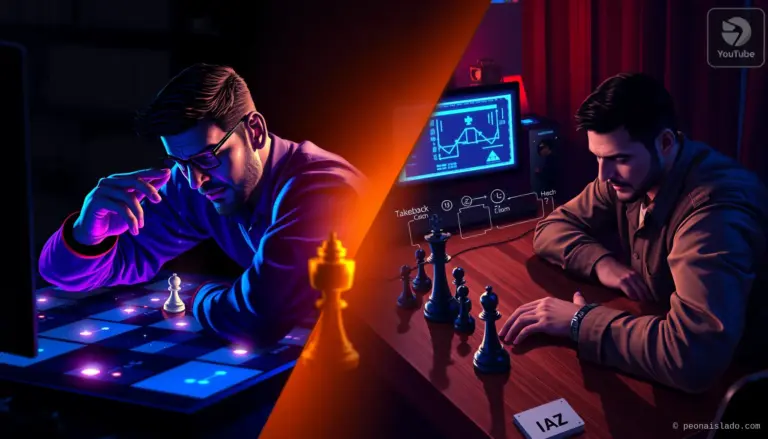
Before diving into tactical or strategic analysis, The first step to reading the opponent is to sharpen your observation. It's not about looking at the board, but to study the player. Experienced chess players know that every move, no matter how small, can reveal valuable information. For example, a player who hesitates too long before capturing a piece may be unsure of his position or fear a trap. In the same way, someone who moves his pieces quickly in one phase of the game but stops in another might be more comfortable in certain types of positions.
The observation also includes seemingly insignificant details, like body posture, breathing or even the way the opponent holds his pieces. A nervous player may drum his fingers on the table, while a confident one usually maintains a relaxed posture. These small gestures, although they are not infallible, They offer clues about your emotional state and, but still, about your possible decisions. However, It is crucial not to fall into generalizations: each person is different, and what for one is a sign of weakness, For another it may simply be a habit..
To train this skill, It is recommended to practice with live games, either in tournaments or on online platforms that allow you to observe your opponents. Noting your opponent's reactions to specific situations—such as an unexpected check or a tactical threat—helps create a “psychological profile” which can be useful in future games. The key is to combine observation with logical analysis, without letting prejudices cloud judgment.
Playing patterns and hidden tendencies
Beyond gestures, chess leaves a trail of decisions that, over time, reveals behavioral patterns. These patterns are like fingerprints: unique to each player and difficult to hide. For example, some chess players have a clear preference for certain pawn structures, like him “isolated pawn” or the “passed pawn”, and they tend to repeat them even when they are not the best option. Others may be predictable in their defensive approach, always choosing to simplify the position when under pressure.
Identifying these tendencies requires an in-depth study of the opponent's previous games., if they are available. Tools like chess databases (like ChessBase or Lichess) allow you to analyze hundreds of games in search of repetitions. For example, if a player often falls into the same tactical trap in the opening, He will likely do it again if given the opportunity.. In the same way, if you systematically avoid rook endings, It could be a sign that you don't feel comfortable in them..
But patterns are not only limited to the technical. They also include emotional reactions to specific situations. A player who is easily frustrated by an even position may make mistakes in a desperate attempt to win., while another might give up prematurely if he thinks the game is lost. Recognizing these tendencies allows us to anticipate not only the opponent's movements, but also your mental state, which opens the door to psychological strategies such as “bluff” or controlled provocation.
The silent language of times of reflection
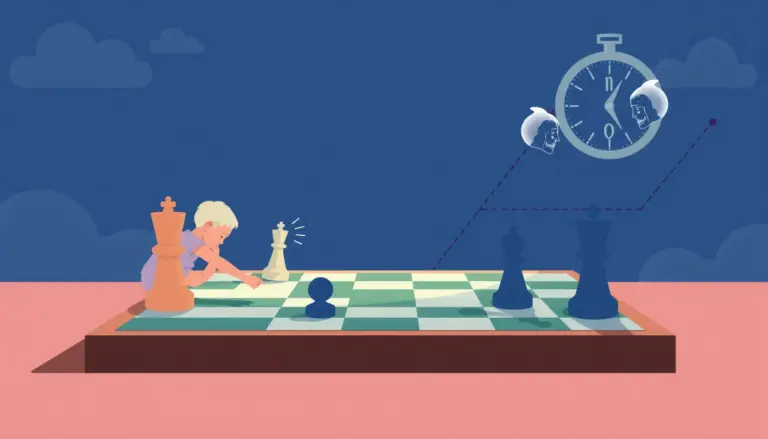
The chess clock not only measures time; also speaks. The seconds it takes a player to make a move are a window into his thought process and, in many cases, to your intentions. A long think time in a seemingly simple position may indicate that the opponent is calculating a complex variation or has detected a hidden threat. On the contrary, A quick move in a critical position could be a sign that you have set a trap or are confident in your plan..
This dynamic becomes even more interesting in games with tight time control. A player who spends too much time on the first moves may be forced to move quickly later, which increases the chances of making mistakes. On the other hand, someone who manages their time well is usually more dangerous, since he can take advantage of the opponent's difficulties to launch a decisive attack. Observing how the opponent manages their clock allows you to adjust your own strategy: if it is detected that you are under time pressure, you can avoid unnecessary complications and force an ending where your lack of time is a determining factor.
Besides, Reflection times reveal the opponent's level of preparation. A player who moves quickly in the opening has probably studied that line in depth, while one who doubts might be improvising. This is especially useful in high level games., where the openings are so analyzed that a small error can be fatal. If the opponent takes a long time to respond to a known theoretical move, you are probably out of your comfort zone, which may be an opportunity to divert the game towards less familiar terrain for him.
The psychology behind unexpected movements
Chess is not just a game of logic; It is also a psychological battlefield where unexpected movements can be powerful weapons.. A seemingly illogical piece sacrifice, A passive move at a critical moment or even a draw offer in an advantageous position can have a profound impact on the opponent's mind.. These movements do not always seek an immediate material or positional advantage, but are designed to destabilize, confuse or provoke an emotional reaction.
For example, A player offering a draw in a clearly winning position may be trying to sow doubt in his opponent., making you question if you've missed something. In the same way, a sacrifice of quality without clear compensation can be a psychological gamble: if the opponent is not sure how to respond, could make a mistake under pressure. These resources are especially effective against players who rely too much on cold calculation and are not used to dealing with uncertainty..
But unexpected movements can also be a double-edged sword.. If the opponent is an experienced player, could interpret these plays as signs of weakness or desperation. That's why, It is crucial to evaluate the context: a risky sacrifice can be brilliant against a tactical player, but against a positional one it could be counterproductive. The key is to know your opponent well enough to know what types of plays destabilize them and which ones strengthen them..
To master this technique, It is useful to study games of grandmasters known for their psychological ability, como Mikhail Tal o Garry Kasparov. Analyzing how these players used unexpected moves to manipulate the opponent's perception can provide valuable insights.. Besides, Practicing with quick games or blitz helps develop the intuition necessary to make bold decisions at the right time.
Conclusions: the art of reading between the lines
Reading your opponent in chess without saying a word is a skill that goes beyond simple observation.; It's a combination of psychology, strategy and experience. From the subtlest gestures to repetitive play patterns, Every detail on the board and off it offers valuable clues about the opponent's intentions and emotional state. The keen observation, trend analysis, The interpretation of reflection times and the use of psychological movements are tools that, when they are mastered, transform chess into an even more fascinating and profound game.
However, It is important to remember that no technique is foolproof.. Chess is still a game of uncertainty, where even the most experienced players can be surprised. The key is to maintain a balance between confidence in your own abilities and the humility to adapt to the unexpected.. In the end, Reading your opponent is not about guessing their movements with certainty., but to reduce the possibilities and make more informed decisions.
For those who wish to improve in this aspect, constant practice is essential. Play live games, analyze your own and other people's items, and studying the psychology of chess are fundamental steps. Over time, These skills will become second nature, allowing not only to anticipate the opponent's movements, but also influence your thinking in subtle and effective ways. Because in chess, like in life, Whoever understands others best usually has the last word.