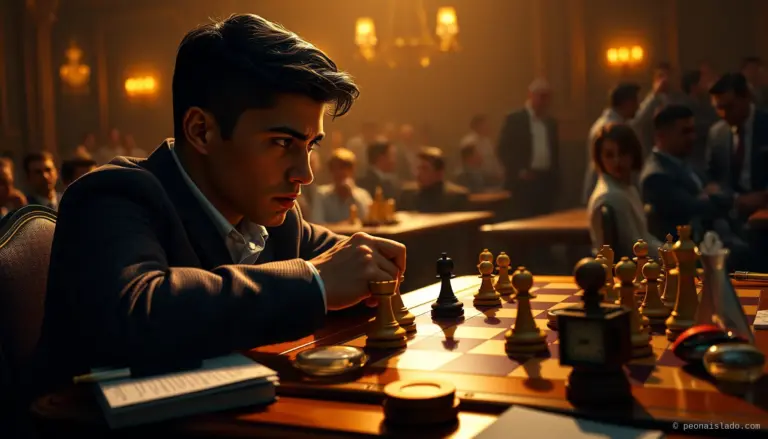
In the vast universe of strategy games, Few rivalries are as fascinating as the one between the xiangqi and the western chess. They are both descendants of a common ancestor, he Chaturanga indio, but they have evolved in radically different ways, reflecting the cultures that adopted them. As chess spread across Europe as a symbol of medieval warfare and logical thinking, Xiangqi took root in China as a reflection of its philosophy, his military history and his vision of the world. This “silent rivalry” not only divides players by preferences, but also unites China in a deeper cultural debate: Which game best represents the essence of Eastern strategic thinking?? Throughout this article, We will explore the historical roots of both games, their fundamental differences, its impact on Chinese society and how, despite their contrasts, They coexist in a balance that defines part of the national identity.
Shared origins and divergent paths
Xiangqi and Western chess share an ancient origin that dates back to the Chaturanga, a strategy game created in India around the 6th century. This game, which simulated a battle between four military divisions (infantry, chivalry, elephants and cars), expanded into Persia, where it became shatranj, and then reached Europe and China via different routes. However, while Western chess evolved under the influence of feudal chivalry and the crusades, The xiangqi was adapted to Chinese military philosophy, especially to Art of War by Sun Tzu.
One of the most notable differences in its evolution was the board. Chess adopted a 8-point layout×8 casillas, with pieces representing medieval figures such as kings, queens and rooks. Instead, the xiangqi opted for a board of 9×10 lines (not boxes), with a “río” central that divides the battlefield and symbolizes a natural barrier. This provision is not accidental: reflects the importance of terrain in Chinese military strategy, where control of open spaces and key points was crucial. Besides, the xiangqi incorporated unique elements such as canon (a piece that captures jumping over another) and the general (equivalent to king, but confined to a “palacio” of 3×3 lines), that have no parallel in Western chess.
Another key aspect is the symbology. While Western chess represents a feudal hierarchy with an all-powerful king and a queen as the central figure, xiangqi reflects a more collectivist structure. The general is not an omnipotent piece, but a leader who depends on his subordinates (like the soldiers, that advance without retreating, symbolizing sacrifice). This difference is not just aesthetic.: reveals how each culture conceives power, strategy and conflict.
Philosophy and strategy: two visions of the world
Beyond the rules, Xiangqi and Western chess embody opposing philosophies on how to approach strategy. Western chess focuses on the opponent elimination through direct attacks and aggressive tactics. Victory is achieved by checkmating the king, a clear and definitive objective. Instead, xiangqi prioritizes space control and patience. Checkmate is rare; instead, The players seek to limit the movements of the opposing general until he leaves him without options, a metaphor for the war of attrition.
This difference is reflected in the dynamics of the games. in chess, openings are usually explosive, with quick movements to gain early advantage. En el xiangqi, openings are slower and more methodical, with a focus on positioning pieces at strategic points before launching attacks. For example, he canon (a unique piece of xiangqi) requires long-term planning, since it can only capture if there is an intermediate piece that “salts”. This forces players to think in multiple layers of strategy, something that Sun Tzu would have approved: “War is the art of deception”.
Besides, xiangqi incorporates principles of yin and yang. The pieces not only interact for their individual value, but by its relationship with the board and the other pieces. For example, los soldiers (pawns) They cross the river and gain mobility, symbolizing how adversities can strengthen an individual. In contrast, Western chess rewards initiative and aggression, with pieces like the queen that dominate the board from the beginning. These differences are not trivial: reveal how each culture values patience, flexibility and adaptation.
Xiangqi as a cultural symbol and political tool
in China, xiangqi is not just a game, but a national identity symbol. During the Ming dynasty (1368-1644), became popular among all social classes, from peasants to emperors. The boards were carved from wood, stone or even on the floor of the patios, and the games became community events. This democratization contrasted with Western chess, which in Europe was a pastime of the nobility.
Xiangqi has also been used as a political tool. During the Cultural Revolution (1966-1976), Mao Zedong's government promoted gambling as a form of “proletarian education”, arguing that its accessibility made it superior to chess, seen as a game “bourgeois”. Even today, Xiangqi is taught in schools as part of the strategic thinking curriculum, while Western chess is associated more with the intellectual elite or international circles.
However, This division is not absolute.. In recent decades, China has adopted Western chess as part of its strategy soft power. The country has produced world champions such as Ding Liren, who in 2023 became the first Chinese to win the World Chess Championship. This success reflects a change in mentality: China no longer sees chess as a foreign game, but as a tool to project your global influence. Nevertheless, xiangqi continues to be a cultural pillar. Tournaments like Xiangqi National Championship attract millions of viewers, and figures like Hu Ronghua (considered the best player in history) They are national celebrities.
Coexistence in the global era: rivalry or complement?
In contemporary China, Xiangqi and Western chess are not exclusive rivals, sino add-ons that reflect the duality of Chinese society: traditional and modern, local y global. While xiangqi remains a symbol of cultural roots, chess has become a bridge to the world. This coexistence is seen in cities like Beijing or Shanghai, where it is common to find parks with elderly people playing xiangqi outdoors, while young people compete in chess tournaments in trendy cafes.
Even in the educational field, both games are promoted for their cognitive benefits. Studies have shown that xiangqi improves Spatial memory and long-term planning, while chess develops the logical reasoning and creativity. Some schools have begun to integrate both games into their programs, arguing that they offer different but equally valuable perspectives.
This coexistence also extends to the digital world. Platforms like Chess.com y Xiangqi.com They have millions of Chinese users, and streamers like GM Hou Yifan (former world chess champion) o Liu Dahua (gran maestro de xiangqi) attract massive audiences. There are even hybrid tournaments, where players of both games compete in games of “chinese chess” (a variant that mixes elements of both).
However, silent rivalry persists in cultural debates. Some purists argue that xiangqi is “deeper” for its connection with Chinese philosophy, while defenders of chess see it as a game “more universal”. The truth is that both have shaped the way China understands strategy, whether on the board or in real life.
Conclusions: more than a game, a reflection of china
The rivalry between xiangqi and Western chess is, in essence, a dialogue between two worldviews. El xiangqi, with its emphasis on patience, control of space and collectivist philosophy, encapsulates values deeply rooted in Chinese culture. chess, with its focus on opponent elimination and hierarchy, reflects a more individualistic and competitive mentality, typical of the West. However, far from being an irreconcilable dichotomy, Both games coexist in China like two sides of the same coin: the pursuit of strategic excellence.
This duality not only enriches the Chinese cultural landscape, but also offers valuable lessons. In an increasingly globalized world, where the borders between local and foreign are blurred, xiangqi and chess remind us that diversity of perspectives can be a strength. China has shown that it is possible to embrace what is one's own without rejecting what is foreign, and that even in the quietest rivalry there can be room for unity.
In the end, true victory is not in choosing one game over the other, but in recognizing that both are tools to understand the world. Whether by moving a canon on a xiangqi board or sacrificing a rook in a chess game, what really matters is the strategy behind the move: that human capacity to think, adapt and, above all, learn.