Chess and mathematics have woven a relationship as deep as it is enigmatic throughout the centuries.. It's not just a strategy game, but of a mental laboratory where pure logic and creativity intertwine in a dance of patterns, algorithms and probabilities. From the calculus of variants to graph theory applied to possible movements, the board 64 boxes becomes a mirror of the most abstract structures of human thought. How is it possible that an ancient game can explain advanced mathematical concepts?, what are you, in turn, Reveal hidden secrets in each game?
In this article, We will explore the most surprising connections between chess and mathematics, unraveling how both disciplines feed off each other to challenge the limits of intelligence. From the Shannon number, which quantifies the complexity of the game, until the application of the game theory in openings and endings, Each chapter will reveal a deeper layer of this symbiosis. Get ready to discover why great masters like Emanuel Lasker – doctor in mathematics – or Garry Kasparov himself saw chess as not just a mental sport., but one exact science disguised as art.
Shannon's number: when chess becomes infinite
In 1950, The engineer and mathematician Claude Shannon published an article titled “Programming a Computer for Playing Chess”, where he introduced a concept that would forever change the perception of chess: he Shannon number. This value, estimated at 10120, represents the approximate number of possible games in the game, a figure so colossal that it even exceeds the number of atoms in the observable universe (approximately 1080).
But, What does this number really imply?? For a start, proves that chess is a system computationally intractable. Unlike games like tic-tac-toe, where all variants can be exhaustively calculated, chess requires a heuristic approach: Players must prioritize lines of play based on patterns, experience and, in many cases, intuition. This feature makes it an ideal testing ground for artificial intelligence, who has found in the board a perfect scenario to develop machine learning algorithms.
Shannon also proposed two fundamental strategies to approach chess from a mathematical perspective.: he type A algorithm (exhaustive evaluation of all possible variants) and the type B algorithm (move selection based on heuristic rules). While the first one is infeasible due to the combinatorial explosion, the second laid the foundation for modern chess engines, like Stockfish or AlphaZero, that combine positional evaluations with selective calculations. This dichotomy between the exhaustive and the heuristic reflects, in essence, the tension between mathematical precision and the human creativity.
Graph theory: the board as a network of possibilities
If chess is a decision system, then each game can be modeled as a directed graph, where the nodes represent positions and the edges symbolize the legal movements between them. This representation, characteristic of graph theory, allows you to analyze the game from a topological perspective, revealing fascinating properties.
For example, he chess graph es acyclic (there are no infinite loops, thanks to the rule of 50 movements) y finished (although immense), which guarantees that every game must end in a finite number of moves. Besides, the notion of distance between positions —measured in movements— has been key to developing search algorithms such as minimax, used by chess engines to evaluate lines of play.
A paradigmatic case is horse problem, a classic of recreational mathematics that consists of going through all the squares of the board with a horse without repeating any. This challenge, first solved in the 9th century by the Arab mathematician Al-Adli, is an example of hamiltonian cycle in graphs, where each node (box) visited exactly once. The solution not only has theoretical applications, but it has also inspired end-game strategies, where the horse's mobility can be decisive.
Beyond the playful, graph theory has allowed us to optimize the organization of chess tournaments, especially in the Swiss system, where matchups are calculated to minimize repetitions between players. Each round can be seen as a bipartite graph, where the nodes are the competitors and the edges represent the possible confrontations. This approach ensures balanced competition, even at events with hundreds of participants.
The hidden geometry of the board: beyond the 64 casillas
The chess board is not just a square of 8×8 casillas, but a geometric space where symmetries converge, distances and algebraic properties. One of the most intriguing connections is the relationship between chess and taxi driver geometry (or Manhattan geometry), where the distance between two points is measured as the sum of the absolute differences of their coordinates. In this context, the movement of the king—which can move one square in any direction—follows this metric, while the bishop and rook operate under linear constraints that define subspaces within the board.
Another key geometric concept is that of invariants. For example, the parity (the property of being even or odd) determines if one position is reachable from another. A famous case is wheat grain problem, attributed to the legendary inventor of chess, Inside. According to legend, King Shirham offered to reward Sissa with grains of wheat arranged on the board: one in the first box, two in the second, four in the third, and so on, doubling the amount in each box. The total sum, 264 – 1 grain, equals more than 18 trillions of grains, an impossible quantity to produce. This problem illustrates how chess can serve as a metaphor for mathematical concepts such as geometric series and the exponential growth.
Geometry also explains why certain openings, like him Queen's Gambit, they are so effective. When giving up a pawn on d4, White seeks to control the center of the board, a geometric principle that maximizes the influence of its pieces. This concept of spatial domain is formalized in the field theory, where each piece generates a “field of influence” that can be quantified. For example, a bishop on a central square controls more diagonals than one on the corner, which translates into greater “place value”.
game theory: when chess becomes economics
chess is, in essence, and zero sum game: what a player earns, the other loses it. This characteristic makes it an ideal study object for game theory, a branch of mathematics that analyzes situations of conflict and cooperation. John von Neumann, one of the fathers of this discipline, showed that every finite zero-sum game with perfect information—like chess—has a optimal strategy which guarantees at least a draw for both players, as long as they follow her.
However, The complexity of chess makes this optimal strategy unattainable in practice.. This is where the concept of Nash equilibrium, which in the context of chess manifests itself in theoretical openings such as Sicilian Defense o to Ruy Lopez. These lines of play represent points of balance where no player can unilaterally improve his position without worsening that of his rival.. Game theory also explains why grandmasters often repeat openings.: It's not just for convenience, but because they have internalized these balances through thousands of games.
A fascinating example of the application of game theory in chess is Prisoner's Dilemma, adapted to situations of table offers. Imagine that two players are in a balanced position, but one of them offers tables. If the rival accepts, both get half a point; if you reject and win, gets a full point, but if you lose, doesn't win anything. The optimal decision depends on the subjective evaluation of the probabilities, which introduces a psychological component into an apparently mathematical framework. These types of dilemmas are common in high level games, where time and risk management become as crucial as variant calculation.
Chess as a model of artificial intelligence
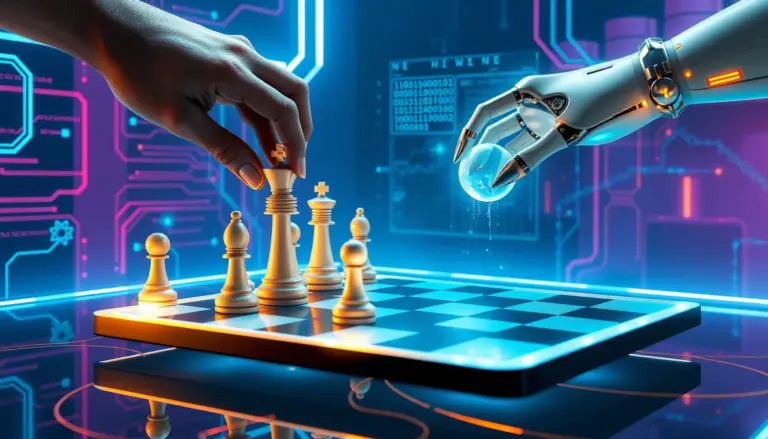
The relationship between chess and mathematics reached its peak with the development of artificial intelligence. In 1997, IBM's Deep Blue supercomputer defeated Garry Kasparov in a historic match, marking a milestone in the history of computing. But beyond the result, what was relevant was the method: Deep Blue combined brute force (evaluation up to 200 million positions per second) con positional heuristics, demonstrating that chess could be reduced to a mathematical optimization problem.
However, the real qualitative leap came with AlphaZero, the engine developed by DeepMind that learned to play chess from scratch, no prior knowledge beyond the rules. Using deep neural networks y reinforcement learning, AlphaZero discovered strategic principles that had taken humans centuries to formalize, such as the importance of piece mobility or control of key squares. This approach, based on the information theory and the bayesian probability, redefined what it means “to understand” chess.
Hoy, Chess engines are not only tools for analyzing games, but also artificial intelligence laboratories. Platforms like Lichess o Chess.com They use algorithms to detect patterns in millions of games, identifying trends that even great teachers might miss. For example, the concept of centipawn loss (loss of hundredths of a pawn) measures the difference between the chosen movement and the optimal one according to the motor, providing a quantitative metric to evaluate errors. This fusion between chess and mathematics has not only revolutionized training, but has also raised philosophical questions: can a machine “grasp” chess, or just simulate understanding through calculations?
Conclusions: the board as a mirror of the mind
Chess and mathematics are two sides of the same coin: searching for patterns in chaos. From Shannon number to graph theory, passing through the hidden geometry of the board and game theory, Each connection reveals a deeper layer of a game that transcends its status as a hobby. Chess is not just a mental sport, but a microcosm of human intelligence, where the logic, creativity and intuition intertwine in an eternal dialogue.
Hoy, with the emergence of artificial intelligence, This dialogue has taken on a new dimension. Engines like AlphaZero not only challenge our understanding of the game, but they also force us to rethink what it means “think”. Does chess, with its underlying mathematical structure, It is the universal language that connects the human mind with the machine? Perhaps the answer is not in choosing between the human and the artificial, but in recognizing that both are part of the same continuum: the one of the tireless search for the truth on the board.
If this article has piqued your curiosity, We invite you to explore how chess can transform your mind beyond the game. From improve your memory and concentration to develop strategic skills applicable in everyday life, the board 64 Casillas remains a training ground without equal. Are you ready to move the first piece?