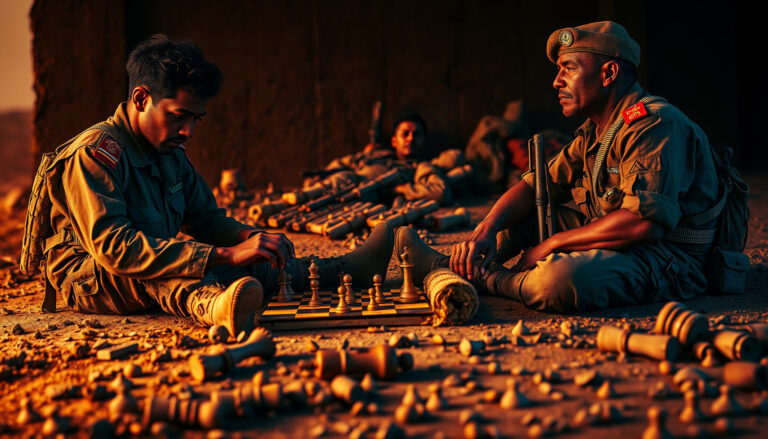
In the heart of Africa, where the Kalahari Desert merges with the modernity of one of the most stable economies on the continent, Botswana emerges as an unexpected setting for luxury and strategy. Gaborone, your capital, not only houses skyscrapers that shine under the southern sun, but also a culture that values tactical thinking as much as the opulence of its diamonds. How are chess—the game of kings and brains—and the luxury industry intertwined in this nation?? Beyond stereotypes, Botswana offers a fascinating metaphor: Just as every move on the board requires foresight and audacity., The country has built its prosperity with patience and vision. This article explores that unique crossover, where the elegance of diamonds meets the precision of the human mind, revealing how Gaborone has become a board where luxury and strategy play an endless game.
Chess as a mirror of a strategic society
Botswana is no stranger to chess. From schools to private clubs, This ancient game has found a place in local culture, not just for entertainment, but as a tool for intellectual development. In a country where education is a priority—with a literacy rate of over 88%—, Chess is taught as a discipline that encourages critical thinking, patience and the ability to anticipate consequences. Programs like the *Botswana Chess Federation* have brought the game to rural communities, proving that, just like on the board, in life every decision counts.
But why does this game resonate so much in a nation that has based its growth on diamond mining?? The answer lies in the very nature of chess.: a game where resources – such as pieces – must be managed intelligently to achieve victory. botswana, aware that its mineral reserves are not infinite, has applied a similar strategy. Since the years 70, the government has reinvested diamond revenues into infrastructure, education and economic diversification, avoiding the “resource curse” that has affected other African countries. So, chess becomes a symbol of how Botswana has played its cards – or its pieces – cleverly.
Not Gaborone, This strategic mentality is even reflected in urban design. the city, precisely planned, contrasts with the chaos of other African capitals. Its ordered streets, Its well-kept parks and modern architecture are the result of a long-term vision, where each “motion” —from building a hospital to opening a university—is calculated to maximize collective benefit. Here, luxury is not just ostentation, but the fruit of a well-executed strategy.
Diamonds: the luxury that finances the future
Diamonds are the economic lifeblood of Botswana. Since they were discovered in Orapa in 1967, These crystals have transformed the country from one of the poorest nations in the world to one of the most prosperous in Africa. But unlike other resource-rich countries, Botswana has avoided falling into the dependency trap. Instead of wasting your profits, has created a unique business model: the association with the company *De Beers*, that since 1969 operates in the country under an agreement that guarantees that the 80% of the profits stay in Botswana.
This approach has allowed diamonds to not only finance luxury – such as exclusive Gaborone hotels or international designer boutiques –, but also sustainable development projects. For example, el *Diamond Technology Park*, inaugurated in 2016, It is an innovation center where diamonds are cut and certified, generating employment and transferring technology. Besides, the government has created sovereign funds, like the *Pula Fund*, to ensure that future generations also benefit from this wealth.
Luxury in Botswana, therefore, It's not a whim, but a consequence of an impeccable economic strategy. While other countries see their resources depleted without leaving a trace, Botswana has turned its diamonds into a legacy. Not Gaborone, This translates into a luxury offer that goes beyond the material.: from luxury safaris in the Okavango Delta to spas using local products, the country sells an experience where exclusivity is combined with authenticity. Here, luxury is not just having, but *knowing* how to enjoy what you have.
Gaborone: the board where luxury and strategy meet
Gaborone is the perfect setting to see how luxury and strategy coexist. the city, founded in 1964, It was designed to be the administrative and economic center of the country, and today is a reflection of that vision. Their neighborhoods, like the *Central Business District* or *Phakalane*, They range from skyscrapers with panoramic views to exclusive residences where local elite and expatriates enjoy a sophisticated lifestyle.. But what makes Gaborone unique is not just its opulence, but how it is integrated with a strategic mentality.
A clear example is the *Gaborone International Finance Park*, a complex that attracts international companies thanks to its favorable regulatory framework and first-class infrastructure. Here, luxury is not just for individuals, but for corporations looking for a stable and well-planned environment. In the same way, el *Mall of Gaborone*, the largest shopping center in the country, not only offers luxury brands such as *Louis Vuitton* or *Rolex*, but it is also a space where local entrepreneurship is encouraged, with shops selling Botswana crafts and products.
But perhaps the best example of this fusion between luxury and strategy is the *Gaborone Sun*, a five-star hotel that has witnessed important political and economic negotiations. In their halls, agreements have been closed that have shaped the future of the country, proving that in Botswana, luxury is not an end in itself, but a tool to achieve greater goals. Here, A dinner in a gourmet restaurant or a game of chess in the lobby are not just pleasures, but opportunities to forge alliances and draw up plans.
The future: Can Botswana maintain its winning game?
Botswana has shown that it is possible to convert natural wealth into sustainable development, but the future poses new challenges. The diamond industry, although still strong, faces pressure from competition from synthetic diamonds and changing market demand. Besides, the country must diversify its economy to reduce its dependence on mineral resources, an objective that is already underway with investments in sectors such as tourism, technology and agriculture.
In this context, chess is once again a useful metaphor. Botswana must anticipate the movements of its “adversaries” —economic volatility, climate change, global competition—and adapt your strategy. For example, the government has launched initiatives such as *Vision 2036*, a plan that seeks to transform the country into an economy based on knowledge and innovation. This includes promoting technology startups and attracting investments in renewable energy., areas where luxury and strategy can intersect again.
Luxury tourism is another key front. With destinations such as the Okavango Delta – declared a World Heritage Site by UNESCO – and Chobe National Park, Botswana has the potential to become a benchmark for *high-end travel*. Companies like *Wilderness Safaris* already offer exclusive experiences, like balloon flights over the delta or dinners under the stars in the middle of the savanna. But for this sector to grow, the country must guarantee that its infrastructure—airports, roads, hotels—live up to the expectations of the most demanding travelers.
The biggest challenge, however, will be to maintain the balance between luxury and equity. Botswana has managed to reduce poverty and improve social indicators, but inequality is still a problem. Luxury cannot be just for a few; It must be an engine that drives collective well-being. In this sense, chess offers a final lesson: on the board, like in life, victory is not just winning, but to do it in a way that all players—or citizens—benefit.
At the end of the day, Botswana is a reminder that luxury and strategy are not opposite concepts, but complementary. Not Gaborone, every cut diamond, Every chess game played and every investment made are moves in a larger game.: building a future where prosperity is not a privilege, but the result of a clear vision and impeccable execution. The country has shown that, with intelligence and patience, it is possible to convert resources into opportunities, and legacy opportunities. Now, the challenge is to maintain that pace, ensuring that the next generation can also sit at the table and play their own game.