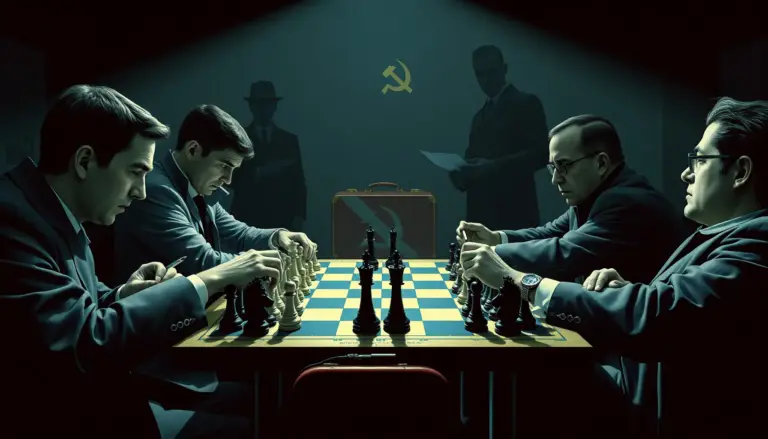
In the shadows of a regime that has tried to erase its presence, Afghan women find chess an act of silent resistance. After the Taliban took power in 2021, Women's rights in Afghanistan have been drastically reduced: ban on studying, work in most sectors and even move without a male companion. However, in the middle of this darkness, The chess board has become a symbol of freedom and challenge. This article explores how, under the burqa, Afghan women play secretly, not just as a hobby, but as a way to keep your agency alive, your critical thinking and your connection with the outside world. Through testimonials, historical analysis and the current political context, We will discover how this ancient game has been transformed into a tool of cultural and psychological resistance in one of the most hostile environments for women in the 21st century..
Chess as a refuge in Afghan history
Chess is not a foreign game to Afghanistan. Introduced to the region during the expansion of the Persian Empire, *shatranj*—the predecessor of modern chess—was deeply rooted in Central Asian culture. For centuries, It was a pastime of both kings and peasants, a space where strategy and patience were valued as much as physical strength. However, with the arrival of the Taliban to power in the years 90, Chess was banned on the grounds that it encouraged “gaming” and the “distraction from religious duties”. The pieces were burned in public bonfires, and those caught gambling could face severe punishments.
This ban failed to eradicate gambling. Instead, pushed him underground, where the women, already marginalized by gender restrictions, They found a refuge in it. During the brief period of relative openness between 2001 y 2021, chess re-emerged as a symbol of progress. Women's clubs were formed in Kabul and Herat, and some players even represented Afghanistan in international tournaments. But with the return of the Taliban, chess was once again a subversive act, especially for women, whose access to public spaces and intellectual activities was again restricted.
Hoy, the board has become a microcosm of resistance. Playing chess in secret not only defies prohibitions, but also reaffirms women's ability to think, plan and compete in an environment that denies them even the right to education. As an anonymous player said in an interview with *The Guardian*: *”Every move on the board is a reminder that I still exist., what I still think about, that I still decide”*.
The burqa as a shield and prison
El burqa, that garment that covers the body and face of Afghan women, It is both a symbol of oppression and a tool of survival. For clandestine chess players, It becomes a shield that allows them to move through the streets without attracting attention, but also in a prison that isolates them from the world. under its folds, They hide not only their identities, but also small folding boards, pocket pieces or even chess apps on mobile phones that keep secret.
The paradox of the burqa in this context is fascinating. On the one hand, It is an imposition that seeks to erase the individuality of women, reducing them to anonymous and submissive figures. On the other, has become an unexpected ally for those seeking to challenge the system. In cities like Kabul or Mazar-i-Sharif, groups of women meet in safe houses, where the burqa allows them to enter and leave without raising suspicion. Once inside, They take off their clothes and unfold their boards, sharing strategies, analyzing games and, above all, feeling for a few hours that they are owners of their time and their decisions.
However, the risk is constant. The Taliban have intensified house searches, and complaints from neighbors or relatives can lead to raids. In 2023, A report by *Human Rights Watch* documented several cases of women detained for “non-islamic activities”, which included playing chess. Despite this, many persist, because the game transcends the playful: It's a way to keep hope alive. As a young woman explained 22 years in a testimony collected by *Amnesty International*: *”If I stop playing, I feel like I cease to exist. Chess is the only thing that reminds me that I have a mind of my own”*.
The invisible network of clandestine players
Behind the chess resistance of Afghan women there is an organized network, although fragile, that operates clandestinely. This structure is based on trust, word of mouth and, in some cases, the support of international organizations that send materials covertly. The players communicate through codes, using everyday terms to refer to games or movements. For example, a “family reunion” it could actually be a chess session, and a “cookbook” can hide an opening manual.
Safe houses are the heart of this network. They are usually homes of women who have achieved a certain degree of economic independence, as widows or professionals who worked before the Taliban takeover. These hostesses risk their lives by opening their doors, but they do it because they understand that chess is more than a game: It is an act of collective healing. In these meetings, women don't just play, but they also share experiences, survival strategies and, in some cases, information on how to access humanitarian aid or online education.
Technology has played a crucial role in this resistance. Although the Taliban have restricted access to the internet, many women use VPNs and private networks to connect with chess communities abroad. Platforms like *Chess.com* or *Lichess* have become windows to the world, where you can play online games, participate in virtual tournaments and even take classes from international teachers. In 2022, A group of Afghan female players participated in an online tournament organized by the *International Chess Federation (FIDE)*, where they competed under pseudonyms to protect their identities. The event, broadcast live, was a reminder to the world that, yet, Afghan women continue fighting.
However, this network faces constant challenges. Lack of resources is one of the biggest obstacles: many players do not have access to physical boards and must settle for drawing the squares on paper or using applications on basic phones. Besides, fear of being discovered limits the frequency of meetings. Even so, the network persists, because it represents one of the few forms of nonviolent resistance left in Afghanistan.
Chess as a metaphor for women's struggle
Beyond its value as a hobby or sport, Chess has become a powerful metaphor for the struggle of Afghan women. Each game is a reflection of your reality: a game where the rules are designed to limit your moves, but where creativity and strategy can open unexpected paths. on the board, like in life, Afghan women learn to navigate a hostile environment, to anticipate the movements of the “opponent” (the regime, patriarchal society) and to find spaces of freedom within restrictions.
Chess teaches patience, an essential virtue in a context where resistance must be silent and sustained. The players know that they cannot win every game, but every movement is an affirmation of its existence. In the words of a chess teacher who now lives in exile: *”In Afghanistan, women can't choose their destiny, but on the board, for a few minutes, they are free. They can be queens, rooks or pawns, but they are the ones who decide how to move”*.
This metaphor also extends to the way Afghan women have adapted the game to their reality.. In some communities, have developed variants of chess that reflect their experiences. For example, in a game called *”Chess under the burqa”*, The white pieces represent the women and the black pieces represent the regime.. The goal is not to checkmate the king., sino “release” to the white pieces taking them to one end of the board, symbolizing the search for freedom. These adaptations not only make the game more relevant, but they also turn it into a pedagogical tool to teach girls about their rights and the importance of resistance.
Chess has also served as a bridge with the outside world. In 2023, a documentary titled *”Checkmate: The Women of Afghanistan”* showed how underground female gamers connected with international communities through online games. He films, which premiered at human rights festivals, helped make their struggle visible and raise funds to support their clandestine network. As one of the protagonists said: *”The world sees us as victims, but on the board, we are warriors”*.
Conclusions: the checkmate that has not yet arrived
The story of Afghan women who secretly play chess is, first of all, a story of resistance. In a country where they are denied the right to education, to work and even mobility, the board has become a space of freedom, a reminder that your mind and spirit cannot be chained. However, This resistance is not without risks. Every game played clandestinely is an act of defiance that can cost them their freedom or even their lives.. Even so, persist, because they understand that chess is more than a game: It's a way to keep your humanity alive.
The outside world has a crucial role in this fight. International pressure on the Taliban regime, Support for organizations that work underground and making these stories visible are essential tools to prevent the resistance from fading.. Platforms such as social networks or online tournaments have shown that, even in the dark, There are ways to connect with the world and remind Afghan women that they are not alone.
But the question that remains in the air is: How long can they continue playing?? chess, with its universal language of strategy and patience, has given these women a tool to survive, but it's not enough. True victory will come when you can play without fear, when the burqa stops being a shield and becomes a choice, when the board is no longer a symbol of resistance, but simply a game. Until then, each game will be a check to the regime, one more move in a game that is not over yet.