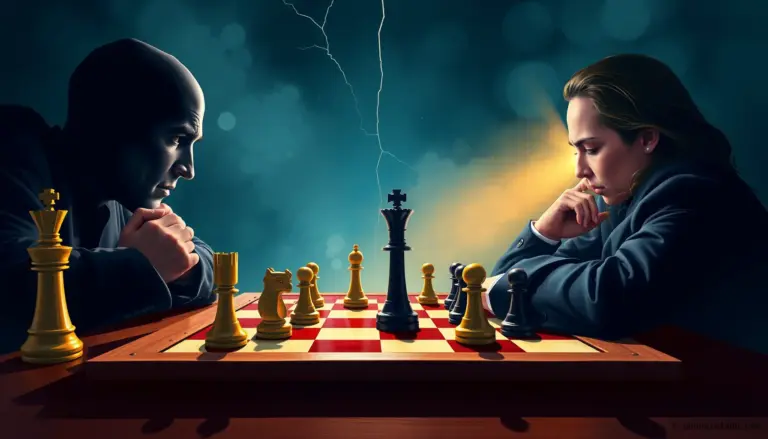
Chess and philosophy have been two disciplines that, throughout history, They have explored the limits of the human mind. While chess defies logic, strategy and anticipation, Philosophy investigates fundamental questions about knowledge, ethics and the nature of thought. What would happen if we united these two spheres? More specifically, what would Socrates say, the father of western philosophy, about Magnus Carlsen, the Norwegian genius who revolutionized modern chess? This article seeks to answer that question., analyzing the connections between the Socratic method and Carlsen's game, the relationship between maieutics and chess strategy, and how ethics and competitiveness are intertwined in both worlds. Through this journey, we will discover that, beyond the apparent differences, chess and philosophy share an essence: the tireless search for the truth.
Chess as a reflection of human thought
Chess is not just a game; It is a microcosm of human thought. Each game is a silent dialogue between two minds that try to anticipate each other, deceive and, ultimately, impose. Magnus Carlsen, considered one of the best chess players in history, has taken this dialogue to an almost philosophical level. His playing style, characterized by flexibility, patience and the ability to adapt to any situation, reflects a deep understanding of human nature and the logic underlying the board.
From a philosophical perspective, chess can be seen as a metaphor for life. Every move is a decision that has consequences, and each game is a narrative that develops in real time. Socrates, with his dialectical method, I was looking for exactly that: unravel the truth through dialogue and reflection. In this sense, Carlsen acts like a philosopher on the board, constantly questioning your opponent's assumptions and looking for the best possible answer. His ability to remain calm under pressure and his focus on the process rather than the end result are traits that would resonate with Socratic philosophy., that values the pursuit of knowledge over superficial victory.
Socratic maieutics and chess strategy
The Socratic method, known as maieutics, consists of asking questions to guide the interlocutor towards the discovery of the truth. Socrates believed that knowledge already resides within each person, and that his role was to help “give birth” those ideas. in chess, This dynamic is repeated in a fascinating way. A player like Carlsen not only calculates movements; also “ask” to the board, exploring your opponent's weaknesses and forcing him to reveal his intentions.
For example, in many of his games, Carlsen opts for seemingly simple but deeply complex positions, where every movement seems innocuous but is actually loaded with meaning. This strategy is reminiscent of maieutics: instead of imposing your will, Carlsen guides his opponent into a dead end, where the contradictions of his game become evident. Socrates would have admired this ability, given that, just like him, Carlsen does not seek to win through brute force, but through clarity of thought and exposure of the logical weaknesses of the other.
Besides, Socratic maieutics also implies an ethical component: Dialogue must be honest and oriented to the common good. in chess, This translates into respect for the rules and the opponent. Carlsen, Known for his sportsmanship and rejection of cheating or unfair tactics, embodies this principle. Your focus is not just on winning, but to do it in a way that the game itself is enriched, something that Socrates would have applauded.
Ethics in chess: victory at any price?
One of the deepest questions that arise when comparing chess with philosophy is the ethics of competition.. Socrates, who valued virtue above all, would have questioned whether the obsession with victory in chess can corrupt the spirit of the game. Magnus Carlsen, despite being a fierce competitor, He has shown on multiple occasions that his priority is not just to win, but do it with integrity.
In the world of chess, where the pressure for results can be overwhelming, Carlsen has stood out for his ability to maintain composure and his rejection of dirty tactics. For example, in 2021, during the World Championship against Ian Nepomniachtchi, Carlsen avoided taking advantage of a technical error by his opponent, something that many other players would have done without hesitation. This gesture, although small, reflects an ethic that Socrates would have approved: the idea that true value is not in victory itself, but in how it is achieved.
However, Modern chess also raises complex ethical dilemmas. The use of chess engines to analyze games, Suspicion of cheating and pressure for results have led some to question whether the game has lost part of its philosophical essence.. Socrates, with its emphasis on authenticity and the search for truth, would have been critical of these practices. Carlsen, for his part, has been a defender of transparency in chess, advocating for stricter rules against cheating and promoting an environment where talent and effort are the only paths to success.
Carlsen and Socrates: two truth seekers
Prima facie, Magnus Carlsen and Socrates seem like figures from completely different worlds. One is an elite athlete in the digital age, while the other was a philosopher who lived in ancient Athens. However, by deepening your approaches, surprising parallels revealed. Both are tireless seekers of truth., although in different contexts. Socrates searched for it through dialogue and reflection, while Carlsen does it by analyzing positions and anticipating movements.
The most fascinating thing is that they both share an essential quality: intellectual humility. Socrates claimed that he only knew that he knew nothing, a position that led him to constantly question his own ideas. Carlsen, for his part, He has recognized in multiple interviews that chess is an infinite game, where there is always something new to learn. This attitude of openness and curiosity is what unites them, beyond superficial differences.
Besides, both Socrates and Carlsen have challenged the conventions of their respective fields. Socrates questioned the established beliefs of Athenian society, while Carlsen has revolutionized chess with his unorthodox style. Both have shown that innovation and excellence do not come from blindly following the rules., but to understand their essence and transcend them.
Conclusions: chess as a philosophical dialogue
Exploring the relationship between chess and philosophy, and in particular between Magnus Carlsen and Socrates, We have discovered that both worlds are not as different as they might seem. chess, like philosophy, It is an exercise in critical thinking., ethics and search for truth. Carlsen, with its strategic approach, his integrity and intellectual humility, embodies many of the principles that Socrates defended: the importance of dialogue, honesty in competition and the tireless search for knowledge.
Socrates would have seen in Carlsen not only a great chess player, but a philosopher in action. A player who, like him, understand that true victory is not in defeating the opponent, but in raising the level of the game and learning from each experience. In a world where obsession with results often overshadows process, Carlsen's figure reminds us that chess, just like philosophy, It is a path of personal and collective growth.
Ultimately, the question “What would Socrates say about Magnus Carlsen??” there is no single answer, but a clear direction: I would admire your ability to think deeply, their ethics in competition and their commitment to the truth. and maybe, on an imaginary board, They would both sit down to play a game where each move was a question, and every answer, one more step towards wisdom.