In communist Albania, under the regime of Enver Hoxha, chess was not just a game, but a tool of political propaganda and social control. This article explores how the board became a symbol of state power, used to shape ideology, educate the masses and reinforce the narrative of real socialism. From the promotion of players as a symbol of intellectual superiority to the manipulation of tournaments to exalt the values of the party, Chess was a reflection of the regime's obsession with dominating all aspects of public life. We will analyze how this practice, seemingly innocuous, was integrated into Hoxha's propaganda machine, revealing the contradictions between the official discourse and the reality of an oppressive system. through this case, We will better understand how art and sport can be instrumentalized to serve political ends..
Chess as a mirror of communist ideology
Enver Hoxha left Albania, chess was not a simple hobby, but an extension of Marxist-Leninist doctrine. The regime presented him as a “village game”, accessible to all, but with rules strictly aligned with the principles of socialism. The Albanian Chess Federation, founded in 1949, was under the direct control of the Labor Party, and its statutes emphasized that sport should serve to “strengthen proletarian consciousness”.
The chess manuals published at the time included prologues that exalted the figure of Hoxha and compared the strategies of the game with revolutionary tactics.. For example, It was taught that the peon—the most humble piece—represented the worker., whose collective strength could defeat the “capitalist kings”. This metaphor was not accidental: sought to instill the idea that victory on the board was a reflection of the superiority of the communist system over the West.
However, This narrative clashed with reality.. While the regime promoted chess as a symbol of equality, in practice, the most outstanding players received privileges, such as trips abroad or access to scarce goods. This created a contradiction: the official speech celebrated proletarian meritocracy, but the system rewarded only those who demonstrated loyalty to the party.
The instrumentalization of tournaments: chess and nationalism
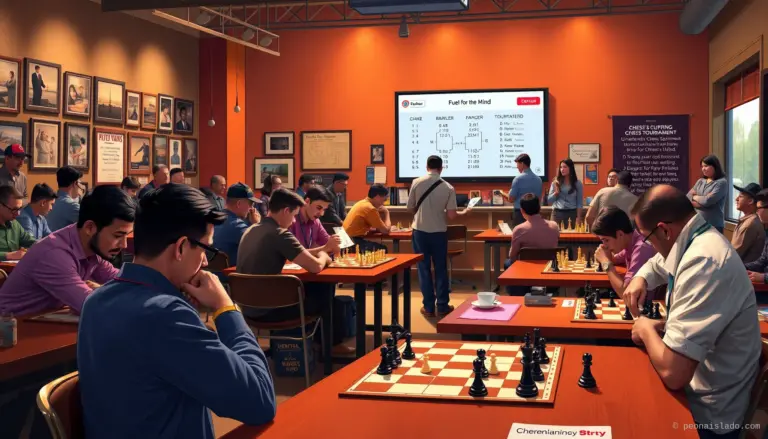
Chess tournaments in communist Albania were carefully orchestrated events to serve state propaganda. The National Championship, For example, it not only measured technical skills, but also adherence to the values of the regime. The players who stood out were presented as “heroes of socialism”, and their victories were used to demonstrate Albania's intellectual superiority over its ideological enemies.
An emblematic case was that of Fatos Muço, Albanian champion in the years 70, whose career was exploited by the official press. Muço was not only a brilliant player, but also a party member, which made him the ideal candidate to embody the “new socialist man”. Their games were analyzed in the media as if they were political battles., where each movement symbolized the Albanian resistance against imperialism. Simultaneous exhibitions were even organized in factories and schools., where Muço and other players related to the regime “they demonstrated” the superiority of Albanian chess.
But this instrumentalization had a dark side. Players who did not meet political expectations were marginalized or even persecuted.. In 1982, the international master Ylli Preza was accused of “ideological deviationism” after privately criticizing the lack of freedom in tournaments. His case illustrates how chess, far from being a neutral space, It was a minefield where dissent could be costly..
Chess in education: form loyal minds
The Hoxha regime understood that chess could be a pedagogical tool to shape new generations. Since the decade of 1960, The game was integrated into the school curriculum as part of the “political and physical education”. Albanian children learned chess not only to develop their logical thinking, but also to internalize the values of socialism.
Schools organized interclass tournaments where the winners received symbolic prizes., such as propaganda books or party flags. Besides, rivalry with other communist countries was encouraged, especially with Yugoslavia, which Albania accused of “revisionism”. In 1973, For example, A meeting was held between young Albanians and Yugoslavs in which the Albanian media presented the victory of their players as a “defeat of titism”.
However, This strategy had limitations. Although chess was promoted as an egalitarian game, in practice, Children from families loyal to the regime had more opportunities to excel. The children of dissidents or “enemies of the people” They were excluded from chess clubs, which perpetuated inequality under the guise of meritocracy. Besides, the ideological approach scared away many young people, who saw chess as an obligation rather than a passion.
The fall of the board: chess and regime collapse
With the death of Enver Hoxha in 1985 and the subsequent collapse of communism in Albania, chess lost its propaganda function. However, His legacy in Albanian society was ambiguous. On the one hand, the regime managed to popularize the game, turning Albania into a country with a strong chess tradition. On the other, Political instrumentalization left a mark of distrust towards sport as a tool of manipulation.
In the years 90, with democratic opening, many Albanian players emigrated to the West in search of opportunities. Figures like Erald Dervish, who became a grandmaster in 1998, They represented a new generation that no longer saw chess as an instrument of the party., but as an art and a profession. However, Hoxha's shadow persisted: some local tournaments were still used by politicians to gain popularity, demonstrating that the relationship between chess and power was not exclusive to communism.
The Albanian case is a reminder of how authoritarian regimes can appropriate seemingly innocuous activities to serve their interests.. chess, with its combination of strategy and symbolism, It was a fertile ground for propaganda, but also a space where the contradictions of the system were revealed. Hoy, when Albania competes in international tournaments, few remember that the board was once a scene of ideological struggle.
Conclusions: chess as a mirror of history
Chess in communist Albania was much more than a game: It was an instrument of control, a symbol of resistance and, finally, a witness to the collapse of a regime. Through your promotion, Enver Hoxha's government sought to shape the minds of Albanians, presenting the board as a microcosm where the values of socialism were reflected. However, This strategy revealed the contradictions inherent in the system: while equality was preached, political loyalty was rewarded; while meritocracy was exalted, dissidents were marginalized.
The history of Albanian chess during communism teaches us how power can take over any activity, even the most innocent, to serve your purposes. But it also shows us that, in the end, The truth always finds a way to come out. Hoy, when Albanian players compete on the international stage, They do so free of the ideological burden that once oppressed them. However, Hoxha's legacy persists in collective memory, reminding us that chess, like the story, It is a game where the pieces always hide more than they seem.
Ultimately, he “Enver Hoxha's board” It was not just a propaganda symbol, but a reflection of human complexity: a space where strategy and ideology intertwined, leaving a lesson about the dangers of mixing art with power.