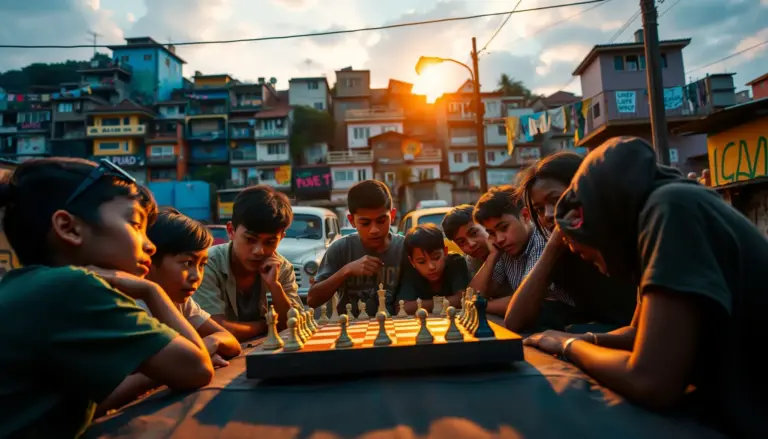
Deep in the Democratic Republic of the Congo (RDC), a country marked by decades of armed conflict, a story of resilience and hope emerges from the shadows of war. Thousands of boys and girls have been forcibly recruited by armed groups, forced to bear arms and live in inhumane conditions. However, in the midst of this desolate panorama, an initiative emerges that is transforming lives: chess as a rehabilitation tool. This article explores how the dashboard 64 Casillas has become a symbol of healing, learning and reintegration for these young people, offering them a second chance in a world that had forgotten them. Through testimonials, data and analysis, We will discover how the ancient game not only teaches strategy, but also essential values to rebuild your future.
The drama of child soldiers in the DRC: an open wound
The Democratic Republic of the Congo has been the scene of one of the longest and most brutal conflicts in Africa, with devastating consequences for its population, especially for the most vulnerable: the children. According to data from UNICEF, It is estimated that more than 30.000 children have been recruited by armed groups in the last two decades, many of them in the eastern provinces of the country, such as North Kivu and South Kivu. These minors, some as young as seven, they are kidnapped, coerced or tricked into joining the ranks of militias such as the Allied Democratic Forces (ADF) oh go May-May, where they are subjected to violent indoctrination.
Forced recruitment is not the only trauma they face. Once inside the armed groups, children are forced to commit atrocities, from looting to murder, which generates deep psychological damage. Many develop post-traumatic stress disorder (expected), depression and anxiety, while others are victims of sexual abuse, especially girls. When they manage to escape or are released, They encounter a society that stigmatizes them, making their reintegration difficult. In this context, rehabilitation programs such as those that use chess become a beacon of hope, but also a monumental challenge.
Chess as therapy: more than a game, a healing tool
At a rehabilitation center in Goma, capital of North Kivu, a group of former child soldiers meets every week around a chess board. What for many might seem like a simple hobby., here it acquires a deep meaning. chess, with its structured rules and its demand for concentration, has become a unconventional therapy for these young people, helping them rebuild their self-esteem and channel their energy in a positive way.
The benefits of chess in rehabilitation are multiple and are supported by psychological studies. First of all, the game encourages patience and strategic thinking, skills that radically contrast with the impulsivity and violence to which they were exposed. Every move on the board forces the player to anticipate consequences, a valuable lesson for those who have lived in an environment where decisions were made under pressure and with deadly consequences. Besides, chess teaches manage frustration, since losing a game can be a metaphor for the defeats they have suffered in real life, but also an opportunity to learn and improve.
Organizations like Chess for Peace y Right to Play have implemented programs in the DRC that combine chess with workshops peaceful conflict resolution y social skills. These projects not only teach how to play, but rather they use the board as a safe space for young people to express their emotions and reconstruct their identity beyond the role of “soldier”. For many, chess becomes a universal language that transcends the barriers of trauma.
From victims to leaders: how chess empowers young people
The impact of chess goes beyond individual therapy; It is also transforming community dynamics. In cities like Rabbit y Beni, Former child soldiers who have participated in these programs are becoming mentors for other at-risk youth, creating a multiplier effect. One of the most emblematic cases is that of Jean-Pierre, a young man from 17 years that he was recruited at 12 by an armed group and spent three years in the jungle before being released. After joining a chess program, not only did he regain his self-confidence, But now he teaches the game to other children in his community.
“Chess taught me that every move has consequences, just like in life. Before, acted without thinking; now, I plan my steps”, comments Jean-Pierre. Your story is not unique. Many of these young people, by mastering the game, They discover skills they did not know, like him leadership and the ability to teach. This allows them to break the cycle of violence and become agents of change in their communities..
Besides, Chess has opened doors to educational and job opportunities. Some former child soldiers have participated in local and international tournaments, where they have demonstrated their talent and have won scholarships to continue their studies. In a country where access to education is limited, especially for those who have been in armed groups, These opportunities are a lifesaver.. Organizations like FIDE (International Chess Federation) have supported initiatives in the DRC, providing materials and training to local trainers.
The pending challenges: between hope and reality
Despite the advances, The road to full rehabilitation of former child soldiers in the DRC is full of obstacles. One of the biggest challenges is the lack of resources. Chess and other therapy programs rely heavily on international donations and volunteer work, which limits its scope. According to Human Rights Watch, less than 20% of children released from armed groups in the DRC receive adequate psychosocial support, and many end up reintegrating into civilian life without the necessary tools to overcome their past..
Another critical problem is the social stigma. In many communities, former child soldiers are seen as “monsters” o “murderers”, which makes it difficult to accept. Even when they participate in rehabilitation programs, face discrimination in schools, markets and even in their own families. This can lead to recidivism, since some young people, not finding support, They join armed groups again in search of belonging.
Besides, Political instability and the persistence of conflicts in the east of the country represent a constant threat. In 2023, more than 1.000 cases of forced recruitment juvenile, according to the Report of the UN Secretary-General on Children and Armed Conflict. This shows that, although chess and other initiatives are valuable, are not enough to eradicate the root problem. It requires a comprehensive response that includes security, education and economic opportunities for youth.
Finally, It is essential that governments and the international community assume a stronger commitment. The DRC has ratified international treaties such as the Optional Protocol to the Convention on the Rights of the Child, prohibiting the recruitment of minors, but its implementation remains poor. Without coordinated action, the cycle of violence and recruitment will continue, leaving thousands of children without a future.
Conclusions: the board as a symbol of a new beginning
The story of child soldiers in the Democratic Republic of the Congo is one of the most painful of the 21st century, but also one that demonstrates the human ability to find light in the darkness. chess, with your mix of strategy, patience and creativity, has become a bridge to rehabilitation for these young people, offering them not just a game, but one new way of seeing the world. Through its black and white squares, They learn that every mistake can be a lesson, that each defeat is temporary and that, with perseverance, they can rebuild their lives.
However, chess is not a magic solution. Its impact, although significant, must be complemented with effective public policies, ongoing psychosocial support and real opportunities for young people. The international community has a responsibility to ensure that these programs are not ephemeral., but part of a sustainable strategy to break the cycle of violence. Meanwhile, in the streets of Goma, Bukavu and other Congolese cities, The sound of the pieces moving on the board remains a reminder that, even in the most war-torn places, hope can bloom.
For former child soldiers, chess is more than a game: it's a symbol of redemption, a tool to heal and, above all, a proof that, with support and determination, it is possible to leave the past behind and build a better future. May this story not only be an example of resilience, but also a call to action so that no child has to live what they lived.