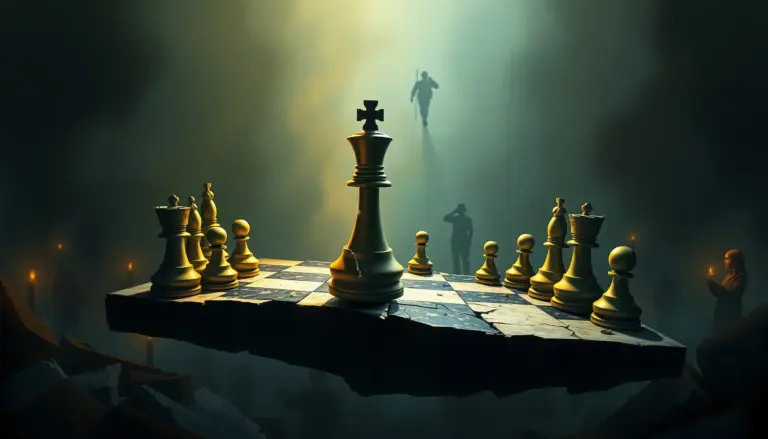
In the 10th century, Europe woke up to a game that would change its history forever. It was neither a military conquest nor a political revolution, but something more subtle: chess. It came like a whisper from Al-Andalus and Byzantium, carrying with him centuries of Persian wisdom, indian and arabic, but also an uncomfortable question: How could a war game become a symbol of Christian faith? The answer was not in the rules, but in the pieces. He “counselor” Islamic became the bishop, a bishop with miter and crosier, while the board was filled with religious metaphors. This article explores how medieval European chess became a mirror of its time: a battlefield where the sacred and the profane, power and resistance, they faced each other in 64 casillas.
Chess comes to Europe: routes of a forbidden game
The 10th century marked a turning point. While the Christian kingdoms of Europe struggled to consolidate their identity, chess sneaked in on two fronts: the south, via Al-Andalus, where Muslims had perfected it for centuries, and the east, via Byzantium, heir to Persian tradition. It was not a peaceful arrival. The Church looked at him with suspicion, associating it with idleness and chance - remember that in its beginnings it included dice -. However, its prohibition at the Council of Paris (1212) it only increased his attractiveness. Why did such a controversial game manage to survive?? The answer lies in your adaptability. Europeans not only adopted it, but they reinvented it, Christianizing its symbols to make it acceptable. He “obligation” Arabic, For example, she became the queen, a nod to the Virgin Mary in some medieval manuscripts. This metamorphosis was not accidental: reflected the Church's need to control narratives, even on the board.
The assimilation process was not uniform. In Muslim Spain, chess coexisted with shatranj —its Persian version—, while in the northern Christian kingdoms, The pieces acquired shapes closer to religious iconography. A fascinating example is the Book of Games by Alfonso X the Wise (1283), where chess appears alongside backgammon and dice, but with a crucial difference: is given a higher status, almost philosophical. For the Castilian king, chess was a “wise game”, a microcosm of divine order. This vision, which you can explore in depth in our article on the persian legacy in chess, laid the foundations for its definitive acceptance in Europe.
The pieces as a mirror of feudal society
Each medieval chess piece was a portrait of the feudal hierarchy. the king, still and central, represented divine authority; the pawns, the servants; and the horses, the cavalry, the armed wing of the nobility. But it was the bishop—before “elephant” in it shatranj— the one that best encapsulated this transformation. Its name in Spanish comes from Arabic al-fil (“elephant”), but in Europe it was given a radical turn: became a bishop, with his miter and his staff, symbolizing ecclesiastical power. This adaptation was not merely aesthetic. It reflected a political reality: in the Middle Ages, The Church not only competed with kings for earthly power, but often surpassed them. The bishop, with its diagonal movement—which in the shatranj original only advanced two squares—, took on a new meaning: the ability of the Church to influence all social strata, from the peasants to the nobility.
Another key piece was the tower, which in Arab chess was a war chariot (rukh). In Europe, was transformed into a mobile fortress, a symbol of feudal castles. Its rectilinear movement and its ability to control entire columns of the board reflected the importance of fortifications in medieval warfare.. But here a paradox arises: while the royal towers were static, the chess piece moved freely. Was this a veiled criticism of the rigidity of the feudal system? some historians, as Harold James Ruthven Murray, suggest that medieval chess functioned as an escape valve, a space where social rules could be symbolically subverted. This idea connects with our article on medieval chess as a mirror of power and resistance, where we explored how the game served to both reinforce and question the established order.
The board as a spiritual battlefield
In medieval Europe, chess was not just a game, but an allegory of the fight between good and evil. Religious manuscripts of the time describe it as a metaphor for human destiny., where each movement represented a moral choice. A notable example is the Book of Games by Alfonso, where chess is compared to the Christian life: the king is god, the pawns are the faithful, and checkmate symbolizes the Last Judgment. This interpretation was not exclusive to Christianity. In the Islamic world, Chess was also seen as a reflection of the cosmic order, but with a crucial difference: while in Europe the conflict was emphasized, balance was emphasized in Islam. He shatranj lost, For example, included rules that limited aggressiveness, such as the impossibility of capturing the king directly.
This duality between conflict and harmony was reflected in the boards themselves.. The most luxurious, like those preserved in the Cluny Museum in Paris, They were decorated with biblical scenes or allegories of virtues. In some cases, the black and white pieces did not represent opposing sides, but the internal struggle of the soul. This spiritual vision of chess contrasts with its use as a tool of power. Kings and nobles used it to negotiate alliances or even to resolve territorial disputes.. A famous case is that of Henry I of England, who in 1100 He resolved a conflict with the Count of Flanders through a game of chess. Was this a show of diplomacy or a way to humiliate the rival? The answer depends on how we interpret the game: as a sacred ritual or as an instrument of domination.
The silent resistance: chess as a subversive act
Behind its religious and courtly facade, medieval chess hid a subversive potential. In a society where knowledge was the privilege of a few, the game democratized strategic thinking. Peasants, craftsmen and even women—despite restrictions—practiced it in secret. A fascinating example is that of the nuns of the convent of San Salvador in León, that in the 13th century they played chess as a form of resistance against ecclesiastical norms. for them, the board was a space of freedom, where they could challenge the imposed hierarchies.
This rebellious dimension of chess was accentuated in subsequent centuries.. During the Black Plague (1347-1351), the game became a symbol of resilience. In cities like Florence, where mortality exceeded 50%, survivors gathered in public squares to play games that lasted days. Was this a way of denying death or accepting it?? The historian Johan Huizinga, in his work The Man Playing, argues that medieval chess functioned as a “rite of passage”, a way to face chaos with order. This idea resonates with our article on chess as a symbol of resistance in historical crises, where we analyze how the game has served as a refuge in times of adversity.
The legacy of medieval chess: from the Middle Ages to the digital age
The transformation of chess in medieval Europe laid the foundations for its later evolution. The Christianized pieces—the bishop, the queen, the tower—remained, but its meaning changed over time. In the Renaissance, the game became secularized, becoming a symbol of human reason. Figures such as Leonardo da Vinci designed boards with pieces that reflected the Renaissance ideal of beauty and proportion. However, the medieval spirit never completely disappeared. Even today, when artificial intelligence dominates chess, The idea persists that the board is a battlefield where not only two minds confront each other, but two visions of the world.
Medieval chess also left a mark on popular culture. From tales of chivalry to modern series like The Queen’s Gambit, the game remains a metaphor for the human struggle. But his greatest legacy is intangible: the idea that, in a world of rigid rules, there is always room for strategy, creativity and, above all, the resistance. As the great teacher Garry Kasparov wrote: “Chess is life in miniature”. And in medieval Europe, that miniature reflected all the contradictions of its time: faith and power, order and chaos, submission and rebellion.
Closing this tour of medieval chess, one question remains: What pieces are missing from our own board?? Hoy, in a world dominated by algorithms and social networks, Chess remains a reminder that strategy—and humanity—cannot be reduced to formulas. Maybe that's why, more than a thousand years after their arrival in Europe, the game is still alive, challenging each generation to find their own checkmate.