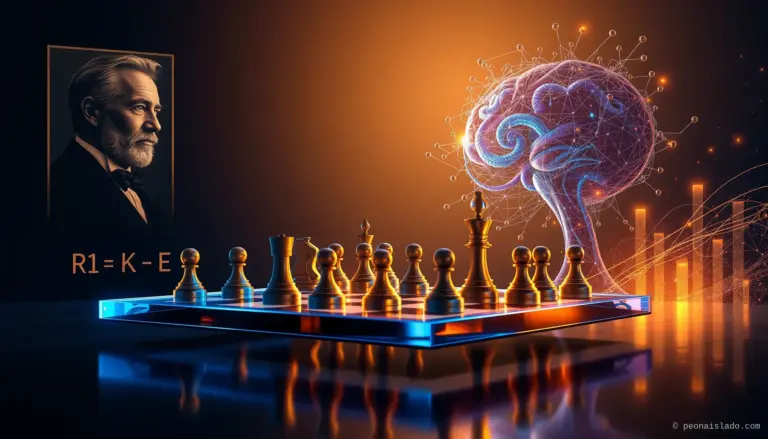
chess, an ancient game of strategy and logical thinking, has transcended its original purpose to become a symbol of power, manipulation and mystery. Although its essence lies in intellectual competence, Its complex structure and association with influential historical figures have fueled conspiracy theories linking the board to hidden secrets., secret societies and even plans for global domination. From seemingly innocuous moves to games that seem to reflect real events, chess has been interpreted as a cipher language, a map of hidden intentions or an indoctrination tool. But, To what extent are these theories justified?? Is chess really an instrument of conspiracy, or its influence on popular culture has distorted its true meaning? In this article, We will explore how this game has inspired conspiracy narratives, analyzing its connection with history, politics and human psychology.
Chess as a metaphor for power and manipulation
Since ancient times, Chess has been used as a metaphor for power and political strategy. Reyes, emperors and military leaders adopted it not only as a pastime, but as a tool to train your mind in making decisions under pressure. However, This association with power also made him a symbol of manipulation. One of the most persistent theories is the idea that chess was designed to teach elites how to control the masses., where each piece would represent a social stratum or a political actor.
For example, The movement of the pawn—the weakest but essential piece—has been interpreted as an allegory of how the lower classes are sacrificed to benefit the interests of the powerful.. This narrative was reinforced during the Cold War, when chess became a symbolic battleground between the United States and the Soviet Union. Games like the one “Match of the Century” between Bobby Fischer and Boris Spassky in 1972 They were seen by some as a representation of the ideological struggle between capitalism and communism., where every movement could be interpreted as a political message.
Besides, The hierarchical structure of chess—with the king as the central figure but dependent on his pieces—has led to comparisons with authoritarian systems of government.. Conspiracy theorists such as David Icke have suggested that the game reflects a pyramidal control structure., where the decisions of a few determine the destiny of many. This interpretation, although it lacks solid historical evidence, has permeated popular culture, fueling the idea that chess is not just a game, but a domination manual.
Chess in popular culture and its relationship with secret societies
Chess has been a recurring element in popular culture, appearing in movies, books and series as a symbol of intelligence, mystery and, sometimes, conspiracy. Works like *The Seventh Seal* by Ingmar Bergman, where a knight plays a game of chess with Death, o *La defensa Luzhin* de Vladimir Nabokov, that explores the obsession with gambling, have contributed to mythologizing its meaning. However, Its representation in fiction has also fueled theories about its connection with secret societies..
One of the most widespread theories is the supposed relationship between chess and the Illuminati or Freemasonry.. Some conspiracy theorists argue that the chess board, with his 64 casillas, represents a hidden code related to Masonic numerology (the number 8, For example, appears in the sum of rows and columns). Besides, the figure of the bishop—originally called “elephant” in Indian chess—has been associated with esoteric symbols, like the all-seeing eye, due to its triangular shape and its ability to move diagonally, which some interpret as a metaphor for the omniscient vision of the elites.
Another point of connection is the use of chess in initiation rituals.. In some Masonic lodges, Chess games have been used as part of symbolic ceremonies, where each movement represents a step on the path to hidden knowledge. Although there is no evidence that these practices are part of a plan for global domination, The mere existence of these rituals has been enough for conspiracy theorists to link chess with secret agendas..
Even in the cinema, Chess has been used to transmit subliminal messages. movies like *2001: A Space Odyssey* or *Blade Runner* include chess scenes that, according to some analysts, they hide references to artificial intelligence, mind control or genetic manipulation. These interpretations, although speculative, demonstrate how chess has become a blank canvas where all kinds of theories are projected.
Historical games that fueled conspiracy theories
throughout history, Some chess games have been the subject of speculation due to their political context or moves that, for some, They seem too calculated to be casual.. One of the most famous is the game between world champion Garry Kasparov and the computer Deep Blue in 1997. Although the result was presented as a victory for artificial intelligence, Some theorists suggested that the game was rigged to demonstrate the West's technological superiority over the human mind., at a time when globalization and automation were beginning to transform the world economy.
Another example is the game between the Soviet chess player Mikhail Tal and the American Bobby Fischer in 1961. Fischer, known for his aggressive style and disdain for Soviet authorities, lost the game in circumstances that some considered suspicious. Theorists such as writer Yuri Felshtinsky have argued that the KGB intervened to ensure Tal's victory., as part of a strategy to weaken Fischer's morale before his confrontation with Spassky in 1972. Although there is no conclusive evidence of this intervention, The episode fueled the idea that chess was a battlefield where governments manipulated results to send political messages..
Even in the 19th century, the game between the Frenchman Louis-Charles Mahé de La Bourdonnais and the British Alexander McDonnell in 1834 It was interpreted by some as a reflection of tensions between France and Great Britain.. The Bourdonnais, which represented the romantic school of chess, It was seen as a symbol of the French revolutionary spirit, while McDonnell embodied the calculating coldness of the British Empire. Although these interpretations are more literary than historical, demonstrate how chess has been used as a mirror of geopolitical conflicts.
The psychology behind the obsession with chess conspiracies
Why chess, a seemingly innocent game, has inspired so many conspiracy theories? The answer may be found in human psychology and the way we process information.. Chess is a closed system, with clear rules but infinite possibilities, which makes it fertile ground for subjective interpretation. When people cannot explain an event—such as an unexpected defeat or a seemingly illogical move—, tend to look for hidden patterns or malicious intent, a phenomenon known as apophenia.
Besides, chess is associated with intelligence and power, two concepts that, in the minds of many, are intrinsically linked to the conspiracy. The idea that “those who know” They manipulate the world from the shadows is a recurring theme in popular culture, and chess, with its aura of mystery, fits perfectly into this narrative. This is reinforced by the fact that many chess geniuses, like Fischer or Kasparov, They have had turbulent personal lives, which has led to speculation about its possible connection to hidden agendas.
Another factor is the confirmation bias, that leads people to interpret information in a way that confirms their preexisting beliefs. For example, someone who already believes in the existence of secret societies will see proof of their theory in chess, while someone skeptical will consider it simply a game. This bias is especially strong in the case of conspiracy theories., where the lack of evidence is interpreted as proof that “something is hiding”.
Finally, Chess has been used as a propaganda tool, which has contributed to its association with manipulation. During the Cold War, For example, The USSR promoted chess as a symbol of the intellectual superiority of communism, while the West used it to demonstrate individual creativity. This political instrumentalization has left a mark on public perception, making the game seen as more than just entertainment.
Conclusions: Fact or fiction?
chess, with its rich history and strategic complexity, has been a magnet for conspiracy theories, But to what extent are these narratives founded?? As we have seen, many of the connections between chess and conspiracies are based on subjective interpretations, Cognitive biases and the human tendency to look for patterns where there are none. However, This does not mean that the game is immune to political or cultural manipulation. From its use as a propaganda tool during the Cold War to its representation in fiction as a symbol of hidden power, chess has been shaped by the societies that have adopted it.
The truth is that chess, in its essence, It is still a game of strategy and creativity, where the real “conspirator” it is the human mind, able to anticipate movements and adapt to circumstances. Theories that link it with secret societies or plans for global domination are, mostly, the result of fascination with the unknown and the desire to find meaning in the complex. Nevertheless, This same fascination demonstrates the symbolic power of chess, that transcends its original function to become a reflection of our fears, ambitions and obsessions.
Ultimately, Chess is neither an instrument of conspiracy nor a simple pastime: It is a mirror of the human condition. Its ability to inspire conspiracy theories does not lie in its rules, but in our need to find order in chaos, meaning in the random and control in the unpredictable. Maybe, instead of looking for conspiracies on the board, we should see it for what it really is: a game that, like life, We win or lose depending on how we move our pieces.