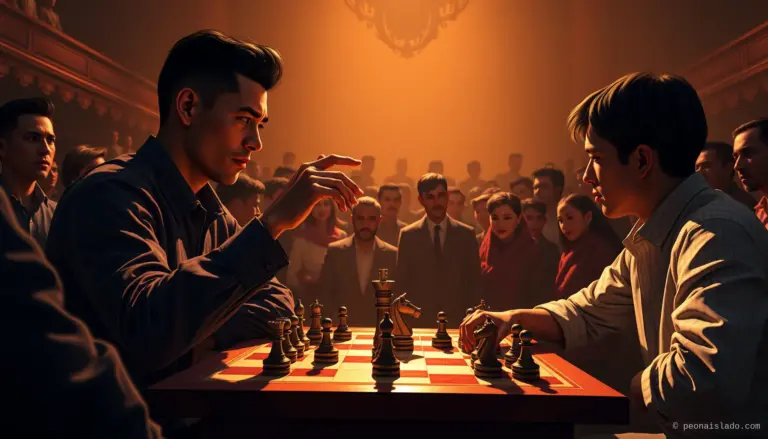
From the shadows of ancient times to the digital boards of today, Chess has fascinated humanity for centuries. But, Have you ever wondered who was the first chess player in history?? It is the enigma, shrouded in legends and myths, takes us on a journey through time to trace the origins of a game that has challenged minds, shaped cultures and transcended borders. Although modern chess is the result of an ancient evolution, Its genesis is lost in ancient civilizations where the game was more than a pastime: a reflection of military strategy, philosophy and even religion. In this article, we will explore the archaeological clues, the historical texts and theories that try to unravel the mystery of the first chess player, an anonymous character whose influence endures in every game played today.
The lost origins: between legend and archeology
Chess was not born overnight, but evolved from older games that combined strategy and chance. The most accepted theory places its origin in the India of the 6th century AD., where was played Chaturanga, a precursor that simulated a battle between four military divisions: infantry, chivalry, elephants and cars. However, attribute the title of “first player” to a specific individual it is almost impossible, since chaturanga was practiced in aristocratic and military circles, where the games were anonymous and transmitted orally.
Archaeological evidence is scarce but revealing.. In 2006, A team of archaeologists discovered Afrasiab (present-day Uzbekistan) a set of chess pieces from the 7th century, the oldest known so far. These pieces, carved in ivory, suggest that the game had already spread from India to Persia, where he acquired the name shatranj. Nevertheless, These findings do not tell us who was the first player, but they confirm that chess was already an expanding cultural phenomenon.
The legends, for his part, They offer more poetic than historical answers. One of the most famous attributes the invention of chess to an Indian Brahmin named Inside, who created it to entertain a bored king. according to the fable, The monarch was so impressed that he offered Sissa any reward, and he asked for a grain of wheat for the first square of the board, two for the second, four for the third, and so on. The result was an astronomical amount that the king could not pay., demonstrating the strategic depth of the game. Although this story is apocryphal, reflects how chess was associated with intelligence and cunning from its beginnings.
The first documented player: a name or a symbol?
While it is impossible to identify the first individual player, Historical records bring us closer to figures who could be considered the first chess players “documented”. In the Sassanid Persia (3rd-7th centuries AD.), shatranj was an elite game, practiced by kings, noble and learned. One of the first texts that mention specific items is the Chatrang-namak, a 10th-century Persian manuscript that tells how the king Khosrow I (531-579 d.C.) received the game as a gift from an Indian ambassador. Although no specific player is named, This story suggests that chess was already a symbol of power and diplomacy.
Another candidate is Al-Adli, a 9th century Persian player considered the first grandmaster of shatranj. According to Arab chronicles, Al-Adli wrote one of the first chess manuals, he book ash-shatranj, where he analyzed openings and endings. His work, today lost, was cited by later authors as Al-Suli, another Persian chess player who compiled problems and games in the 10th century. These texts show that, by then, Chess already had a technical language and a community of specialized players.
However, reducing the search to a single name would be unfair. The first chess player was not a person, sino a culture. in India, Persia and the Arab world, the game was a pedagogical tool, an art and even a means to resolve conflicts. For example, in the Medieval Spain, Christian and Muslim kings organized parties as a symbol of truce. So, the first chess player could be any nobleman, soldier the philosopher who, in silence, moved a piece for the first time on a rudimentary board.
The evolution of the player: from the elite to the masses
During the Middle Ages, chess slowly became democratized, going from being a privilege of kings and clerics to a game accessible to merchants and artisans. This change was key to understanding how the “first player” multiplied into thousands. In Europa, the game came through the Arabs in the 9th century, but its mass adoption occurred in the 12th and 13th centuries, when modern rules were introduced, like the queen and bishop move.
One of the milestones in this transformation was the publication of the book of games (1283) by order of the king Alfonso X of Castile. This manuscript, illustrated with miniatures, included chess games, backgammon and dice, and showed how the game was no longer exclusive to the nobility. In medieval cities, the boards were painted on tavern tables, and the players competed for bets. So, chess became a social phenomenon, and the “first player” He stopped being an individual to become a global community.
This massification process also brought with it professionalization. In the 15th century, the first ones emerged chess masters, like spanish Ruy López de Segura, author of one of the first European treatises on the game. López not only played, but analyzed openings and strategies, laying the foundations of modern chess. His figure illustrates how the player evolved: he was no longer an anonymous strategist, but a specialist who left a legacy.
The legacy of the first player: beyond the board
The mystery of the first chess player is not just a historical question, but a reflection of how the game has shaped human culture. From its origins in India to its global expansion, chess has been a mirror of society. In medieval Persia, It was a symbol of wisdom.; in Renaissance Europe, a metaphor for war; and in the modern era, a tool for cognitive development.
Hoy, chess is more accessible than ever. Platforms like Chess.com o Lichess allow millions of people to play online, and figures like Magnus Carlsen o Judit Polgár They have brought the game to new audiences. However, behind each game there is an echo of the first player, that anonymous strategist who, more than fifteen hundred years ago, moved a piece for the first time. Your legacy is not in a name, but in the universality of chess: a language that transcends languages, borders and times.
Besides, chess has influenced other areas. In the computing, It was one of the first challenges for artificial intelligence, with programs like Deep Blue defeating the world champion Garry Kasparov in 1997. In the psychology, It has been used to study decision making and creativity. Even in the literature, works like The chess player by Stefan Zweig explore its impact on the human mind.
So, the first chess player is not just a historical figure, but a symbol of human curiosity. Your identity is lost in time, but his influence lasts in each game, in each strategy and in each player that, when sitting in front of a board, pays tribute to an ancient legacy.
Conclusions: the enigma that will never be solved
The mystery of the first chess player is, in essence, a reminder that history is not always written with names and dates. Although archaeological evidence and ancient texts bring us closer to the origins of the game, the identity of its first practitioner remains a mystery. What we do know is that chess was born in a context of military strategy and philosophy., evolved across cultures and times, and became a global phenomenon that transcends the playful.
From Afrasiab parts to artificial intelligence algorithms, chess has been a reflection of human intelligence. The first player was not an individual, but one idea: that of challenging the mind, anticipate movements and find beauty in complexity. In that sense, every person who has played chess throughout history is, in part, heir to that anonymous legacy.
Maybe the real mystery isn't who the first player was, sino why chess continues to fascinate us. Its ability to adapt to each era, Its strategic depth and universality make it an eternal game. So next time you move a piece, remember: you are participating in a tradition that began more than fifteen hundred years ago, on a board that, although it changed shape, never lost its essence. The first chess player may have been a Persian nobleman, an Indian Brahmin or an anonymous soldier, but his spirit lives on in every game played today.