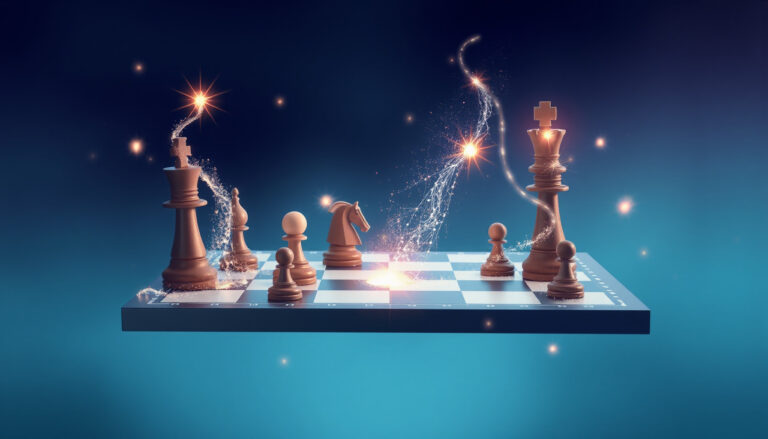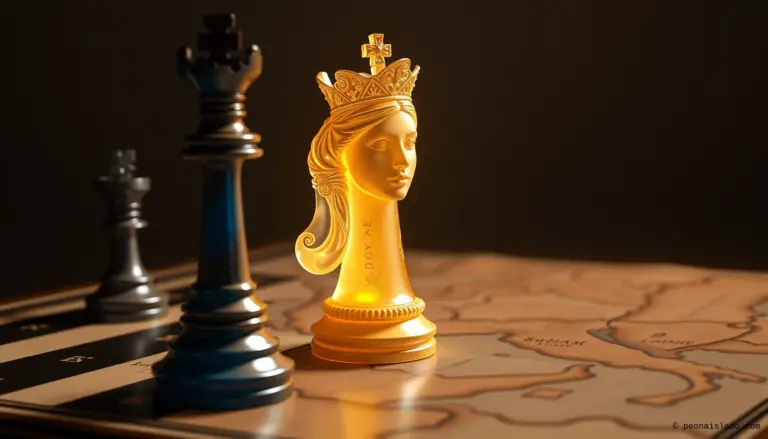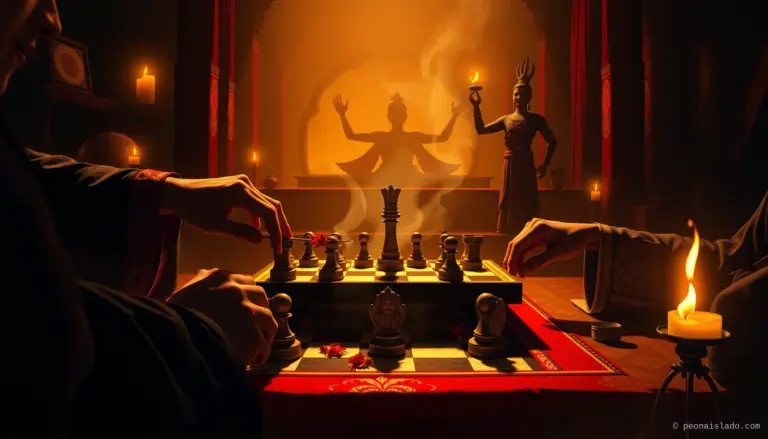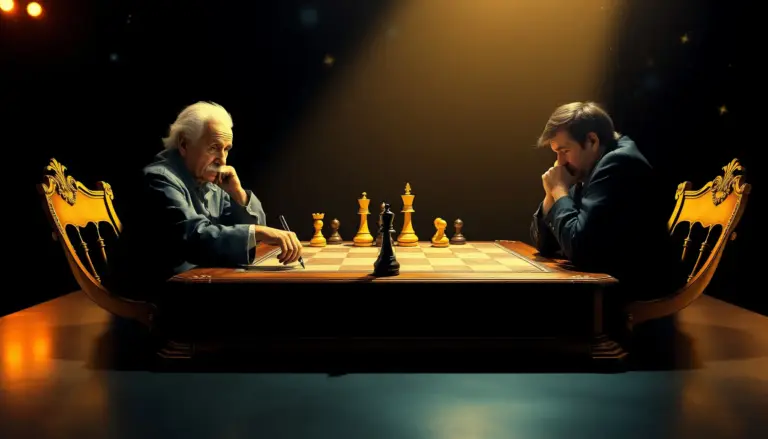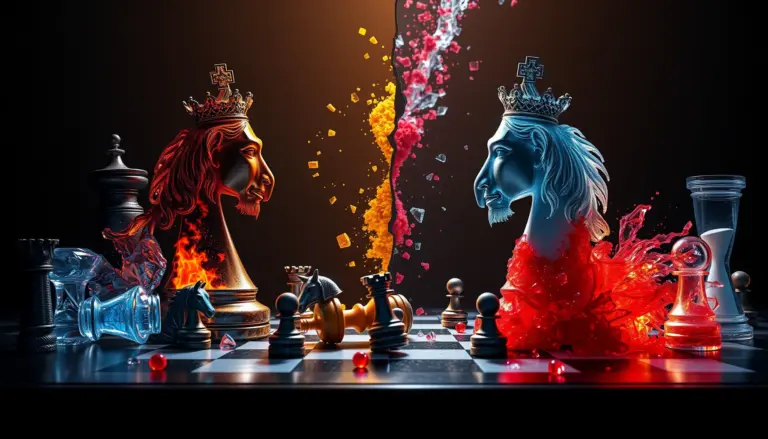
chess, more than just a strategy game, has transcended throughout the centuries as an inexhaustible source of inspiration for art. From painting to literature, passing through cinema and sculpture, this ancient board 64 Casillas has left an indelible mark on human creativity. Its symmetrical structure, Its precise rules and its symbolism of conflict and harmony have served as a metaphor for life, the war, power and even destiny. But, How exactly has chess influenced different artistic expressions?? What elements of the game have captured the imagination of artists and why does this fascination endure to this day??
Exploring the relationship between chess and art not only reveals aesthetic connections, but also deep reflections on the human condition. Through masterpieces, avant-garde movements and contemporary reinterpretations, Chess has become a universal language that dialogues with beauty, the tension and complexity of the world. In the following lines, We will analyze how this game has shaped art in different eras, unraveling its hidden meanings and its impact on visual culture.
Chess as a symbol in classical painting
From the Renaissance to the Baroque, chess appeared on canvas as an element loaded with symbolism. Artists like Lucas van Leyden y Sofonisba Anguissola they used it to represent not only the intellect, but also the dynamics of power and seduction. In works like *”The chess game”* (1555) of Anguissola, the board becomes a stage where social tensions develop: the looks of the players, the arrangement of the pieces and even the gestures reveal hierarchies, alliances and personal conflicts.
In religious art, chess took on an even deeper meaning. Paintings like *”The chess game”* of Giulio Campi (16th century) They linked it with the fight between good and evil, where each movement represented a moral decision. Even in the Triumph of Death of Pieter Bruegel the Elder, the board appears as a metaphor for the transience of life, where the pieces, just like humans, are destined to fall.
This duality—between the playful and the transcendental—is what made chess a recurring motif in classical painting.. It wasn't just about playing a game., but to express the contradictions of existence: reason versus chance, order versus chaos, and strategy as a reflection of the human condition.
Chess at the forefront: breakup and reinvention
With the arrival of the artistic avant-garde at the beginning of the 20th century, Chess stopped being a simple symbol to become a disruptive element. Movements like cubism, he dadaism and the surrealism They reinterpreted it from radically new perspectives, challenging aesthetic and conceptual conventions.
Marcel Duchamp, one of the most influential artists of the 20th century, took this relationship to its maximum expression. His work *”Portrait of chess players”* (1911) decomposed the figures into geometric shapes, anticipating cubism, while his personal obsession with chess led him to temporarily abandon the art to dedicate himself to the game. Duchamp saw chess as an art form in itself., where logic and creativity merged. He even designed minimalist chess pieces, reducing the game to its purest essence: the strategy.
The surrealists, for his part, They explored chess as a dream space. In works like *”automatic chess”* of Man Ray, the pieces took on a life of their own, challenging the rules of the game and traditional art. Salvador Dali, in *”Unorthodox chess”* (1934), mixed the board with biomorphic elements, suggesting that the game was a metaphor for the unconscious, where the pieces moved by irrational impulses.
This stage marked a turning point: chess was no longer just a topic, but a means to question reality, the perception and limits of art itself.
Cinema and literature: chess as narrative
Chess has been a powerful narrative resource in film and literature., where its conflict and resolution structure adapts perfectly to dramatic plots. in literature, authors like Vladimir Nabokov (*”La defensa Luzhin”*) y Stefan Zweig (*”chess novel”*) They used the game to explore the psychology of their characters. Luzhin, Nabokov's protagonist, see the world through chess patterns, to the point that his obsession drives him to madness. Zweig, for his part, contrasts the coldness of the chess champion with the humanity of a prisoner learning the game in captivity, showing how the board can be both a prison and an escape route.
in the cinema, chess has served to build scenes of intellectual tension and confrontation. Movies like *”The seventh seal”* (1957) of Ingmar Bergman They use the game as an allegory of life and death, where the knight plays a game against Death himself. In *”Searching for Bobby Fischer”* (1993), chess becomes a reflection of childhood, social pressure and the search for genius. Even in science fiction movies, how *”Blade Runner 2049″*, Chess appears as a symbol of humanity in the face of artificial intelligence, where every movement is a question about what makes us human.
The fascinating thing about these narratives is how chess transcends its recreational function to become a mirror of the internal and external conflicts of the characters.. Whether as a metaphor for war, madness or redemption, the board continues to be a stage where more than just a game is played.
Chess in contemporary art: between the conceptual and the digital
In contemporary art, Chess has evolved towards more conceptual and technological proposals, reflecting the changes of an increasingly digitalized society. Artists like Yoko Ono y Damien Hirst have used the game to explore themes such as interactivity, violence and the transience of power.
Ono, in his work *”Play It by Trust”* (1966), invited the public to play chess on a completely white board, where the pieces were only distinguished by their texture. The premise was simple: players had to communicate and trust each other to move the pieces, transforming the game into a collaborative rather than competitive experience. This piece questioned power structures and human nature, proving that chess could be a means to peace instead of confrontation.
In the digital sphere, chess has found a new space for experimentation. Artists like Rafael Lozano-Hemmer have created interactive installations where the board is projected on urban surfaces, and the players' movements generate light and sound patterns. These works not only democratize the game, but they turn it into an immersive experience, where art and technology merge.
Even in the street art, chess has been reinterpreted as a symbol of resistance. Murals in cities like Berlin or Buenos Aires represent games between historical or anonymous figures, using the board as a space for social dialogue. In an increasingly polarized world, chess remains a reminder that, even in confrontation, there is the possibility of understanding.
Chess and art have maintained a constant dialogue throughout history, evolving from symbolic representations to avant-garde and digital proposals. What began as a pictorial motif in the Renaissance became a tool to question reality, tell stories and explore the human condition. From Anguissola's canvases to Lozano-Hemmer's interactive installations, the board 64 Casillas has proven to be a canvas in itself, able to reflect fears, the obsessions and hopes of each era.
More than just a game, Chess is a universal language that transcends cultures and disciplines. His influence on art lies not only in his aesthetics., but in its ability to encapsulate the complexity of existence: strategy as a metaphor for life, conflict as a driver of creativity and resolution as an act of beauty. In a world where the rules seem to constantly change, chess remains a reminder that, in the end, It's all a matter of well-calculated movements and, above all, of imagination.