“`html
chess, that ancient game that has challenged minds from the confines of ancient India to the digital boards of today, It is much more than just a hobby. It is a reflection of the culture, strategy and human evolution. But, What happens when a nation decides to turn this game into a school of thought, in a model that transcends play to become an elite training system? This is where the Indian Chess School, a phenomenon that has redefined not only how chess is taught, but also how its impact on society is understood. From its roots in Chaturanga, the Indian precursor of modern chess, to its influence on the training of great contemporary masters, This school has shown that the board can be a mirror of life, a power tool and a bridge between generations.
The origin: When chess was born in India
To understand the Indian School of Chess, It is essential to go back in time, until the 6th century AD., when he Chaturanga -he “four member game”— was played in the palaces of India. This game, which simulated a battle between four military divisions (infantry, chivalry, elephants and cars), It wasn't just entertainment., but also an exercise in military strategy. Its evolution towards modern chess, through Persia and the Arab world, is a fascinating story that reveals how ideas travel and transform. However, What few know is that India was not only the birthplace of chess, but also the place where the foundations of a teaching philosophy that endures to this day were laid..
He Chaturanga It wasn't just any game.: It was a microcosm of war, politics and life itself. Indian kings used it to train their generals, teaching them to think several moves ahead, to anticipate the enemy's moves and adapt to changing situations. This strategic mindset, rooted in Indian culture, was passed down from generation to generation, until it became a pillar of what we know today as the Indian School of Chess. But, How did it go from being an elite game to a revolutionary educational model??
The answer lies in the combination of tradition and innovation. While in other cultures chess remained an aristocratic pastime, in India it was democratized, becoming a tool accessible to everyone. This philosophy of inclusion and excellence is what distinguishes the Indian School, and what has led it to produce some of the most brilliant players in history, as Viswanathan Anand, the first Indian grandmaster and world champion.
The philosophy: beyond the board, a mentality
The Indian Chess School is not limited to teaching openings, defenses or tactics. It goes much further: seeks to form strategic minds, able to apply chess principles to everyday life. This philosophy is based on three fundamental pillars: deep thought, adaptability y resilience. In a world where immediacy and superficiality dominate, These values are more relevant than ever.
Deep thinking is, maybe, the most valuable legacy of the Indian School. In an article about chess and lateral thinking, Explores how play fosters creativity and problem-solving from unexpected angles. The Indian School takes this one step further, teaching your students to analyze each movement not only in terms of its immediate consequences, but also its long-term impact. This ability, known as positional calculus, It's what separates grandmasters from average players..
Adaptability is another key pillar. in chess, like in life, things rarely go as planned. An opponent can surprise you with an unconventional opening, or a tactical error can change the course of the game. The Indian School teaches its students to flow with changes, turn threats into opportunities and stay calm under pressure. This mindset is especially valuable in a world where uncertainty is the only constant..
Finally, resilience is a fundamental value. Losing a game is not the end of the world; It's an opportunity to learn. The Indian School instills this mentality from the beginning, teaching your students to analyze their mistakes, to identify patterns and continually improve. This philosophy not only improves performance on the board, but also strengthens character, preparing players for real life challenges.
The method: how India creates champions
If philosophy is the soul of the Indian School of Chess, the method is your body. Unlike other schools, like the Russian School, which focuses on memorizing openings and repeating patterns, The Indian School prioritizes the development of independent thinking. Your approach is holistic: combines theoretical study with intensive practice, competition with reflection, and technique with creativity.
One of the most innovative aspects of the Indian method is its emphasis on positional chess. While many schools teach their students to look for spectacular checkmates or tactical combinations, the Indian School focuses on building solid positions, in controlling the center of the board and limiting the opponent's options. This approach, which may seem less exciting at first glance, It is actually the basis of long-term success. Players like Anand have shown that patience and precision are as important as aggressiveness.
Another key element of the Indian method is the psychological preparation. In an article about psychological errors in chess, dangers of overconfidence highlighted, fear of losing and lack of concentration. The Indian School addresses these problems head-on, teaching your students to handle pressure, to remain calm in critical situations and develop a winning mentality. This does not mean that the technique is ignored; on the contrary, Integrates with psychology to create complete players, capable of facing any challenge.
Competition is another pillar of the Indian method. From an early age, students participate in local tournaments, national and international, where they learn to deal with pressure, to analyze your games and continually improve. This early exposure to competition is what has allowed India to produce a generation of young talent., como Rameshbabu Praggnanandhaa and Gukesh Dommaraju, who are challenging the best players in the world.
The impact: how the Indian School is changing global chess
The success of the Indian Chess School is not an isolated phenomenon. It is the result of decades of investment in infrastructure, training of coaches and promotion of the game at a national level. Hoy, India is one of the fastest growing countries in world chess, and its influence extends beyond its borders. But, How has this impact been achieved??
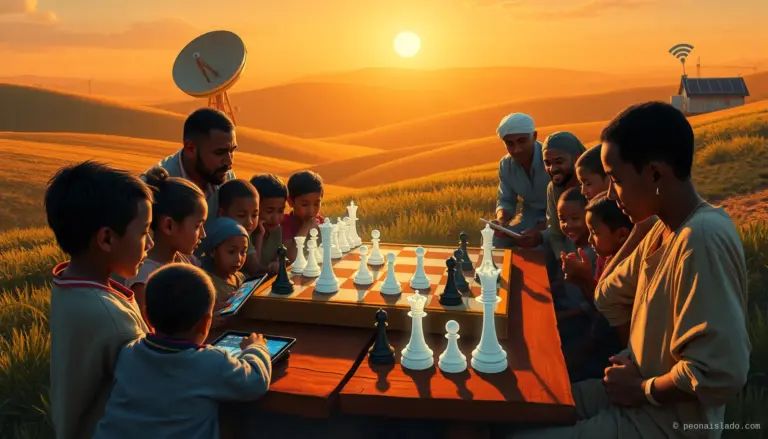
First of all, India has democratized access to chess. Unlike other countries, where gambling remains a privilege of the elites, In India it has become a tool of social mobility. Programs like Chess in Schools have brought chess to thousands of children in rural and urban areas, offering them an opportunity to develop cognitive skills, improve your academic performance and, in some cases, even become professionals. This inclusive approach is what has allowed India to discover and nurture talent in every corner of the country..
In second place, India has invested in training coaches. Unlike other countries, where the coaches are simply retired players, In India, a certification system has been created that ensures that coaches not only master the game, but also know how to teach it. This has allowed the Indian School to develop a unique teaching style, that combines tradition with innovation, and that has been key to the success of its players.
Finally, India has known how to harness the power of technology. Platforms like ChessBase India y Chess.com have enabled Indian players to access high-quality training resources, compete in online tournaments and connect with the global chess community. This combination of tradition and modernity is what has allowed India to position itself as a power in world chess..
The future: Where is the Indian Chess School going??
The future of the Indian Chess School is promising, but it is not without challenges. On the one hand, The growth of chess in India has been exponential, with an increase in the number of players, tournaments and sponsors. On the other hand, This growth has also brought with it new challenges, such as the need to maintain high quality standards, avoid market saturation and ensure that chess remains accessible to all.
One of the biggest challenges is competition with other schools, like the Chinese School, which has proven to be equally effective in training champions. India must continue to innovate, adapting to new trends in chess and maintaining its unique focus on strategic thinking and creativity. This won't be easy, But if the Indian School has demonstrated anything, it is its ability to reinvent itself and overcome obstacles.
Another challenge is the integration of artificial intelligence. In a world where engines like Stockfish y AlphaZero master game analysis, The Indian School must find a balance between the use of technology and the development of human thought. AI can be a valuable tool for training, but it should not replace creativity and intuition, which are the heart of Indian chess.
Finally, The Indian School must continue to promote inclusion and diversity. Although chess has grown in popularity in the country, there are still barriers to overcome, especially in terms of gender and access in rural areas. Programs like Chess for Girls y Chess in Villages They are a good start, but it will take continued effort to ensure that chess remains a game for everyone.
The Indian School of Chess has shown that the board can be much more than a game: It is a tool of social transformation, a bridge between cultures and a laboratory of brilliant minds. Your focus on deep thinking, adaptability and resilience has not only produced champions, but also people capable of facing life's challenges with intelligence and determination. In a world where immediacy and superficiality dominate, The Indian School reminds us that true power is in patience, strategy and the ability to think several moves ahead.
But the legacy of the Indian School is not limited to its achievements on the board. It is a model of how education can be inclusive, innovative and transformative. In a country with a diversity as rich and complex as India, chess has become a universal language, able to unite people from different backgrounds, genders and ages. This is, maybe, his greatest achievement: prove that chess is not just a game of kings, but a tool to build a better future.
The challenge now is to keep this legacy alive, adapting to changes without losing its essence. The Indian Chess School has the potential to continue inspiring generations of players, not only in India, but all over the world. His story is a reminder that, in chess as in life, true success is not measured by victories, but for the ability to learn, grow and overcome obstacles. And in that sense, The Indian School has already won the most important game: that of forming brilliant minds, capable of facing any challenge with intelligence and determination.
“`