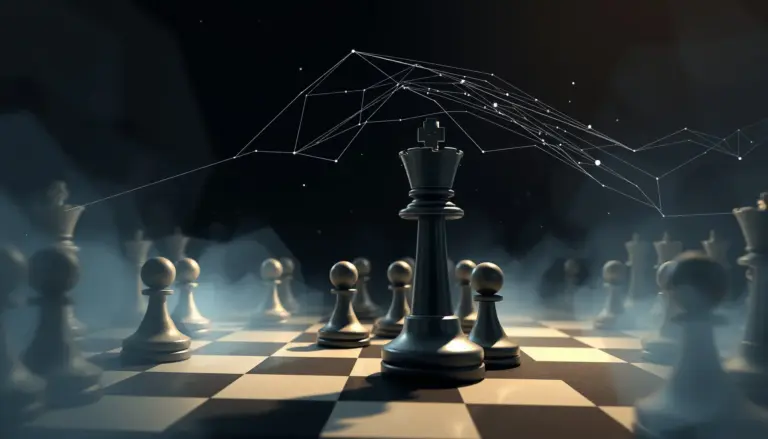
Imagine for a moment that every decision you make in life—from choosing which path to take at a fork in the road to negotiating a pay raise—is a play on an invisible board.. The pieces are your resources: time, energy, relations. The rival, although not always visible, is the uncertainty, chance or even your own doubts. What would happen if there was an ancient training, designed to tune your mind like a violinist tunes his instrument before a concert? chess, that game of kings and strategists, It's not just a hobby: It is a laboratory of life. In their 64 boxes hide lessons about patience, anticipation, resilience and, above all, the ability to see beyond immediate movement. But, Can chess really transcend the board and become a practical tool for navigating everyday challenges?
Chess as a mirror of decision making
in chess, each movement requires evaluating multiple variables: the position of the pieces, the rival's intentions, potential risks and hidden opportunities. This dynamic is not very different from what we face when making decisions in real life.. A study published in the journal Frontiers in Psychology revealed that chess players develop a greater ability to analyze complex situations and anticipate long-term consequences. But, how does this translate off the board?
Consider the financial planning process. Just like in a game, you must evaluate your “parts” -income, bills, investments—and anticipate how each decision will affect your future position. A common error in both areas is short term bias: sacrifice a pawn (or a savings) without considering how that loss can weaken your structure in the future. This is where chess acts as a algorithmic thinking laboratory, teaching you to decompose problems into manageable steps and prioritize actions based on their strategic impact.
Besides, chess encourages cognitive flexibility, a crucial skill in a world where plans rarely survive the first contact with reality. Great teachers don't just memorize openings; They learn to adapt when the opponent deviates from what is expected. This ability to pivot, to reassess and adjust strategy as you go, It's what separates effective leaders from those who cling to outdated plans.. As psychologist Barry Schwartz points out in his book The Paradox of Choice, true wisdom is not in making the decision “perfect”, but in knowing when and how to correct course.
The psychology of the board: how chess trains your emotional mind
Chess is not just a game of logic; It is a psychological duel where the human mind faces its own limitations. In a game, errors are rarely technical: They are usually emotional. Frustration after a failed play, The euphoria after a pyrrhic victory or the fear of losing can cloud judgment as much as a thick fog in a forest.. Here, chess becomes a mental gym to master these emotions.
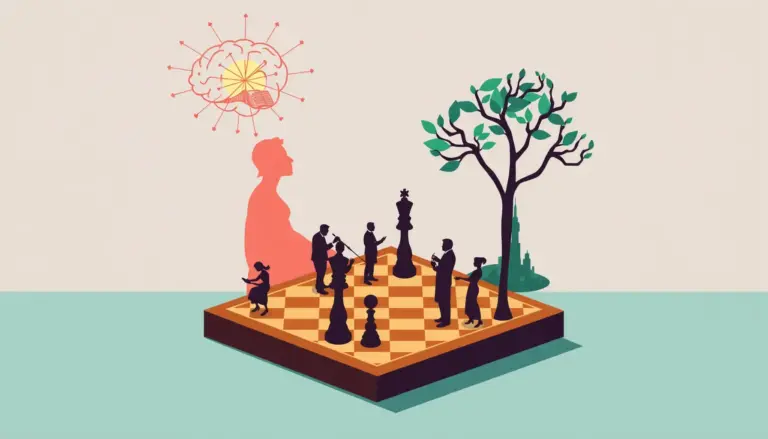
A key concept in this area is the tilt, a term borrowed from poker that describes the state of emotional loss of control after a defeat or mistake. in chess, tilt can manifest itself as a series of impulsive plays, premature abandonment of strategy or even surrender before the game is lost. Science has shown that players who manage to remain calm under pressure activate the prefrontal cortex, the region of the brain associated with rational thinking and emotional regulation. In daily life, This ability translates into greater resilience in the face of failure., whether at work, in studies or in personal relationships.
But chess also teaches the value of strategic empathy. To anticipate the opponent's movements, you must put yourself in his place, understand their motivations and anticipate their reactions. This ability to “file” to others is invaluable in negotiations, leadership and even in parenting. As the great teacher Savielly Tartakower wrote: “Chess is the art of analysis”. and in life, analyzing is not just calculating; is to understand.
From theory to practice: how to apply chess lessons in everyday life
If chess is a microcosm of life, How can we extract its lessons and apply them off the board?? The answer is not to memorize openings or endings, but in internalizing its fundamental principles. One of them is the center control, a concept that in chess refers to dominating the central squares of the board to maximize the mobility of the pieces. in life, This translates into identifying and securing your “central squares”: your values, your long-term goals and the resources that allow you to adapt to changes. For example, in the professional field, This could mean developing transferable skills (such as critical thinking or communication) instead of specializing in a niche that is too narrow.
Another principle is zugzwang, a situation where any movement you make worsens your position. in life, zugzwang can manifest as a crossroads where all options seem unfavorable: change jobs and risk instability, or stay and resign yourself to stagnation. The lesson here is not to avoid difficult decisions, but to recognize that, sometimes, the best play is not move and wait for the context to change. This requires patience, a virtue that chess cultivates like few other activities. As the French philosopher Blaise Pascal said: “All the unhappiness of men comes from one thing.: not knowing how to stay at rest in a room”.
Finally, chess teaches the value of preparation. Great teachers do not improvise; study previous games, They analyze the weaknesses of their rivals and design strategies before the game begins. in life, This translates into the importance of planning and continuous learning. A Harvard University study found that people who spend time reflecting on their experiences—whether successes or failures—improve their performance by 23% compared to those who do not. Here, chess offers a powerful tool: he post-mortem analysis. Review your games (or your decisions) honestly, Identifying mistakes and adjusting your approach is the key to personal and professional growth.
Chess as a tool for inclusion and social transformation
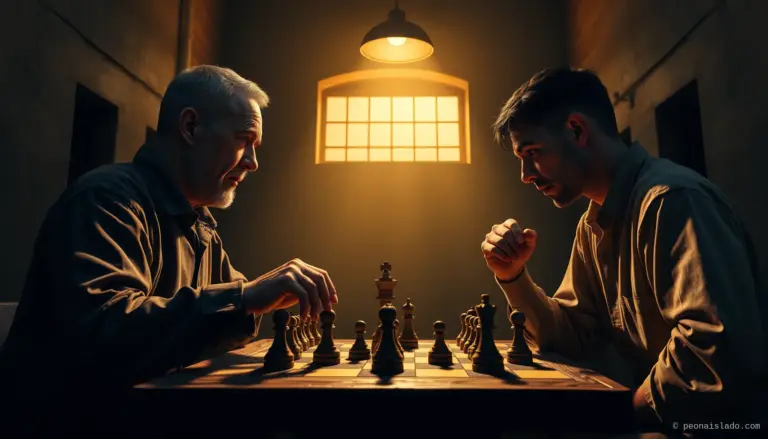
Beyond its individual benefits, Chess has proven to be a powerful tool for social transformation. In contexts of vulnerability, like prisons, refugee camps or marginalized communities, the game acts as a bridge to reintegration, education and emotional healing. A notable example is the program Chess for Freedom, implemented in prisons in the United States and Europe, where chess is used to teach skills such as patience, respect for rules and managing frustration. The results are eloquent: in Norwegian prisons, Inmates who participate in chess programs have a 30% less likely to reoffend.
In the educational field, Chess has been adopted as a subject in countries like Armenia, Spain and Uruguay, with results that go beyond academic performance. A study from the University of Trier, in Germany, found that children who learn chess improve their ability to concentrate, your working memory and your creativity. But perhaps the most profound impact is the one it has on the self-efficacy, that is to say, belief in one's ability to achieve goals. In a world where children are increasingly exposed to the immediacy of social networks and video games, Chess teaches them that effort and strategy are rewarded, a lesson that transcends the board. As the pedagogue José Antonio Marina points out: “Chess is the only game in which mistakes are paid for with defeat., but it is also the only one in which the mistake becomes a lesson”.
Besides, Chess is a universal language that breaks cultural barriers, linguistic and even generational. in a tournament, a child of 8 years old can face an old man of 80, and both will compete under the same rules, with the same opportunities. This level playing field is rare in other areas of life., and it is one of the reasons why chess has been used as a tool of diplomacy and peace. An emblematic case is that of the Israeli and Palestinian children what, through chess, have found a space to interact beyond political conflicts. In an increasingly polarized world, The board becomes a neutral ground where logic and strategy prevail over prejudices.
Can chess save you from the age of distraction?
We live in an era of overstimulation, where attention is a scarce and valuable resource. Notifications, algorithms and the culture of immediacy have fragmented our ability to concentrate, turning even the simplest tasks into herculean challenges. In this context, chess emerges as a antidote against dispersion. A game requires absolute concentration, an immersion in the present that few activities can match. Neuroscientists such as Daniel Levitin have pointed out that chess activates the default mode network of the brain, a neural network associated with creativity and introspection. In other words, playing chess not only trains you to focus; prepares you to think more deeply and originally.
But chess also teaches the value of silence. In a game, no room for outside noise or distractions. Every move must be considered in silence, without the interference of other people's opinions or social pressures. This practice of silence—so rare in the digital age—is a transferable skill to other areas of life.. As the Korean philosopher Byung-Chul Han wrote in The fatigue society: “Silence is the space where thought is born”. In a world where everyone talks but few listen, chess reminds us that, sometimes, wisdom is in being silent and observing.
Finally, Chess is a reminder that life is not a zero-sum game. Although there can only be one winner on the board, in real life, the true triumph is in learning, in connection with others and in the ability to find beauty even in defeat. As the great teacher Emanuel Lasker said: “in chess, like in life, the strongest rival is oneself”. And perhaps that is the most valuable lesson of all.: that the true checkmate is not against the other, but against our own limitations.
Chess won't give you all the answers, but it will provide you with the right questions. It will teach you to think before acting, to value the process as much as the result and to find order in chaos. In a world that rewards speed over depth, Chess is a reminder that true intelligence is not about moving fast, but in moving with purpose. So the next time you're faced with a dilemma—whether personal, professional or emotional—ask yourself: what would a great teacher do? The Answer Could Change Your Game.