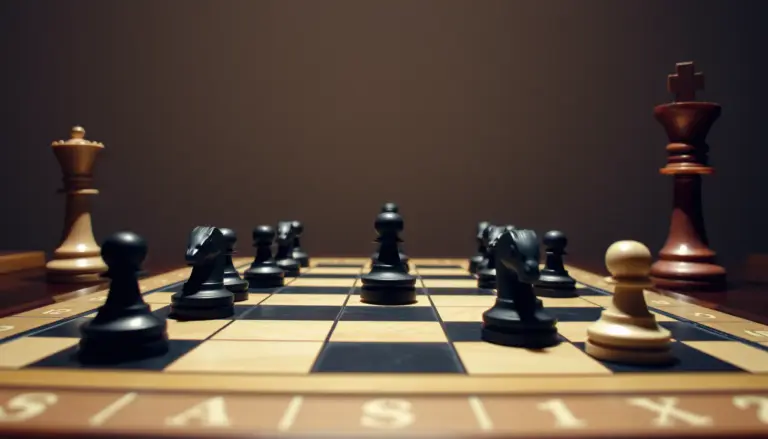
Chess is one of the oldest and most respected strategy games in the world., but its complexity and depth can be overwhelming for some players. While mastering chess requires years of practice, There are alternatives that capture its strategic essence without the same learning curve. These games, although less known, offer unique mechanics, intellectual challenges and the opportunity to develop similar skills, like tactical thinking, long-term planning and anticipation of opponent's moves. In this article, We'll explore some of the best options for those looking to diversify their strategic board game experience., whether to relax, improve your skills or simply discover new ways to compete.
Why look for alternatives to chess
Chess is an exceptional game, but it's not perfect for everyone. Some players may be frustrated by its rigidity in the rules, the lack of variability in the games or the difficulty in finding rivals with a similar level. Besides, although chess teaches valuable lessons about strategy and patience, its focus on absolute victory can be exhausting for those seeking a more relaxed or creative experience.
Alternatives to chess usually introduce elements that make it more dynamic, as:
- Asymmetrical mechanics: Where each player has different objectives or abilities, which adds layers of complexity and variety.
- Modular boards: What changes in each game, avoiding memorization of openings and encouraging adaptation.
- Incorporation of controlled chance: Like cards or dice, that introduce unpredictability without sacrificing strategic depth.
- Thematic approaches: That allow you to explore specific narratives or scenarios, like historical battles or fantasy.
Not only are these games a great way to break up the monotony, but they can also serve as tools to improve transferable skills to chess., such as spatial visualization or resource management.
Games with similar mechanics but greater flexibility
If what you are looking for is a game that preserves the essence of chess—alternating turns, tactical movements and victory by elimination or control—but with more accessible or varied rules, These options are ideal:
1. Shogi (Japanese chess)
shogi is, definitely, the closest relative to western chess. Share its basic structure: a board of 9×9 casillas, pieces with specific movements and the objective of checkmating the king. However, introduces two key differences that make it unique:
- Re-entry of parts: When you capture an opponent's piece, you can reintroduce it to the board under your control on a later turn. This eliminates the feeling of “waste” of pieces and adds an additional strategic layer, since you must decide when and how to reuse them.
- Parts promotion: Almost all parts (except the king and the gold) can be promoted by entering the rival's promotion zone, gaining new moves. This prevents games from stagnating and encourages more aggressive play.
Shogi is ideal for chess players looking for a fresh challenge without completely abandoning the mechanics they already know.. Your community is active, especially in Japan, and there are numerous online resources to learn.
2. Xiangqi (Chinese chess)
Xiangqi is another direct descendant of chess, but with a more territorial approach and less focused on the total elimination of the rival. It is played on a board of 9×10 lines (not boxes), with a “río” in the center that divides the field and affects the movements of some pieces. The most notable differences are:
- Checkmate or Drowning Objective: Unlike chess, where the drowned man is a tie, in xiangqi it can be a victory if the rival king has no legal moves.
- Parts with geographic restrictions: For example, elephants can't cross the river, and cannons require an intermediate piece to capture.
- Absence of castling: Which makes the king's protection more dynamic and less predictable.
The xiangqi is perfect for those who enjoy a faster game with greater emphasis on mobility. Its popularity in Asia guarantees a large number of tournaments and learning materials.
Games with a strategic focus but innovative mechanics
If you find chess too rigid or you are looking for something that combines strategy with elements of other genres, These games offer a unique experience without sacrificing depth:
1. Hive
Hive is an abstract strategy game that completely ignores the board. instead, The pieces – inspired by insects – are placed and moved on a flat surface, creating a “honeycomb” that evolves with each turn. Each type of piece has a different movement:
- The ant: Can be moved to any free position around the honeycomb.
- The spider: Must move exactly three squares (hexagons) in any direction.
- The beetle: You can move one square or climb over other pieces, blocking your movement.
The objective is to completely surround the opponent's queen (similar to the king in chess) with your pieces. Hive is ideal for gamers who enjoy pure strategy but want something more portable and visually appealing. Its learning curve is gentle, but games can get extremely tactical.
2. Arimaa
Specifically created to be more accessible than chess but just as deep, Arimaa uses a board of 8×8 and pieces with simple movements. However, Its real innovation lies in the push and pull rules:
- Basic movements: Each piece can move one square in any direction (like the king in chess).
- Push and drag: Stronger pieces can move weaker ones, allowing for blocking and space control tactics.
- Aim: Take one of your weak pieces (like the rabbit) to the last row of the rival.
Arimaa was designed to be resistant to artificial intelligence engines, making it a challenge even for experienced players. It is an excellent option for those looking for a game with simple rules but strategic depth comparable to chess..
Games that combine strategy with narrative or chance
For those looking for more than just a duel of minds, There are games that incorporate narrative elements, thematic or even a touch of chance without losing the strategic essence. These titles are perfect for players who enjoy a more immersive or social experience:
1. Chess 960 (Fischer Random Chess)
Invented by the legendary Bobby Fischer, el Chess 960 It is a variant of traditional chess that eliminates the memorization of openings by placing the pieces in random positions at the beginning of each game. The rules are identical to standard chess, but with a crucial difference:
- Random starting position: The pawns are placed in their usual position, but the remaining pieces (torres, horses, bishops, lady and king) are randomly distributed in the first row, respecting only two conditions: The bishops must be in spaces of a different color, and the king must be between the two rooks to allow castling.
This variant is ideal for chess players who want to focus on creativity and adaptation rather than relying on memorized openings.. Besides, It is an excellent tool to improve positional understanding and the ability to improvise.
2. The Duke
The Duke is a strategy game that combines elements of chess with deck-building mechanics. Each player controls an army of pieces that move according to cards that reveal their abilities when turned over.. Some key features are:
- dynamic movements: Each piece has two faces with different movements. When moving it, turns around, changing their behavior in the next round.
- variable objective: In addition to capturing the rival's duke, you can win by controlling the majority of the squares on the board or by completing other secret objectives.
- controlled chance: Starting cards are random, but the strategy lies in how you use them and when you reveal them.
The Duke is perfect for those looking for a game with greater variety in each game and a more gradual learning curve. Its narrative component (Each piece represents a character with unique abilities) makes it especially attractive to casual players.
Conclusions: What is the ideal game for you??
Exploring alternatives to chess does not mean abandoning this classic, but to broaden horizons and discover new ways to enjoy strategy. Each of the games mentioned offers a unique experience, adapted to different tastes and objectives:
- If you are looking for tactical depth without abandoning chess: Shogi and xiangqi are the closest options, with familiar mechanics but enough differences to maintain interest.
- If you prefer something more innovative but equally strategic: Hive and Arimaa offer simple rules but complex games, ideal for those who enjoy pure strategy.
- If you want to combine strategy with narrative or chance: Chess 960 and The Duke are excellent for breaking the monotony and adding variety to your games.
The choice will depend on what you value most in a game: Tradition and strategic purity? Innovation and creativity? Or immersion in a thematic world? The important thing is to remember that chess is not the only way to develop skills such as critical thinking., patience and anticipation. Trying these games will not only enrich your experience as a player, but it can also help you see chess from a new perspective.
So, why not take the first step? Choose one of these games, Immerse yourself in its rules and discover a universe of strategic possibilities that go beyond the board of 8×8. who knows, maybe you'll find your new passion or even get better as a chess player in the process.