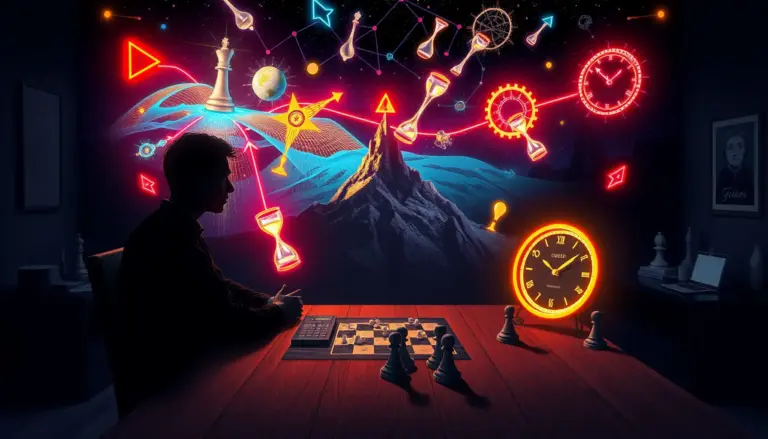
Chess is much more than just a strategy game.: It is a reflection of cultural evolution, political and social of humanity. From its mysterious origins in ancient times to its consolidation as a globally recognized mental sport, chess has crossed continents, empires and revolutions, adapting and transforming at each stage. His story not only tells the development of a hobby, but also the way in which civilizations have interacted, competed and shared knowledge. In this article, We will explore the fascinating journey of chess through time, from its roots in India to its expansion through Persia, the arab world, Europe and beyond. We will discover how this game has influenced art, science and philosophy, and how his legacy lives on in the digital age.
The origins of chess: between legend and history
Chess was not born overnight, but rather it is the result of a millennia-long evolution whose beginnings are lost among myths and fragmentary historical records.. The most accepted theory places its origin in the India of the 6th century AD., where it emerged under the name of Chaturanga, a war game that simulated the four divisions of the Indian army: infantry (pawns), chivalry (horses), elephants (bishops) and battle tanks (torres). This game, described in texts such as Bhavishya Old, It wasn't just entertainment., but also a tool to teach military tactics and strategy to princes and warriors.
However, chaturanga was not identical to modern chess. For example, he bishop It represented a war elephant and moved differently, while the agitate (o visir) It was a weak piece., limited to a single diagonal movement. Besides, castling did not exist, and the objective was not always to checkmate the king, but to capture all the opponent's pieces in some variants. These details reveal how the game was deeply linked to the culture and social structure of ancient India..
Legend attributes the creation of chaturanga to the Brahmin Inside, who, according to the story, He invented it to entertain a bored king. As a reward, Sissa asked for a grain of wheat for the first square of the board, two for the second, four for the third, and so on, doubling the amount in each. The king accepted, not realizing that the total sum would exceed the resources of his kingdom. This anecdote, although probably apocryphal, illustrates the fascination that chess has exerted since its beginnings, combining mathematics, strategy and narrative.
Expansion to Persia and the Islamic world: game transformation
Chess arrived in Persia around siglo VII d.C., shortly after the Muslim conquest of the region. The Persians adopted the game with enthusiasm, but not without introducing significant changes that brought it closer to the version we know today. It was in Persia that the game received the name shatranj, and where terms like shah (rey) y shah mat (“the king is trapped”), where does the word come from jack dead. The Persians also refined the rules, establishing that the objective was to checkmate the king, instead of capturing all the pieces.
One of the most important contributions of the Persians was the introduction of algebraic notation, a system to record games that facilitated the transmission of chess knowledge. Besides, the Persians developed theoretical treatises, like him Chatrang-namak, who analyzed openings, tactics and endings. These texts not only preserved the game, but they also laid the foundations for its systematic study.
With the spread of Islam in the 8th century, the shatranj spread throughout the Arab world, where he reached his golden age. The Arabs not only played chess, but they elevated it to a form of art and science. Figures like Al-Adli y As-Suli wrote manuals that classified openings and studied complex positions. Chess became a symbol of intellectual refinement, and the caliphs promoted it as part of the education of the elites. During this period, the game reached Europe through Al-Andalus and Sicily, where Christians adopted it and adapted it to their own culture.
The arrival in Europe: from the game of kings to mass sport
Chess entered Europe through multiple routes, but its consolidation on the continent occurred during the Middle Ages. The Arabs introduced it to the Iberian Peninsula, while the Vikings brought it to northern Europe through their raids. However, It was at the court of Charlemagne that the game began to be associated with the nobility. Chess boards and pieces became luxury objects, carved in ivory and decorated with gold, reflecting the status of those who owned them.
During the centuries XV y XVI, Europe experienced a revolution in the rules of chess. The agitate went from being a weak piece to the most powerful on the board, a change that reflected the growing influence of female figures in politics, like Isabella the Catholic. Also introduced was castling, a defensive play that accelerated the development of the games. These modifications, known as modern chess, emerged in Spain and Italy, and they spread quickly thanks to the printing press, which allowed the publication of the first chess books, like him Book of liberal invention and art of the game of chess (1561) by Ruy López.
Chess became a symbol of Renaissance culture, associated with logical thinking and creativity. However, His popularity was not limited to the elites. In the cafes of Paris and London, the game became democratized, attracting merchants, artists and philosophers. This expansion laid the foundations for the creation of the first chess clubs in the 19th century., where tournaments were organized and the competitive rules that still govern the game today were established.
Chess in the modern era: from tournaments to artificial intelligence
The century XIX marked a turning point in the history of chess, with the professionalization of the game and the emergence of the first world champions. In 1851, was held in London on first international chess tournament, organized by Howard Staunton, who also promoted the design of the pieces that bear his name. This event established chess as a mental sport., with standardized rules and a performance-based grading system.
The first official world champion, Wilhelm Steinitz, revolutionized the game by introducing the concept of positional strategy, which prioritized control of space and pawn structure over direct attacks. His ideas laid the foundation for the modern school of chess., which reached its peak with figures such as Emanuel Lasker, José Raúl Capablanca y Alexander Alekhine. These players not only dominated the board, but they also elevated chess to a level of theoretical depth comparable to that of mathematics or physics..
The century XX brought with it new challenges and opportunities. The Cold War turned chess into an ideological battlefield, with the Soviet Union dominating the international stage for decades. Figures like Mikhail Botvinnik y Garry Kasparov They became symbols of Soviet intellectual superiority, while the West sought to counteract its hegemony. In 1997, The world witnessed a historic milestone when the supercomputer Deep Blue defeated Kasparov, marking the beginning of a new era in which artificial intelligence challenges the limits of human creativity.
Hoy, chess is more accessible than ever. Platforms like Chess.com y Lichess allow millions of people to play online, while streamers and youtubers popularize the game among new generations. However, its essence remains the same: a duel of minds that transcends borders and eras.
Conclusions: chess as a mirror of humanity
Chess's journey through history is a testament to the human ability to create, adapt and transmit knowledge. From its humble origins in India to its transformation into a global phenomenon, chess has been much more than a game: It has been a universal language, a reflection of power structures and a battleground for innovation. Each culture that adopted it left its mark, enriching its rules, its symbolism and meaning.
in ancient times, chess was an instrument of military education; in the Middle Ages, a status symbol; in the Renaissance, a tool for logical thinking; and in the modern era, a mental sport and a challenge for artificial intelligence. Its evolution reflects the changes in society, from the importance of strategy in war to the democratization of knowledge in the digital age. Hoy, chess is still relevant because, in essence, It's a game about decision making, patience and creativity, qualities that transcend time.
Looking back at chess history is also looking forward.. In a world increasingly dominated by technology, chess reminds us of the value of the human mind: your ability to analyze, improvise and, above all, learn. Whether as a hobby, sport or educational tool, Chess will continue to be a faithful companion on humanity's journey, adapting to the challenges of the future without losing its timeless essence.