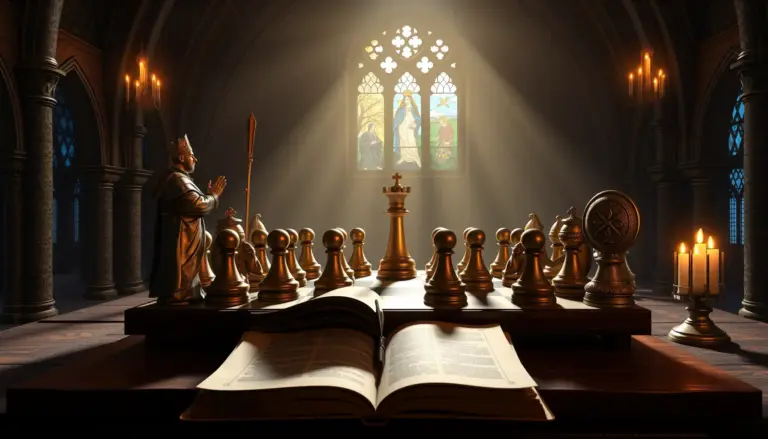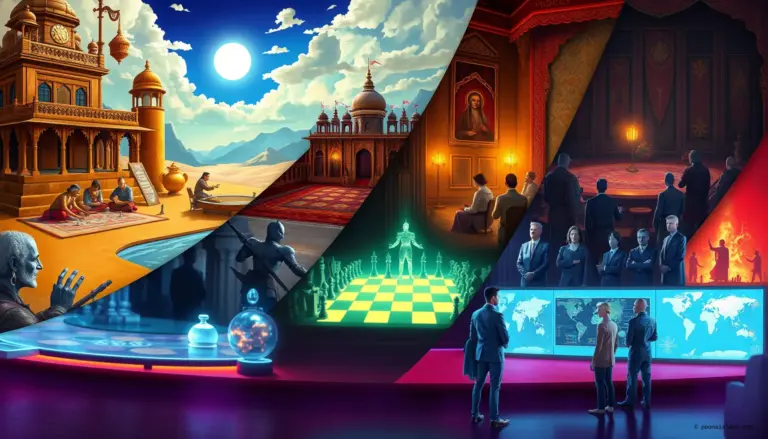
modern chess, with its standardized rules and its status as an elite mental sport, It is a legacy that transcends centuries and continents. However, few remember that its origin dates back to ancient India, where a game called Chaturanga laid the foundations of what we know today. Before Magnus Carlsen dominated the boards with his Norwegian genius, There was an almost mythical figure: indian chess, not as a simple hobby, but as a reflection of military strategy, the philosophy and culture of a civilization that saw in its pieces something more than wood or ivory. This article explores how the Chaturanga He was not only the precursor of chess, but also a symbol of power, intelligence and even spirituality in ancient India. From its roots in the armies of the Rajahs to its evolution in the hands of the Persians, Arabs and Europeans, we will find out why, long before Carlsen moved a pawn, there was a “hindu god” of chess.
The warlike roots of Chaturanga: a game born on the battlefield
He Chaturanga, whose name means “four divisions” in sanskrit, It emerged in India between the 6th and 7th centuries AD., although some theories place it even before, during the Gupta Empire (3rd-6th centuries). Unlike current chess, which is associated with the elegance of European salons, he Chaturanga It was a direct reflection of the war. Its four divisions—infantry (pawns), chivalry (horses), elephants (bishops) and cars (torres)— represented the military units of the Indian armies of the time. the king, of course, was the centerpiece, but his movement was limited, symbolizing the dependence of the monarch on his troops.
The fascinating thing about Chaturanga It wasn't just its mechanics., but its purpose. It was not just entertainment., but rather a training tool for military strategists. The ancient texts, like him Manasolasa (12th century), written by king Someshvara III, They describe how warriors used it to simulate battles and perfect tactics. It is even said that the game was so valued that the rajahs included it in the education of their children., along with the art of war, poetry and astronomy. This connection between the board and the battlefield explains why, in India, Chess was never seen as a trivial game, but as an extension of military intelligence.
A curious detail is that, in its beginnings, he Chaturanga it was played with dice, which added a component of chance. However, This practice was abandoned over time, possibly due to the influence of Indian religions such as Buddhism and Jainism, who rejected gambling. This marked a crucial turning point.: Chess stopped being a game of luck and became a duel of pure strategy, a change that would bring it closer to its modern form.
From India to Persia: how Chaturanga became Shatranj
He Chaturanga did not remain confined to India. Its expansion into Persia in the 7th century, during the reign of the Sassanids, It was a turning point in his evolution. The Persians, fascinated by the game, They adapted it to their culture and renamed it Shatranj. Although the basic rules remained, They introduced significant changes that differentiated it from its Indian version. For example, the queen (firzán) replaced royal advisor (mantri), although his movement was extremely limited: could only advance one square diagonally. The bishop, originally a war elephant, became a fil (elephant in Persian), but its movement also changed, allowing you to jump two squares diagonally.
He Shatranj It wasn't just a game, but a status symbol at the Persian court. The Sassanian kings, como Khosrow I, They were known for their passion for chess, and it is said that they even organized tournaments where the best players competed for prizes and honors.. One of the most famous stories is that of Buzurgmihr, a vizier of the 6th century who, according to legend, solved a chess problem sent by the king of India as a diplomatic challenge. This episode, collected in texts such as Shahnameh (Book of Kings) of Ferdousí, illustrates how chess became a cultural bridge between civilizations.
The arrival of Shatranj to Persia also marked the beginning of its diffusion to the Arab world. After the Muslim conquest of Persia in the 7th century, The Arabs adopted the game with enthusiasm, perfecting its rules and writing the first strategy treatises. It was in this context that the first chess masters emerged., as al-Adli y as-Suli, whose games and analysis laid the foundations of chess theory. Without the Persian adaptation, chess probably would not have reached Europe with the same force, underscoring Persia's crucial role as an intermediary between India and the West.
Chess as a mirror of Indian philosophy and spirituality
Beyond its military and strategic dimension, he Chaturanga was deeply intertwined with ancient Indian philosophy and spirituality. On a symbolic level, the board 64 squares represented the universe, with its cycles of creation and destruction. Vedic texts and treatises yoga They often compared life to a game of chess, where every movement was a lesson in karma and the dharma. He Mahabharata, one of the most important epic texts of India, He even mentions a dice game that sparks a war., a metaphor for how human decisions can have catastrophic consequences.
In it Chaturanga, each piece had a meaning beyond its function in the game. The pawns, For example, They symbolized shudra (the servant caste), while the king represented the brahman (the priestly caste), which reflected the social structure of India. This hierarchy was not accidental: chess served as an allegory of cosmic order, where each element had its place and purpose. Even today, some chess masters in india, like the great teacher Viswanathan Anand, They have talked about how the game has taught them patience, Discipline and the importance of long-term thinking, values deeply rooted in Indian culture.
Another fascinating aspect is the connection between chess and tantra, an esoteric tradition of Hinduism and Buddhism. In some tantric texts, the chess board is used as a meditation tool, where the pieces represent cosmic energies and their movement symbolizes spiritual transformation. This mystical dimension of chess is little known in the West, but in India, gaming has always been seen as more than just a hobby: It is a path to enlightenment.
The legacy of Chaturanga: How India shaped modern chess
Although modern chess has evolved significantly since its days as Chaturanga, his DNA is still Indian. The pieces we move today—the king, the tower, the horse, the bishop and the pawns—are direct heirs of the military divisions of the original game. Even the concept of “jack dead”, which comes from Persian shah mat (“the king is trapped”), has its roots in India, where the defeat of the king on the board symbolized the fall of a kingdom in battle.
One of the most important changes in the transition of Chaturanga to modern chess was the introduction of the queen as the most powerful piece, a change that occurred in Europe during the 15th century. This modification, possibly inspired by figures such as Queen Isabel I of Castile, transformed the game into a more dynamic and aggressive battle. However, Even this change has an echo in India: in some regional variants of the Chaturanga, like him Chaturaji (a game for four players), there were feminine pieces with broader movements, suggesting that the idea of a powerful queen was not entirely foreign to Indian culture.
Hoy, chess is a global sport, with millions of players around the world. However, His story in India remains a reminder that, before Magnus Carlsen dominated the boards, There was a civilization that saw something sacred in this game. He Chaturanga He was not only the precursor of chess, but also a testimony of how ancient India combined strategy, philosophy and art on a board 64 casillas. In a world where chess is increasingly associated with algorithms and computers, Remembering your human and spiritual origins is an act of reconnecting with your deepest essence..
chess, in its purest form, remains a reflection of the human mind: complex, creative and, ultimately, unpredictable. And it all started with a game that the ancient Indians created not only for entertainment, but to understand the world.
Conclusions: chess as a bridge between the past and the present
The history of Chaturanga It is much more than a story about the origin of a game. It is a window to ancient India, where military strategy, philosophy and spirituality were intertwined in a board that transcended the playful. Before Magnus Carlsen became the “Mozart of chess”, There was a civilization that saw in this game a reflection of the universe, a tool for war and a path to enlightenment. He Chaturanga not only did he lay the foundations of modern chess, but also reminds us that, in its essence, The game has always been a dialogue between the human mind and the forces that govern life.
Hoy, when we see players like Viswanathan Anand or Rameshbabu Praggnanandhaa representing India on the global stage, we are not just witnessing a sports competition, but the continuation of an ancient tradition. chess, on their journey from the battlefields of India to the elite tournaments of the 21st century, has retained its ability to challenge, inspire and connect cultures. Maybe, in a world increasingly dominated by technology, The true value of chess lies in its humanity: in his ability to teach us that, in the end, every move is a decision, and every game, a lesson.
So the next time you move a pawn or capture a rook, remember that you are participating in a game that has survived empires, It has crossed continents and been touched by the hand of gods and kings. Chess is not just a game; It's a legacy, and its story began in India, long before Carlsen was born.