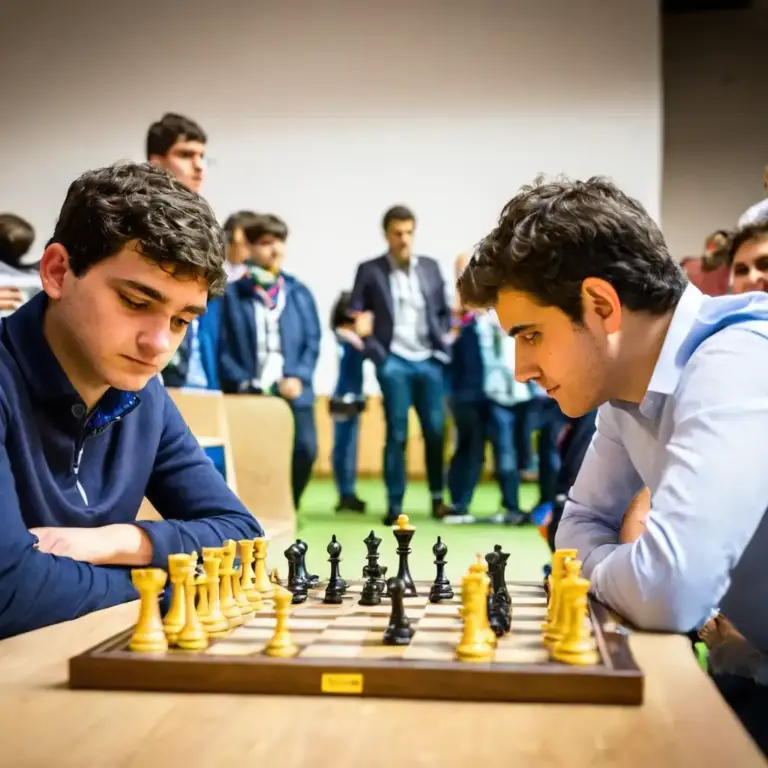
Imagine sitting in a tournament room, surrounded by players, like you, They have spent hours perfecting their strategy. The air is charged with tension, but also with an almost palpable curiosity: who will be your next rival? In Swiss tournaments, That question is not answered randomly.. Behind each pairing there is a mathematical algorithm that, like a chess within chess, decide the fate of your games. Reading and understanding Swiss round pairs is not just a technical skill; is to decipher the code that structures competition, anticipate challenges and, above all, prepare to turn each game into an opportunity for growth. This system, apparently cold, is actually a reflection of how chess balances rigor and fairness, where every move on the board begins long before the pieces touch.
The Swiss system: more than a method, a philosophy of competition
The Swiss system is not a modern invention, but a pragmatic solution born in the 19th century to solve an eternal problem: how to organize tournaments with many participants without chance dictating the results. Its creator, the Swiss Julius Müller, I was looking for a format that would allow players to face rivals of a similar level, avoiding early eliminations and ensuring that each game was relevant. Unlike direct elimination tournaments, where a mistake can mean immediate exit, the Swiss system rewards consistency. Here, a defeat does not exclude you; relocates you to a new strategic context, forcing you to adapt and improve.
The key to the system lies in its pairing algorithm, which follows three fundamental principles: score proximity, color alternation y avoid repetitions. In the first round, The players are ordered by rating (or randomly if they don't have it), and they match from top to bottom. From the second round, The system groups the participants into “bands” of similar score. For example, if in a round you have 2 points of 3 possible, you will compete against someone with 1.5 o 2.5 points, never against someone with 0 o 3. This mechanism not only ensures equity, but also creates a competitive narrative: Each game is a link in a chain of progressive challenges.
However, the Swiss system is not infallible. Its greatest virtue—flexibility—can also be its Achilles heel.. In tournaments with few participants or rounds, some players may benefit from matchups “soft” if the algorithm does not have enough options to balance colors or avoid repetitions. That's why, Understanding how it works is crucial to prepare fully for a tournament, not only from the technical point of view, but also from the psychological. Know that your next opponent could be someone with an aggressive or positional style, depending on how the scoring bands have been moved, allows you to fine-tune your repertoire of openings and strategies.
Decoding the pairs: how to interpret key information
When the pairs of a round are published, They are often presented in a format that may seem cryptic to the uninitiated.. However, each column in that table is a valuable piece of information. The typical structure includes: round number, table number, player name with white, player name in black, rating of both and, in some cases, the result of the game if it has already been played. But there are details that go beyond the obvious..
One of the most important aspects is the color assignment. In the Swiss system, The algorithm prioritizes each player alternating between white and black as much as possible. If in the previous round you played white, It is likely that in the next one you will have black, although this may vary if there are imbalances in the score. This detail is crucial for your preparation: if you know you will have black, you can review openings such as the Sicilian Defense or the King's Indian, while if you get white, you could focus on the Queen's Gambit or the Italian Opening. The importance of center control in these openings cannot be underestimated, since it defines the tone of the game from the first moves.
Another key element is the rating del rival. Although the Swiss system seeks to match players of similar level, Rating differences can give you clues about your opponent's playing style. A rival with a significantly higher rating could opt for complex theoretical lines, while one with a lower rating might depend on solid but predictable structures. This information allows you to adjust your strategy: Should you risk a sharp variation or keep the game on familiar ground?? Here, the tactical vision becomes essential, since even in balanced positions, a tactical error can tip the balance.
Finally, pay attention to the previous results of your rival. If you have won your last games, he is likely to arrive with confidence and a sharp repertoire. And, on the contrary, comes from a defeat, could be more prone to mistakes or playing conservatively to recover. This type of psychological analysis is as important as the technical one., and can make a difference in tight games. In this sense, chess is not just a game of pieces, but also of minds, where the chess psychology plays a determining role.
Strategies to take advantage of the Swiss system to your advantage
The Swiss system is not an enemy, but an ally if you know how to use it. One of the most effective strategies is manage your energy. In the first rounds, when the matchups are more balanced, It is tempting to seek victory at all costs. However, in long tournaments, an early defeat can be less harmful than physical and mental exhaustion. Play solid games, without risking too much, allows you to stay in the right scoring band to face stronger opponents in later rounds.
Another key tactic is adapt your repertoire according to the flow of the tournament. If you notice that many of your rivals choose similar openings, you can prepare specifically to counter them. For example, if several players use the Sicilian Defense, Studying variants like Alapin Attack or Dashing Dragon can give you a theoretical advantage. This ability to adapt is what differentiates players who simply “they play” of those who compete. In this process, tools like free tools to analyze games They can be invaluable, allowing you to quickly review your rivals' games and adjust your strategy.
It is also essential control the pace of the tournament. In the middle rounds, when matchups get more competitive, It is common for players to face opponents with very different styles. Here, versatility is key. If your opponent is a positional player, You could opt for a dynamic opening that takes you out of your comfort zone. And, on the contrary, He is a born tactician, a solid structure without weaknesses may be the best option. This approach requires not only theoretical knowledge, but also a deep understanding of your own playing style and how to exploit the weaknesses of others.
Common mistakes (and how to avoid them)
Even experienced players make mistakes when interpreting Swiss round pairs. One of the most frequent is get obsessed with the rating. It is easy to fall into the trap of underestimating a rival with a lower rating or, on the contrary, feel excessive pressure from someone with a higher rating. The rating is just a number; what really matters is how you play on the board. A player with a rating of 1800 can have an exceptional day and defeat one of 2200, especially if the latter underestimates the challenge.
Another common mistake is ignore tournament context. For example, in the last rounds, when matchups become more critical, Some players focus so much on their own score that they forget to analyze the overall situation.. If you are in the fight for the top positions, some opponents may play more conservatively to secure a draw, while others will risk everything for a victory. Knowing how to read these dynamics allows you to adjust your strategy accordingly. In this sense, the mindfulness practice can be useful for staying calm and making objective decisions in times of high pressure.
Finally, many players fall into the trap of prepare only for the openings. While it is important to have a solid repertoire, The Swiss system rewards those who can adapt to different types of positions. An opponent can deviate from the theory in the move 10, and if you are not prepared to play unbalanced positions or complex endings, your initial preparation will have been in vain. That's why, it is crucial to spend time studying chess endings, where many games are decided in Swiss tournaments.
The Swiss system as a metaphor for life
Beyond its practical function, The Swiss system is a powerful metaphor for how we face challenges in life. Just like in a tournament, In life we don't always choose our rivals, but we can choose how to prepare for them. The Swiss system teaches us that success does not depend on a single game, but the ability to adapt, learn from each experience and keep moving forward, even after a defeat. Every pairing is an opportunity to grow, to try new strategies and to discover facets of ourselves that we did not know.
Besides, The Swiss system reflects the importance of equity. In a world where luck or connections are often rewarded, This format ensures that each player has the same opportunities to prove themselves. It doesn't matter if you are a beginner or a grandmaster; the system places you against rivals of your level, allowing you to compete on equal terms. This philosophy is applicable to many aspects of life., where justice and meritocracy are increasingly scarce values.
Finally, The Swiss system reminds us that chess, in essence, it's a game of patience and perseverance. It's not about winning every game., but to play each one with the greatest concentration and determination possible. As the great teacher Savielly Tartakower said: “Chess is the art of analysis”. And in the Swiss system, Every analysis begins long before the pieces move, in the careful reading of the pairs of rounds and in the meticulous preparation that follows.
In the end, Understanding Swiss round pairs is not just a technical skill, but a way to honor the spirit of chess. It is recognizing that each game is a link in a larger chain, where the real prize is not just the trophy, but the personal growth that arises from each challenge. The next time you see the pairs of a round, don't look at them as a simple matchup list. look beyond: They are the map of a journey, the invisible board where the real game is played.