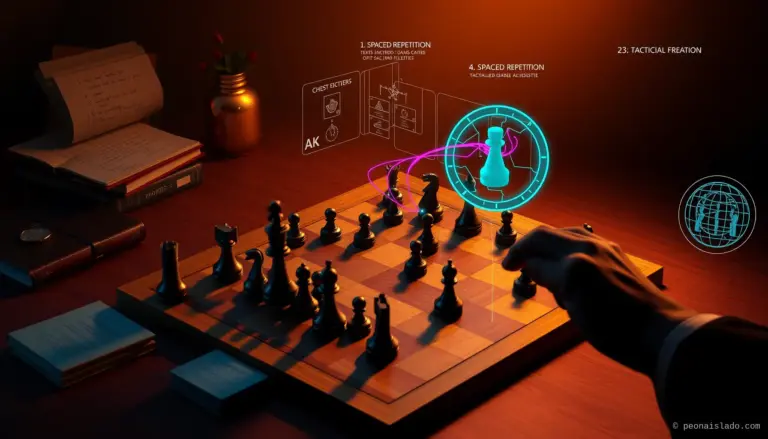
Imagine a board where each move is a verse from an epic poem, where the king is not just a target, but a symbol of resistance, and the pawns, those anonymous soldiers, They keep in their progress the very essence of learning. chess, in its final phase, becomes a laboratory of memory: here, each position is an enigma that requires not only calculation, but also a deep understanding of patterns that repeat like stanzas in a symphony. But, How to study these endings without falling into the monotony of mechanical repetition? The answer is not in memorizing plays, but in deciphering the hidden language of the board, where logic intertwines with creativity and memory is fed with meaning.
The problem is not a lack of resources—books, databases, analysis engines—but the disconnection between the study and the live experience of the game. When endings are reduced to abstract exercises, they lose their magic: the tension of a lonely king against a tower, the elegance of a pawn that crowns at the last moment, or the subtlety of a zugzwang that paralyzes the rival. These moments, that define entire games, They are also life lessons: teach patience, anticipation and the ability to see beyond the obvious. But to internalize them, we must transform the study into an intellectual adventure, where each position is a personal challenge and each mistake, an opportunity to deepen understanding.
Memory in chess: beyond repetition
Memory in chess is not a store of moves, but a dynamic system of connections. Grandmasters do not remember complete games like someone who recites a poem by heart; instead, recognize patterns, like a musician identifying chords in a complex melody. A study from the University of California revealed that expert chess players activate brain regions associated with spatial perception and decision making, not only with pure memory. This explains why, when facing a rook ending, an advanced player “ve” the solution as a whole, while a beginner gets lost in isolated variants.
The most common mistake when studying finals is trying to memorize them as if they were mathematical formulas. However, true mastery comes when you understand the underlying logic. For example, the king and pawn against king ending is not resolved by repeating “the king must go before the pawn”, but understanding why that position is a winner: the defending king cannot cover all critical squares at the same time. This understanding transforms passive knowledge into an active tool., applicable to similar but not identical situations.
To train this memory “intelligent”, It is useful to resort to methods that combine repetition with reflection. An effective technique is reverse analysis: instead of resolving an ending from the starting position, you start from the solution and go back, wondering at every step “why is this move the right one?”. This approach, recommended in the guide to calculating variants like a grandmaster, forces the brain to process information critically, not mechanical.
The art of turning study into play
Boredom in the study of finals arises when we lose sight of its playful dimension. chess, in its essence, It's a strategy game, and as such, It must be approached with the same curiosity with which a child explores a labyrinth.. One way to revitalize learning is through gamification: transform exercises into challenges with symbolic rewards. For example, assign points for solving finals in under a minute or compete against yourself to improve resolution time. Platforms like Lichess already incorporate this philosophy, but the true value is in adapting it to individual needs.
Another strategy is thematic study, where endings are grouped by concepts instead of by pieces. Instead of dedicating a session to “bishop endings”, you can explore the topic of “king's activity”, analyzing how this piece, apparently weak, becomes a decisive factor in endings such as king and rook against king and rook. This approach, defended by coaches like Josef Pribyl, allows you to see chess as an interconnected system, where each concept reinforces each other.
Creativity also plays a key role. Imagine that you are studying the ending of two bishops against king. Instead of just repeating the standard technique, you might ask: “What if the defending king was in a different corner? Or what if the bishops were opposite colors??”. These variations, although they are not practical in real games, sharpen adaptive capacity and reinforce understanding of fundamental principles.
The science behind effective learning
Neuroscience has shown that the brain learns better when information is presented in varied contexts and with an emotional component.. This explains why remembering an exciting tournament game is easier than memorizing a list of theoretical endings.. To apply this principle to the study of finals, It is useful to use techniques such as spacing and the intercalation.
Spacing consists of distributing study sessions over time, instead of concentrating them in a single day. For example, devote 20 late minutes daily for a week is more effective than a two-hour marathon session. This method takes advantage of the spacing effect, a phenomenon whereby the brain consolidates information better when it is reviewed at increasing intervals.
The intercalation, for his part, involves mixing different types of endings in the same session. Instead of studying just pawn endings for an hour, can be alternated with rook or bishop endings. Although this may cause initial confusion, Studies such as those carried out by psychologist Robert Bjork show that this technique improves long-term retention, since it forces the brain to discriminate between similar concepts.
A valuable resource to implement these techniques is routine 30 minutes based on science, that proposes a balanced study scheme, combining theory, practice and review. This structure not only optimizes time, but also prevents mental fatigue, a common enemy in finals study.
The role of technology: ally or distraction
In the digital age, finals study has found an ally in technological tools, but also a risk: passive dependence on analysis engines. Programs like Stockfish or Lc0 can resolve any position in seconds, but if they are used without criteria, can stunt the ability to think independently. The true value of technology is in its ability to facilitate active learning.
For example, chess modules can be used to generate custom exercises, adjusted to the player's level. If you are learning pawn endings, you can configure the engine to only show positions where the pawn is about to promote, or where the defending king has draw options. This customization turns the engine into a virtual trainer, tailored to your specific needs.
Another useful application is the analysis of own items.. When reviewing an ending you have played, you can compare your decisions with those of the engine, but with a critical approach: “Why did I choose this move instead of the one recommended by the engine? What principles did I overlook??”. This exercise, detailed in the guide to analyzing games, transform mistakes into learning opportunities.
However, It is crucial to remember that technology is a tool, not a substitute for human thought. As the article warns about how modules redefined chess, Excessive use of motors can lead to a mentality of “quick fix”, where memorization is prioritized over understanding. To avoid this, It is advisable to alternate study with motors with blind play sessions or with time limitations, where intuition and creativity are the protagonists.
Endings as metaphors of life
Chess endings are not just technical exercises; They are also mirrors of the human condition. in them, values such as perseverance are reflected (a pawn that advances against all odds), patience (wait for the right moment to act) or resilience (recover from a mistake and find a new opportunity). These lessons transcend the board and apply to everyday situations, from conflict resolution to decision making under pressure.
A classic example is the king and rook versus king ending., where the technique to win involves cutting the defending king into smaller and smaller lines. This process, known as “ladder checkmate”, It is a metaphor for how complex problems are solved by breaking them down into manageable parts.. In the same way, in life, Overwhelming challenges become more accessible when approached step by step, with a clear plan and disciplined execution.
Another revealing ending is bishop and pawn against bishop of opposite color, where theoretical table positions are often reached. Here, the lesson is not only technical, but also philosophical: There are situations in which, no matter how hard you try, you can't force a result. Learning to recognize these moments—both in chess and in life—is an invaluable skill., which avoids unnecessary wear and tear and allows energy to be concentrated on what can really be changed.
These connections between chess and life are explored in depth in the article on lessons to make better decisions, which analyzes how the principles of the game can be applied to contexts as diverse as business, personal relationships or time management. When studying finals, not only do you improve in chess, but also cultivate transferable skills to other areas.
The study of chess endgames is, ultimately, a journey of self discovery. It's not just about learning to win games, but to develop a more structured way of thinking, creative and resilient. memory, in this context, It is not an end in itself, but a means to access a deeper level of understanding, where each position becomes a story and each movement, in a chapter of that narrative.
To avoid boredom, We must remember that chess is a game, and as such, must be approached with curiosity and passion. Finals are not obstacles on the path to mastery, but doors to a world of strategic and creative possibilities. By integrating science-based study methods, technological tools and a playful mentality, it is possible to transform memorization into meaningful learning, and learning in an enriching experience.
So the next time you face a rook ending or a passed pawn, don't see it as a boring task, but as an opportunity to explore the limits of your mind. Because in chess, like in life, what really matters is not the destination, but the path taken to get there.