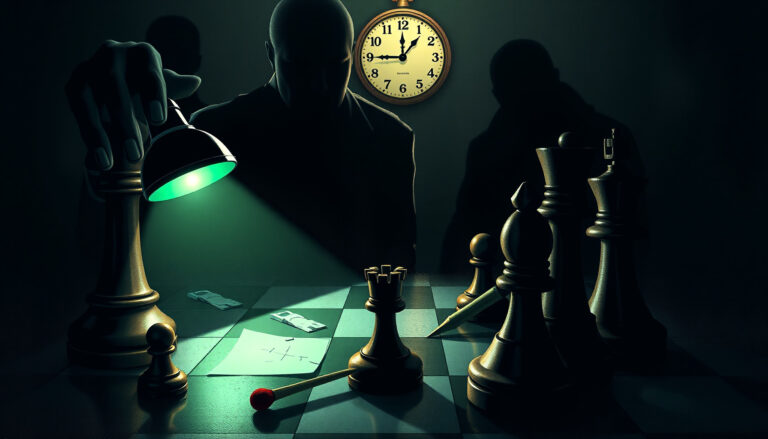
The silence in a tournament room is so thick that the creak of a Staunton When it lands on the board it resonates like an echo in the minds of the players. Beyond memorized openings or calculated endings, There is an invisible code that governs every movement: the label. It's not just about written rules, but of a non-verbal language that distinguishes the amateur from the serious competitor. In this scenario, where each gesture can be interpreted as a signal or a provocation, Mastering the unwritten rules is as crucial as knowing the origin of chess or the strategies of the great masters. Here, elegance is not an ornament, but a tool of power.
The board as sacred space: rituals that precede the game
Before the referee pronounces the phrase “White plays and wins”, the board has already spoken. The arrangement of the parts, the clock setting and even the player's posture reveal more than any words. In face-to-face tournaments, The first act of courtesy—and strategy—is to verify that the board is correctly oriented: the white square must be to the player's right. This detail, seemingly trivial, avoid confusion in quick games and show respect for your opponent. But there is more: The order in which the pieces are placed is not random. Experienced players start with pawns, then the towers, horses and bishops, saving the queen and king for last, as if they were pieces of a ritual. This gesture not only reflects concentration, but also the understanding that chess, in its essence, It is a dialogue between two minds.
The clock, that implacable judge, It also requires its own protocol. Adjusting it before starting the game is not just a matter of precision, but of equity. A poorly configured clock can alter the pace of the game, especially in modalities such as blitz chess, where every second counts. Besides, in tournaments with increased time, like the famous “Fischer Random”, This detail becomes even more relevant.. Etiquette here is not just formality: It's the difference between a fair game and calculated chaos.
Silence as a weapon: when words are unnecessary
in chess, silence is not absence of communication, but its purest form. a sigh, A sudden movement or even the creaking of a chair can be interpreted as psychological signals. The great teachers know it: in the duel between Karpov and Kasparov, Every gesture off the board was analyzed with the same intensity as the plays on it.. Kasparov, For example, He was known for his penetrating gaze, capable of intimidating rivals before they moved a piece. But etiquette demands restraint: Staring at your opponent for more than a few seconds is considered disrespectful., almost an invasion of the rival's mental space.
The use of language is also regulated. Phrases like “You're sure?” o “That's a mistake” are prohibited, not only by FIDE rules, but for common sense. Even a simple “check” spoken out loud can be misinterpreted as a provocation. instead, players resort to universal gestures: touch a piece to indicate that it is going to move, or raise your hand to call the referee without breaking the opponent's concentration. This non-verbal language is not instinctive; you learn with practice, How to learn to calculate variants or manage time on the clock.
The art of losing (and win) with dignity
The most critical moment of a tournament is not always checkmate, but what comes after. Squeezing your opponent's hand at the end of the game is a gesture that transcends courtesy: is the mutual recognition that, beyond the result, both have participated in an act of intellectual creation. However, the label at this point is subtle. A handshake that is too firm can be seen as mockery., while a weak one denotes lack of conviction. The key is in balance, in transmitting respect without submission.
But what happens when defeat hurts?? This is where the label becomes a shield. Congratulate your rival sincerely, even in defeat, It's not hypocrisy, but maturity. Bobby Fischer, in his legendary victory over Boris Spassky in 1972, He showed that greatness is not just about winning., but in how you win. Fischer avoided any gesture of superiority, limited to a handshake and a brief “good game”. Instead, in modern chess, Some players have fallen into the trap of celebrating excessively, as if the board were a football stadium. This behavior is not only frowned upon, but rather reveals a lack of understanding of the spirit of the game.
The defeat, on the other hand, requires its own protocol. Analyze the game immediately after losing, especially in the presence of the rival, can be interpreted as a lack of sportsmanship. The correct thing to do is to wait until both players have left the game room.. Here, technology has changed the rules: hoy, Many players record their games with applications such as free tools to analyze games, but even in this case, discretion is key. Sharing analysis on social networks before your rival does so can be seen as a lack of elegance.
The clock and time: the invisible battle
Time in chess is not just a resource, but a psychological battlefield. Watch etiquette is perhaps one of the strictest and least understood.. For example, pressing the watch hard after each movement is not only unnecessary, but it can be interpreted as a tactic to distract the rival. The correct thing is to do it gently, as if the watch were a delicate instrument. Besides, in games with increased time, some players try “steal” seconds by not pressing the watch immediately after moving. This practice, although it is not explicitly prohibited, It is considered in bad taste.
Another crucial aspect is time management during the game.. Being left with only a few seconds on the clock is no excuse to move hastily or, even worse, to leave the table without warning. In serious tournaments, even in difficult situations, the player must maintain composure. The referee is there to ensure that the rules are followed, but etiquette requires that the player not abuse his patience. In classical chess, where games can last hours, this time management is even more critical. A player who constantly gets up from the table, who drinks water excessively or stares at an opponent may be sanctioned for unsportsmanlike conduct.
The referee: key shadow figure
The referee in a chess tournament is not just an applier of rules, but a keeper of etiquette. His presence is discreet, but his authority is absolute. For example, in games where the use of chess modules for post-game analysis is allowed, the referee must ensure that these do not interfere with the development of the game. In face-to-face tournaments, the use of electronic devices is strictly prohibited, and the referee has the power to disqualify a player if he suspects that he is receiving outside help.
But its role goes beyond the technical. A good referee knows when to intervene and when to let the players resolve their differences.. For example, If a player claims a tie by triple repetition, the referee must verify the position without altering the rhythm of the game. In cases of disputes, his word is final, and his ability to remain calm in tense situations is what ensures the tournament goes off without incident. The relationship between players and referees is, in many ways, a reflection of the relationship between chess and society: a balance between rules and freedom.
Conclusion: the label as a mirror of the chess soul
In-person tournament etiquette is not an arbitrary set of rules, but the tangible manifestation of what chess represents: a strategy game, Yeah, but also respect, patience and self-control. In a world where immediacy and impulsiveness seem to dominate, chess offers an oasis of reflection, and etiquette is your code of honor. Beyond the openings, gambits or endings, What really distinguishes a player is not just his technical ability, but his ability to move elegantly on and off the board.
The next tournament you attend won't just be a test of your tactical prowess, but also your ability to navigate the complex network of gestures, silences and protocols that define chess as an art. and remember: on the board, like in life, The true victory is not always the one celebrated with a trophy, but what is earned with dignity. If you want to delve deeper into how to prepare for your first tournament, don't stop reading our complete guide to debut, where you'll find practical tips to take your experience to the next level.