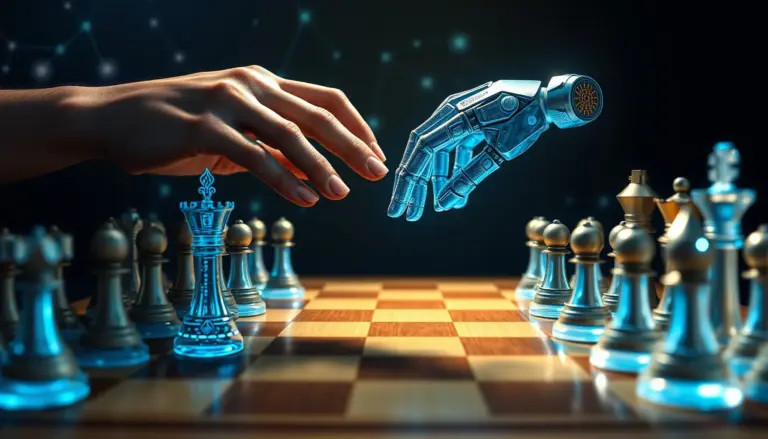
In a world where political decisions, economic and social seem to be taken in inaccessible halls of power, a disturbing question arises: Is there a select group that, from the shadows, shape global destiny through chess? The idea of a “secret chess club” where the planet's directions are decided is not new, but it gains strength when the connections between influential figures are analyzed, geopolitical strategies and the ancient symbolism of this game. Beyond fiction, there are historical clues, Behavioral patterns and theories that suggest chess could be much more than a hobby: a coded language for the elite. In this article, We will explore the origins of this hypothesis, the evidence that supports it, the hidden mechanisms behind its possible operation and the implications it would have for society if such a club existed.
Chess as a tool of power: more than a game
Chess is not just a mental sport; It is a system of thinking that has been used for centuries to teach strategy, patience and long-term vision. Its origin dates back to the 6th century in India, where *chaturanga* served as a battle simulator for kings and generals. Over time, the game expanded to Persia, the Arab world and Europe, adapting to each culture but maintaining its essence: the representation of a conflict where each piece has a specific role and victory depends on anticipating the opponent's movements.
What few know is that, since the Middle Ages, chess has been linked to circles of power. At the court of European kings, as Philip II of Spain o Louis XIV of France, Playing chess was an activity reserved for the nobility and their closest advisors.. It wasn't just about entertainment., but rather an exercise in decision-making under pressure. Historical documents, like the letters of the Venetian ambassador Marino Sanuto, describe how rulers used the board to discuss alliances and wars without raising suspicions.
In the 20th century, This connection became even more evident. During the Cold War, Chess became a symbolic battleground between the United States and the Soviet Union. The duel between Bobby Fischer y Boris Spassky in 1972 It wasn't just a world championship, but an ideological confrontation where each movement on the board reflected geopolitical tensions. According to the historian David Shenk, author of “The Immortal Game”, “Chess was a perfect metaphor for the Cold War: two superpowers measuring forces in a controlled space, where every mistake could have global consequences”.
But, why chess and not another game? The answer lies in its structure. Unlike poker, where chance plays an important role, or the bent ajedrez (*xiangqi*), which has more local rules, western chess is universal. His language is clear: each piece has a value and a function, and victory depends on the ability to foresee multiple scenarios. This makes it an ideal system for discussing complex strategies without the need to reveal explicit intentions.. As the great teacher said Garry Kasparov: “Chess is life in miniature. If you understand the board, you understand the world”.
The signs of a secret club: connections between chess and global elites
The idea that a select group uses chess to make global decisions is not far-fetched if you analyze the connections between elite players., magnates and political leaders. One of the most documented cases is that of Club Bilderberg, an annual gathering of influential figures who, according to his critics, discusses key issues for the future of the world. The curious thing is that, among his assistants, There is a notable presence of chess players and game enthusiasts.
For example, in 2016, the then CEO of Google, Eric Schmidt, participated in a live chess game during a technology conference. Schmidt, known for his love of gambling, He has stated in interviews that chess taught him “think in systems” already “anticipate competitor moves”. Another case is that of Peter Thiel, co-founder of PayPal and one of the most influential investors in Silicon Valley, who has financed chess tournaments and expressed admiration for the game's ability to develop strategic thinking. Thiel, besides, is a member of Steering Committee del Club Bilderberg.
But the connections go beyond technology. In the political sphere, figures like Henry Kissinger —architect of American foreign policy during the Cold War—have recognized the value of chess as a negotiation tool. in his book “Diplomacy”, Kissinger compares international relations to a game of chess, where each movement must be calculated based on the possible responses of the opponent. In fact, Kissinger is known to have played games with leaders like Mikhail Gorbachev y Anwar Sadat, not just as a hobby, but as a way to establish trust and test strategies in a neutral environment.
Another clue comes from chess tournaments sponsored by large corporations.. Companies like Gazprom, Renaissance Technologies (the most successful hedge fund in the world) y JPMorgan Chase They have invested millions in chess events. Because? According to the economist Nassim Nicholas Taleb, “Chess attracts people who think in terms of probabilities and risks, something essential in financial markets”. But there is a darker theory: These tournaments could serve as a meeting point for figures who, under the guise of a sporting event, They discuss sensitive topics without attracting attention.
A concrete example is the Linares Chess Tournament, held in Spain between 1978 y 2010. This event, considered the “Wimbledon of chess”, was sponsored by the banker Luis Rentero, who had ties to international banking and the world of politics. According to the journalist Leontxo García, “Linares was not just a tournament, It was a place where economic and geopolitical interests intersected”. On one occasion, the then president of the World Bank, James Wolfensohn, attended as a special guest and played a game against the champion Vladimir Kramnik. Coincidence or a sign that chess is a bridge between financial and political power?
The hidden language of chess: codes and symbolism in decision making
If chess is used as a tool by the elites, how do they communicate through it? The answer could be in the symbolic codes that the game allows. Unlike a direct conversation, where intentions are explicit, chess offers a system of indirect communication, where every movement can convey a message without the need for words.
A historical example is Match of the Century of 1972 between Fischer and Spassky. During the game, Fischer performed unconventional moves, how to sacrifice a pawn in the opening, something that analysts interpreted as a provocation. However, Some historians suggest that these movements could have been a way of sending signals to third parties.. According to the writer Fred Waitzkin, author of “Searching for Bobby Fischer”, “Fischer not only played against Spassky, but he was communicating something to the CIA, to the KGB or even Wall Street”.
This type of communication is not exclusive to chess. in diplomacy, board games have been used such as go or the bridge to discuss sensitive topics. But chess has an advantage: its hierarchical structure. Each piece represents a specific role (the king as central figure, the queen as mobile power, pawns as sacrificial resources), which allows simulating real scenarios. For example, A rook sacrifice could be interpreted as a willingness to give up an important asset in exchange for a long-term strategic advantage..
Another key aspect is the time. in chess, the clock sets the pace of the game, and each player must manage their time efficiently. This reflects the pressure under which global leaders operate., where decisions must be made within tight deadlines. In 1984, during the World Chess Championship between Anatoly Karpov y Garry Kasparov, The game was suspended after 48 games without a clear winner. Some analysts suggested that this prolongation was a metaphor for the stagnant Cold War., where no superpower could prevail over the other.
But the symbolism goes beyond the pieces and time. The board itself can be a representation of the world. In the theory of geopolitical chess, proposed by the strategist Zbigniew Brzezinski, Each square on the board represents a country or region, and movements reflect alliances and conflicts. Brzezinski, national security advisor Jimmy Carter, argued that “the world is a chess board, and great powers must anticipate the movements of their adversaries to maintain balance”. This vision has been adopted by think tanks such as the Council on Foreign Relations, where chess simulations are used to analyze international crises.
Could this symbolism extend to a secret club? Is plausible. If an elite group used chess to discuss strategies, Each game would be a miniature representation of a real conflict. An aggressive move by the queen could symbolize military intervention, while a castling (defensive move) could indicate the intention to protect an economic interest. The most intriguing thing is that, being a game, These discussions could be framed as simple games, thus avoiding any official registration.
The implications of a secret club: global control or paranoia?
The existence of a secret chess club that makes global decisions raises uncomfortable questions. Are we facing a real conspiracy or simply a theory that exploits the fear of hidden power? To answer, It is necessary to analyze the possible implications from two perspectives: that of those who believe in its existence and that of those who discard it as a fantasy.
From the point of view of the defenders of the theory, A club of this type would have clear advantages for its members. First of all, chess provides a neutral language to discuss sensitive topics. In a world where communications are monitored and official meetings are recorded, a chess board offers a space where ideas can flow without leaving a trace. As the philosopher said Walter Benjamin, “chess is the game of secrets, because there are no words in it, only actions”.
In second place, chess encourages systems thinking, essential for large-scale decision makers. Great teachers don't just think about their next move, but on how that move will affect the game in five, ten or twenty plays. This ability to anticipate is crucial in geopolitics., where a decision in one country can have global repercussions. For example, the Cuban missile crisis 1962 was resolved thanks to John F. Kennedy and his advisors anticipated the possible responses of the USSR, something that, according to some historians, was influenced by his training in strategy games such as chess.
However, Critics argue that this theory falls into the confirmation bias: the tendency to interpret isolated events as part of a larger pattern. For example, The fact that Kissinger played chess with Gorbachev does not prove that a secret club existed, but simply that two leaders shared a hobby. Besides, They point out that chess is too public a game to be used as a conspiracy tool. Tournaments like World Championship or the Grand Chess Tour are broadcast live and analyzed by millions of people, which would make any attempt to hide messages difficult.
Another argument against is lack of concrete evidence. Despite the signs, there is no document, recording or testimony confirming the existence of a secret chess club. Defenders of the theory respond that, precisely because of its hidden nature, it would be impossible to find direct evidence. But this also makes it a hypothesis not falsifiable, that is to say, impossible to refute, which brings it closer to speculation than reality.
So, where is the truth? Probably somewhere in between. It is unlikely that there is a “secret club” in the strict sense of the word, with scheduled meetings and official members. But it is plausible that influential figures use chess as an informal tool to discuss strategies., make connections and test ideas in a safe environment. In this sense, chess would be less an instrument of global control and more a power network facilitator.
The implications of this are profound.. If chess is used by elites to shape decisions, so his influence goes beyond the board. It could explain why certain patterns repeat themselves in politics and economics.: financial crises that benefit a few, wars that seem to follow a predetermined script, or alliances that emerge “casual”. As the writer said George Orwell in “1984”, “power is not a means, It is an end in itself”. And if chess is a tool of that power, So understanding it is key to deciphering how decisions that affect the world are made..
In the end, The question is not so much whether there is a secret club., but what can we learn from the connection between chess and power. If the game is, as many claim, a reflection of life, So studying it allows us to better understand the unwritten rules that govern the world. Whether as a metaphor, tool or simple hobby, Chess continues to be a mirror of the strategies that shape our destiny.
The idea of a “secret chess club” where global decisions are made may sound like a spy novel plot, but, as we have seen, is backed by historical connections, behavioral patterns and symbolism inherent to the game. From the Middle Ages to the Cold War, Chess has served as a coded language for the elite, a space where strategies are discussed without the need for words. The evidence, although circumstantial, They are too numerous to ignore: figures like Kissinger, Thiel or Schmidt not only play chess, but they see it as an essential tool for strategic thinking.
However, It is important not to fall into reductionism. Chess is not an instrument of absolute control, but a facilitator of influence networks. There is not a “club” with official membership, but an ecosystem where the game acts as a bridge between political power, economic and military. In this sense, The true value of chess lies in its ability to teach systems thinking., to anticipate consequences and make decisions under pressure. These skills are universal, and those who master them have a clear advantage in any field.
For the common citizen, This raises an awkward question.: if the rules of the game are written by those who control the board, how can we participate in it? The answer is not to look for conspiracies, but in understanding the dynamics of power. Chess teaches us that, even in a seemingly rigid system, there is room for creativity and resistance. As he said Emanuel Lasker, world champion during 27 years: “in chess, like in life, the most dangerous adversary is oneself”.
Ultimately, the mystery of “secret club” it's not so much if it exists, but what can we learn from it. Chess is a reminder that global decisions are rarely the product of chance., but of carefully calculated strategies. And if we want to change the course of the game, We must first understand its rules.