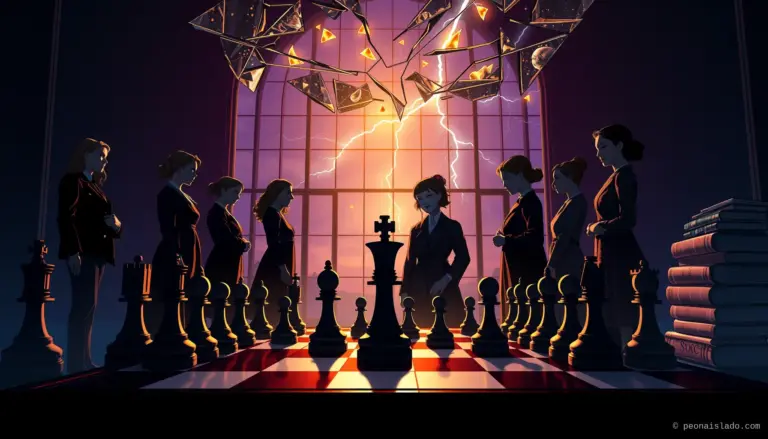
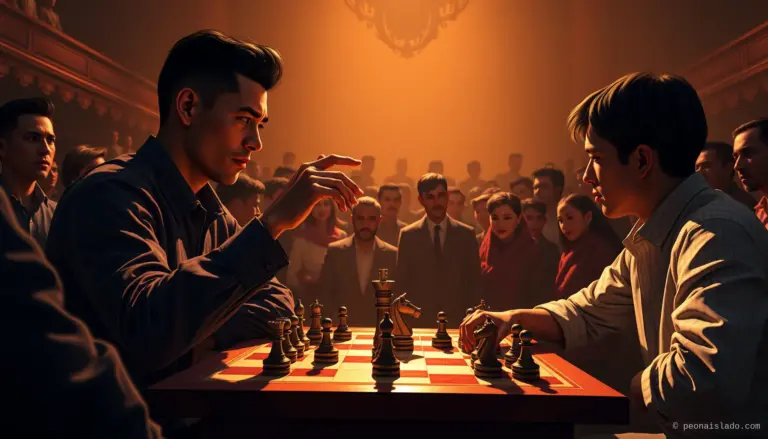
The board became a battlefield where not only wooden pieces moved, but ideologies, egos and the future of chess itself. The rivalry between Anatoli Karpov and Garry Kasparov It was not a simple duel of titans; It was an earthquake that redefined the limits of strategy, psychology and even politics in the science game. For more than a decade, These two giants faced each other in games that transcended sport to become symbols of an era.: the cold war in 64 casillas. But, What made this confrontation so unique?? It wasn't just his technical mastery, but the way in which each one represented a different philosophy, a lifestyle and, above all, a vision of the world. Karpov, the cold and calculating strategist, embodied Soviet patience; Kasparov, the tactical dynamite, He personified the rebellion of a new generation. Together, wrote one of the most fascinating chapters of the history of chess, where each game was a reflection of geopolitical and personal tensions.
The historical context: chess in the cold war
To understand the magnitude of the Karpov-Kasparov rivalry, It is essential to place it in its context. chess, during the cold war, It was not a simple hobby: was a propaganda weapon. The Soviet Union had dominated the chess scene since the years 40, with figures like Botvinnik, Tal and Petrosian carrying the world title almost uninterruptedly. This dominance was not accidental; The Soviet regime saw chess as a tool to demonstrate the intellectual superiority of its system.. Karpov, crowned champion in 1975 after the resignation of Bobby Fischer, He was the perfect heir to this tradition: a system product, disciplined, methodical and, above all, leal. His playing style, based on the accumulation of small advantages and the relentless exploitation of the rival's mistakes, reflected the mentality of a system that valued patience and control above all else.
But in 1984, a young man from 21 years burst onto the scene with boundless energy. Garry Kasparov, born in Baku (Azerbaijan), not only did he challenge Karpov on the board, but also Soviet hegemony. His aggressive style, full of sacrifices and bold combinations, It was the antithesis of chess “insurance” de Karpov. Kasparov did not play not to lose; played to win, and that made him a symbol of change. For the Kremlin, this was dangerous. Not only because it threatened Soviet dominance in chess, but because Kasparov, with his charisma and his defiant attitude, was becoming an icon for a generation longing for reform. So, The duel between Karpov and Kasparov turned into something bigger: a battle between the old order and the new, between orthodoxy and innovation.
The psychology of grief: two minds, of the universes
If chess is a reflection of the human mind, So the confrontation between Karpov and Kasparov was a psychological study in real time. Karpov, nicknamed “the boa constrictor” for his ability to suffocate his rivals with precise plays and without apparent effort, He was the embodiment of calculating coldness. Its preparation was based on the exhaustive study of openings and endings, and his greatest weapon was patience. I wasn't looking for the spectacular checkmate, but the sure victory, accumulating minimal advantages until the rival, exhausted, I made a fatal mistake. This mentality was not just chess; It was a reflection of his personality.. Karpov avoided conflicts, I preferred stability and, in many ways, He was the perfect chess player for a system that rewarded conformity.
Kasparov, instead, It was pure intensity.. His playing style was chaotic, full of sacrifices and calculated risks. He didn't care if the position was “objectively” better; what I was looking for was to complicate the game, force your rival to make decisions under pressure. This attitude extended beyond the board: Kasparov was a born polemicist, an outspoken critic of the Soviet system and, later, a political activist. His mentality was not that of a chess player, but that of a warrior. for him, every game was a battle, and every victory, a declaration of principles. This psychological difference became evident in their first world title match in 1984, a marathon of 48 games that lasted for five months and that, finally, was suspended by the president of FIDE, Florencio Campomanes, under still controversial circumstances. Karpov lederaba 5-3, the pen of Kasparov, with amazing physical and mental resistance, had managed to tie several games in desperate positions. The suspension of the match, which many interpreted as an attempt to protect Karpov, it only fueled the legend of Kasparov as a tireless fighter.
This psychological duel was not limited to the games. Both players developed strategies off the board to destabilize the rival. Karpov, For example, I used to be late for games, a tactic that sought to make Kasparov nervous, known for his obsessive punctuality. Kasparov, for his part, responded with verbal provocations and theatrical gestures during the game. On one occasion, during the match 1985, Kasparov got up from the table and went to the window., staring at Karpov while he thought about his move. The message was clear: “You don't intimidate me”. These psychological battles were as important as the plays on the board, and they showed that, in elite chess, the mind is as crucial as the technique. To delve deeper into how psychology influences chess performance, you can explore this analysis of psychology in chess.
The technical revolution: how they changed the game
Beyond psychology and political context, The Karpov-Kasparov rivalry had a profound impact on the technical evolution of chess. Karpov, with its positional approach, took strategic chess to new heights. His ability to evaluate complex positions and find long-term plans was unmatched. Plays that for others were simple movements, For Karpov they were pieces of a larger puzzle, where every detail counted. His mastery of the endings, in particular, it was legendary. In an era where many players depended on memorizing openings, Karpov showed that a deep understanding of the game was more valuable than any theoretical preparation.
Kasparov, however, revolutionized chess from another angle. He was the first world champion to use computing as a preparation tool, something that is standard today but that in the years 80 was revolutionary. His team of analysts worked with rudimentary programs to explore opening variants, and Kasparov did not hesitate to introduce new ideas into his games.. One of his most important contributions was the popularization of Sicilian Defense, especially the Najdorf variant, which became his favorite weapon against 1.e4. But beyond the openings, Kasparov changed the way players approached the middlegame. His dynamic style, where material was often sacrificed on initiative, inspired a generation of chess players to prioritize creativity over safety.
The contrast between both styles was captured in their most famous games. In the match of 1985, For example, Kasparov surprised the world with a theoretical novelty in Defensa Grünfeld (match 16), an opening that Karpov had mastered for years. Move 12…b5!, a pawn sacrifice that Kasparov had prepared with his team, It unbalanced the position and gave him a psychological advantage that he maintained for the rest of the match.. Karpov, for his part, demonstrated his mastery in the game 9 from the same meeting, where with white he achieved a superior position thanks to his mastery of strategic plans. These games were not only exciting; were chess lessons that players around the world studied avidly. If you want to analyze historical games that revolutionized the game, it is article about historical games It's an excellent starting point..
The legacy: beyond the 64 casillas
The rivalry between Karpov and Kasparov officially ended in 1990, when Kasparov retained his title in a match that, although less dramatic than the previous ones, consolidated his dominance. But his influence endures to this day.. Karpov, although he is no longer the invincible player of the years 70 y 80, remains a reference in positional chess, and their games are studied in academies around the world. Kasparov, for his part, became a global figure, not only as a chess player, but as a writer, speaker and political activist. your book My great predecessors, where he analyzes the games of previous world champions, It is considered a masterpiece of literary chess.
But perhaps the most important legacy of this rivalry is its impact on the way we understand modern chess.. Before Karpov and Kasparov, chess was seen as an elite game, reserved for lonely geniuses. after them, became a global sport, accessible and exciting. Karpov showed that patience and precision could overcome occasional brilliance; Kasparov proved that creativity and audacity could challenge even the most established systems.. Together, they redefined what it meant to be a chess champion.
Besides, Their rivalry laid the foundation for the digital age of chess. Kasparov, with its pioneering use of computing, paved the way for modern players to rely on analytics engines like Stockfish or Leela Chess Zero. Hoy, any fan can set up a chess engine at home and analyze games as the grandmasters did in the years 80. Karpov, for his part, remains a defender of classical chess, arguing that fast play and over-reliance on technology are eroding the essence of chess. It's debate, between tradition and modernity, It is another of the legacies of their rivalry.
Conclusion: chess as a mirror of humanity
The rivalry between Karpov and Kasparov was much more than a series of chess games. It was a microcosm of the tensions of its time: the fight between the old order and the new, between orthodoxy and innovation, between control and freedom. on the board, These two giants not only moved pieces; they moved ideas, emotions and, ultimately, the course of chess history. His legacy reminds us that chess is not just a game, but a reflection of the human condition. In each game, in each strategy, in every sacrifice, there is something about us: our ambitions, our fears, our ability to create and destroy.
Hoy, when chess is experiencing a renaissance thanks to digital platforms and series like The Queen’s Gambit, It is easy to forget that behind every game there are stories like that of Karpov and Kasparov. Stories of passion, of conflict, of genius. If you want to delve deeper into how chess can transform your mind and your life, We invite you to explore this article on the cognitive benefits of chess. Why, in the end, chess is not just a game; It is a tool to understand the world and, maybe, to understand ourselves.