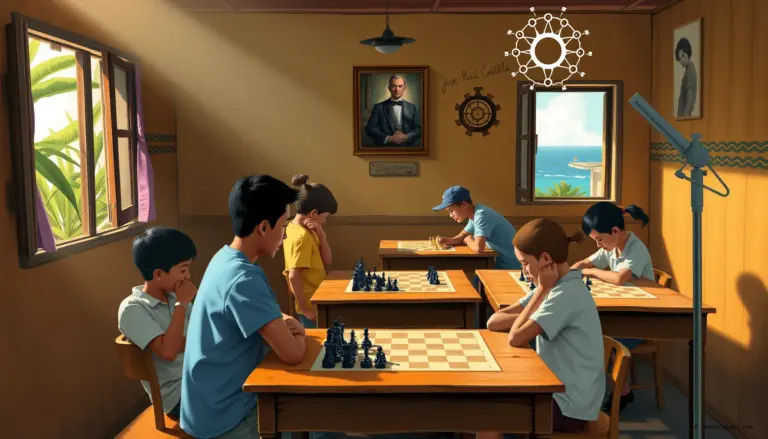
chess, more than a game, It is a mirror of human evolution. Each memorable game not only redefines strategies, but also challenges the limits of creativity, psychology and even technology. On this board 64 casillas, some plays have transcended time, becoming milestones that shaped the way we understand the game today. From the romanticism of The Immortal to the cold precision of Deep Blue, These games not only changed chess, but they also reflected the conflicts, advances and paradoxes of their times. What makes them so transcendental?? It's not just the result, but the audacity of those, in a moment of genius, they rewrote the rules of the possible.
The Immortal: when sacrifice became art
In 1851, Adolf Anderssen and Lionel Kieseritzky played a game that defied all the conventions of romantic chess. Known as The Immortal, This masterpiece is not only an example of excessive sacrifice, but also a manifesto of chess creativity. Anderssen delivered two towers, a bishop and the queen to checkmate with the minor pieces, demonstrating that chess could be both a calculation game and an artistic expression. This game not only consolidated the romantic style, but also laid the foundations for understanding chess as a universal language, where beauty and strategy intertwine. As indicated by the analysis of The Immortal: art and sacrifice in romantic chess, This meeting redefined what it meant “play well”, prioritizing imagination over safety.
But beyond its aesthetic value, The Immortal marked a turning point in the evolution of chess rules. At a time when openings were not yet systematized, Games like this showed that the game could be dynamic, unpredictable and, above all, exciting. Kieseritzky, although defeated, was immortalized as the witness of a moment that transcended the board.
Steinitz and the birth of scientific chess
If Anderssen represented romanticism, Wilhelm Steinitz was the architect of his antithesis: scientific chess. His duel against Johannes Zukertort in 1886 It was not only the first official World Championship, but also the game that demonstrated that chess could be analyzed with logical rigor. Steinitz introduced concepts such as center control, the accumulation of small advantages and the importance of the pawn structure, principles that today are pillars of modern theory. His revolutionary approach was not just technical, but philosophical: Chess stopped being an ephemeral art to become a methodical discipline.
Steinitz's legacy is so profound that even today, when chess engines dominate analysis, Its methodology is still valid. How do you explain Steinitz: How chess went from art to science, His greatest contribution was to demonstrate that the game could be systematized. This not only raised the competitive level, but also democratized access to knowledge, allowing players from all over the world to study games with a clear theoretical framework. Sin Steinitz, modern chess—and its relationship with artificial intelligence— simply would not exist.
Fischer vs Spassky: Chess as a weapon of the Cold War
In 1972, the world stopped breathing. Bobby Fischer and Boris Spassky faced each other in Reykjavík not only for the world title, but also as representatives of two conflicting ideologies. This game transcended the board to become a symbol of the Cold War, where each movement was analyzed as a political message. Fischer, with his eccentric genius, he not only defeated Spassky, but also exposed the cracks in the Soviet system, which for decades had dominated chess with its state training machinery.
The impact of this duel was so profound that it redefined the relationship between chess and geopolitics.. As detailed Fischer vs Spassky: the chess that stopped the Cold War, The game was not only a sporting triumph, but also a propaganda blow for the West. Fischer, with his aggressive style and his rejection of conventions, He embodied individualism against Soviet collectivism, inspiring a generation of players to see chess as a battlefield beyond sports.
But this meeting also left lessons about psychology in chess. Fischer, Known for his eccentric demands (how to play in a soundproof room), proved that mental control was as crucial as technical mastery. His victory was not just a triumph of calculation, but also the ability to destabilize the rival, a lesson that today is applied by great teachers to players of blitz and bullet.
Deep Blue vs Kasparov: when the machine challenged the man
He 11 May 1997, Garry Kasparov, considered the best player in history, fell before a machine. Deep Blue, the IBM supercomputer, not only did he beat the world champion, but it also marked the beginning of a new era: that of chess dominated by artificial intelligence. This game was not just a technological milestone, but also a moment of reflection on the limits of human creativity in the face of cold algorithmic precision.
The duel between Kasparov and Deep Blue raised uncomfortable questions: Can a machine understand the essence of chess? Or is it limited to calculating variants with inhuman efficiency? How to analyze Deep Blue vs Kasparov: AI victory or human error?, Kasparov's defeat was not just an individual failure, but the beginning of a debate that today defines modern chess. AI not only changed the way of analyzing games, but also redefined what it means “play well”.
Hoy, tools like Stockfish or AlphaZero They are accessible to any player, but its impact goes beyond technique. As pointed out Chess and AI: how machines redefined gaming, artificial intelligence has democratized knowledge, but it has also homogenized the playing styles. The question is no longer whether AI can beat a human, but how players can use these tools without losing their creative essence.
Carlsen and practical chess: the era of pragmatism
Magnus Carlsen did not reinvent chess, but it did redefine what it means to be a champion. Your style, based on psychological resilience and the ability to turn even positions into victories, showed that modern chess is no longer about brilliant sacrifices, but of efficiency. Carlsen does not look for the most spectacular play, but the one that maximizes your chances of winning, even in seemingly sterile positions.
His approach has had a profound impact on the way we train and compete.. How do you explain Carlsen: practical chess that defeated brilliance, The Norwegian prioritizes emotional control and adaptability over memorizing openings. This has led to a reassessment of what it means “preparation” in elite chess, where today the ability to handle pressure is valued more than pure theoretical knowledge.
But Carlsen has also been a catalyst for the popularization of chess in the digital age.. Your participation in platforms such as Chess.com and Lichess, as well as your presence on social networks, has brought the game to new audiences. His legacy is not just a rating record, but the demonstration that chess can be both an elite sport and a cultural phenomenon.
The games that changed chess: an evolving legacy
These games are not just historical moments, but nodes of a network that connects the past, the present and future of chess. From The Immortal until Deep Blue, each one of them redefined what the game could be: an art, a science, a political weapon or a technological battlefield. But beyond their differences, they all share a characteristic: the ability to inspire, challenge and transform.
Hoy, when artificial intelligence and digital platforms dominate the landscape, These games remind us that chess is still, first of all, a reflection of the human condition. Whether through romantic sacrifice, scientific rigor or psychological resistance, each generation has left its mark on the board. And although the rules and tools evolve, The essence of the game—that silent duel between two minds—remains unchanged..
For those looking to deepen their understanding of chess, These games are more than technical lessons: They are invitations to explore history, the psychology and philosophy behind the game. As pointed out Analyze your chess games to improve: practical guide, the real learning is not in memorizing openings, but in understanding why certain plays resonate over time. And in that sense, These games are an inexhaustible treasure.
chess, in its essence, It is a dialogue between eras. Every memorable game is a voice in that conversation, and each player, a link in a chain that goes back centuries. The question is not whether chess will continue to evolve — because it will., but how we, as players and spectators, we will choose to participate in that dialogue. Will we be mere witnesses of his story, we will help you write the next chapter?