Chess is an ancient game that has fascinated generations for its strategic depth., its ability to challenge the mind and its rich history. Among the most amazing records that this intellectual sport has left, highlights the longest chess game in history, a duel that transcended the limits of time and human resistance. This confrontation not only broke records, but also raised questions about the limits of the game, the psychology of the players and the evolution of the rules that govern chess. In this article, We will explore the details of this epic game, from its historical context to the implications it had in the world of modern chess. How was it possible for a game to last so long?? What strategies were used? And what lessons did it leave for players and tournament organizers?
The historical context: when chess didn't have clocks
To understand the longest game in history, It is essential to go back in time, to a time when chess was not subject to the strict time rules we know today. Before the introduction of chess clocks in the 19th century, Games could last for hours., and even days, without there being a clear limit for its duration. This scenario was conducive for players to employ delaying tactics., especially in high level games where a draw was an acceptable result.
The record for the longest game was set in 1989, during the tournament Belgrade, in what was then Yugoslavia. However, This was not an isolated case.. In the 19th century, For example, games were recorded that exceeded 100 plays, like the famous confrontation between Paul Morphy y Louis Paulsen in 1857, which lasted more than 15 hours. But what made the Belgrade departure unique was its extreme duration: 269 plays, spread over more than 20 hours of effective play, a record that remains valid to this day.
Then, the rules of chess were not yet completely standardized. The rule of 50 plays, which establishes that a game can be declared a draw if there are no captures or movements of pawns in that period, was not always applied rigorously. This allowed players to prolong the game beyond reason., exploring theoretically equal positions but with a minimal margin for victory. The lack of strict time control also contributed to players, in some cases, They will seek to exhaust their rival psychologically.
The record game: Ivan Nikolić vs. Goran Arsovic
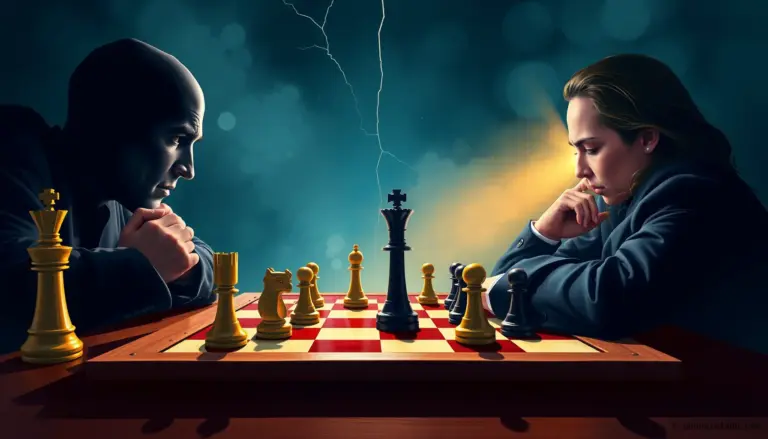
The longest game in history pitted two Yugoslav masters against each other: Ivan Nikolić y Goran Arsovic. this duel, which took place at the Belgrade tournament of 1989, It not only broke records for its duration, but also for the tenacity of both players, who refused to give up even in a position that, for any outside observer, looked clearly tables.
The meeting began as an opening King's Indian Defense, a variant known for its strategic complexity and potential for long games. However, as it progressed, The game led to a series of repetitive maneuvers, where both players avoided any risk that could lead to defeat. Nikolic, with white pieces, y Arsović, with the black ones, They engaged in a dance of movements that, in theory, did not alter the balance of the position.
The most surprising thing about this game was not its duration itself, but the psychological resistance that both contenders demonstrated. At a given moment, The game exceeded 200 plays, and viewers began to wonder if either of them would give up.. However, none gave in, even when the position was so symmetrical that any movement seemed irrelevant. Finally, after 269 plays, The game ended in a draw due to repetition of moves, a result that, in retrospect, seemed inevitable long before.
This confrontation raised a debate in the chess community: Was it necessary to modify the rules to prevent games like this from being repeated?? The answer came years later, with adjustments in the regulations of the FIDE (International Chess Federation), which further limited the possibilities of artificially lengthening games.
The strategies behind an endless game
Behind the longest game in history there was not only physical and mental resistance, but also a strategic calculation by both players. Although the final result was a tie, The path to reach it was full of tactical decisions that sought, ultimately, wear down the rival.
One of the keys to understanding how this game lasted so long is the concept of zugzwang, a situation where any move a player makes worsens his position. In long games, Players can maneuver to bring the opponent into a zugzwang position, forcing him to make difficult decisions. However, en el caso de Nikolić and Arsović, both carefully avoided falling into this trap, maintaining a balance that allowed them to continue playing without risks.
Another strategy used was repetition of plays. in chess, If the same position is repeated three times, the game can be declared a draw. However, in this game, players avoided repeating positions exactly, opting for minimal variations that allowed them to continue playing. This required an extraordinary level of precision., since any mistake could lead to a losing position.
Besides, Both players took advantage of the tie rules in your favor. Then, the rule of 50 plays were not applied with the same rigor as today, which allowed them to extend the game without the referee intervening. This later changed, when FIDE tightened the rules to prevent games like this from being repeated.
Finally, you can't ignore the psychological factor. In long games, fatigue and mental pressure can lead to mistakes. Nikolić and Arsović demonstrated an exceptional ability to maintain concentration for hours, something that not all players can achieve. This aspect is crucial in high level chess., where a single carelessness can cost the game.
The legacy of the longest game and its impact on modern chess
The game between Nikolić and Arsović was not only registered as a record, but also had a lasting impact on the way chess is played and regulated.. After this confrontation, FIDE implemented changes to the rules to prevent such long games from being repeated, introducing stricter limits on ties and strengthening the application of the rule of the 50 plays.
One of the most significant changes was the reduction in the number of plays allowed without progress. Before 1989, Players could extend games indefinitely if they avoided captures and pawn movements.. However, after this record, FIDE established that, if there is no progress in 75 plays, the game must be declared a draw. This has led to, currently, long games are much less common, even in high level tournaments.
Besides, the longest game in history served as a reminder of the importance of time control. Nowadays, chess clocks are an essential part of the game, and players must manage their time efficiently to avoid falling into trouble. This has added a new layer of complexity to chess., where time management has become a skill as crucial as strategy itself.
On the other hand, This game also left a lesson about chess psychology. The ability to maintain concentration for hours, resisting pressure and avoiding mistakes in fatigue situations is something that distinguishes great teachers. Nikolić and Arsović demonstrated que, in chess, Mental toughness may be as important as strategic talent.
Finally, This record is still a topic of debate among chess fans.. Some see it as an example of human tenacity., while others consider it an anomaly that exposed the deficiencies of the rules of the time. Be that as it may, The longest game in history remains a milestone that illustrates how far players can go in their quest for victory, or at least, of the tie.
Final thoughts: a record for eternity?
The longest chess game in history is much more than just a record. It is a testament to human resilience, of the evolution of the rules of chess and the psychological complexity contained in this ancient game. Throughout this article, We have explored how a duel between two Yugoslav masters in 1989 managed to transcend his time, influencing the rules that govern modern chess and leaving an indelible mark on the history of the sport.
Hoy, thanks to the changes implemented by FIDE, it is unlikely that we will see a game as long as Nikolić and Arsović. The current rules, that limit the number of moves without progress and reinforce time control, have made chess a more dynamic game and less prone to endless ties. However, This record remains a reminder that, in chess, patience and strategy can lead to extreme situations.
For the players, This game offers a valuable lesson: the importance of mental toughness and the ability to stay focused in high-pressure situations. For tournament organizers, is an example of how the rules need to be adapted to ensure the game remains fair and exciting. And for the fans, It is a fascinating story that shows that, in chess, Even a tie can become a historic milestone.
Ultimately, the longest game in history not only broke records, but also enriched the legacy of chess. And although it is unlikely that this record will be surpassed, Its impact will endure as a unique chapter in the history of this infinite game.