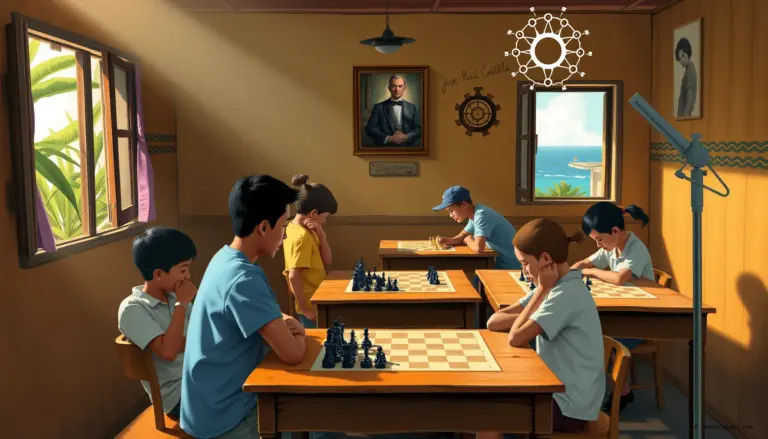
chess, that board 64 squares where bloodless battles are fought, It's much more than a game: It is a mirror of human evolution. From its origins in ancient India to the era of artificial intelligence, the rules of chess have mutated not only to adapt to the times, but to reflect changes in the way we understand strategy, power and even psychology. Why are some rules that were born in the 6th century still in force?, while others radically transformed? The answer lies in a fragile balance between tradition and adaptation, where each modification has redefined what it means to play—and win—on the board.
primitive chess: when the queen was a vizier and the bishop an elephant
He Chaturanga, precursor of modern chess, emerged in India around the 6th century as a war game that simulated the four divisions of the army: infantry (pawns), chivalry (horses), elephants (bishops) and cars (torres). However, what we know today as the most powerful piece—the queen—was then a visor, a weak advisor who could only move one square diagonally. This limitation was not accidental: in a society where military and political power was dominated by men, chess reflected that hierarchy. But the game traveled, and with him, its rules.
Upon arrival in Persia, he shatranj introduced the concept of shah mat (“the king is trapped”), origin of the current “jack dead”. The Arabs, after conquering Persia, They adopted the game and spread it throughout Europe, where he underwent his first great metamorphosis. In medieval Spain, he book of games by Alfonso X the Wise (1283) already documented variants with different rules, as the possibility of the pawns advancing two squares on their first move. However, the most radical change was yet to come: the transformation of the queen into the most powerful piece on the board, a reflection of the growing influence of female figures in Renaissance Europe, like Isabella the Catholic.
This evolution was not linear. In some regions, like Italy, the lady retained limited movements until the 15th century, while in France and England they were already playing with the version “modern”. The standardization of rules in the 19th century, driven by the creation of the International Chess Federation (FIDE), not only did it unify the game, but it laid the foundations for its global expansion. But even then, chess was still a reflection of its time: a game of elites, dominated by men and with rules that privileged patience and planning over speed.
The chess clock: when time became another rival
Until the end of the 19th century, chess games had no time limit. Players could take hours—even days—to move a piece, which turned tournaments into endless marathons. The turning point came in 1851, during the London tournament, when maestro Adolf Anderssen faced Lionel Kieseritzky in a game that lasted more than 10 hours. The solution came from Thomas Bright Wilson, who in 1883 introduced the first mechanical chess clock, with two connected spheres that alternated time between players.
This invention not only speeded up the game, but he democratized it. Tournaments were no longer exclusive events for those who could afford to waste entire days in front of the board.. Besides, the clock added a new layer of complexity: time management. Players like Magnus Carlsen have elevated this skill to almost artistic levels, using the clock as a psychological tool to pressure his rivals. But the most significant change came with the introduction of the time increase in the years 90, a system that grants additional seconds for each movement performed. This rule, popularized by platforms such as Lichess, has allowed for more dynamic games and has reduced time stress, especially in fast formats like blitz or bullet.
The clock, in essence, transformed chess into a sport of mental endurance, where the ability to think under pressure became as crucial as the strategy itself. Hoy, even in classic games, Players must balance the depth of their calculations with the urgency of ticking, a duality that defines modern chess.
The digital age: when the rules were rewritten in code
The arrival of computing not only changed how chess is played, but also how its rules are understood. In 1997, when Deep Blue defeated Garry Kasparov, The world discovered that machines could outperform humans in a game considered the pinnacle of strategic intelligence.. But this milestone had an unexpected side effect: the obsession with perfection. Chess engines like Stockfish o Leela Chess Zero They not only analyze millions of positions per second, but they have redefined what it means “play well”. Hoy, a considered move “creative” in the 20th century it could be discarded by an AI as an elementary error.
This technological revolution has led to changes in the competition rules. For example, FIDE banned 2023 the use of electronic devices during games, a measure unthinkable before the digital age. Besides, platforms like Chess.com have introduced tools such as takeback (go back one movement), that although controversial, have changed the way players learn and practice. In online chess, the rules have also been adapted: he premove (move before the opponent ends his turn) or the possibility of playing multiple simultaneous games have created an ecosystem where speed and multitasking are as important as strategy.
But the deepest change is philosophical. Before, chess was a duel between two minds; hoy, It is a collaboration between humans and machines. Players like Ding Liren They prepare their openings with the help of AI, and elite tournaments include real-time analysis with engines. This has led to an ethical debate: Are the current rules designed for humans or human-machine hybrids?? The answer is still in play.
Rules that defy logic: from castling to drowning
Some chess rules seem arbitrary, but its evolution reveals a constant search for balance. He castling, For example, It was introduced to Europe in the 14th century to protect the king and activate the tower, but its mechanics—moving two pieces in a single turn—break with the basic logic of the game. However, This exception is justified by its strategic usefulness: without castling, The games would be slower and more predictable.
Another controversial rule is the drowned, which declares a draw when a player cannot move any piece but is not in check. In it shatranj lost, the drowning was a victory for the player who caused it, a rule that reflected the importance of the king's capture over the position. FIDE changed this rule in the 19th century to avoid endless games., but its existence continues to generate debates. Is it fair that a player with an overwhelming disadvantage can be saved thanks to a technicality?
Even the most basic rules have been questioned. In 2017, FIDE modified the definition of jack dead to clarify that the king cannot “move to a square where it is in check”, a precision that seems obvious but that avoided disputes in high-level games. These settings, although minor, They show that the rules of chess are not immutable: evolve to close gaps, adapt to new contexts or simply make the game fairer.
The future of rules: towards a post-human chess?
If the 20th century was the era of standardization, The 21st century could be the era of experimentation. Variants like the chess 960 (where the pieces are placed randomly in the first row) or the chess with handicap (where the strongest player starts with a disadvantage) are gaining popularity, especially on online platforms. Radical rules have even been proposed, such as allowing pawns to capture forward or allowing the queen to move like a knight once per game.
But the most disruptive change could come from artificial intelligence. There are already engines that play chess variants with modified rules, like him chess without king or the chess with additional pieces. These innovations not only challenge traditional rules, but they could redefine what it means “play chess”. Are we facing the birth of a new game, or simply before a natural evolution?
The truth is that the rules of chess have always been a reflection of the society that creates them.. In the Middle Ages, the game imitated feudal battles; in the Renaissance, reflected the power of monarchies; in the 20th century, became an ideological battleground during the Cold War. Hoy, in the digital age, chess is torn between tradition and innovation, between the human and the artificial. And although the rules may change, one thing remains constant: the board remains a mirror of those who play it.
Chess is not just a game of rules, but a dialogue between the past and the future. Each modification, from the introduction of castling to the ban on electronic devices, It has been a response to the challenges of its time. Hoy, When artificial intelligence threatens to redefine what it means to be a grandmaster, chess faces its greatest test: Will it be able to adapt without losing its essence? The answer, as usual, it's on the board.
For those who want to delve deeper into how the rules have shaped the game, explore resources like this guide to learn chess from scratch can be an excellent starting point. And if the interest goes beyond the technical, to understand how chess reflects philosophy and life offers a unique perspective on why this game continues to fascinate humanity after 1500 years.