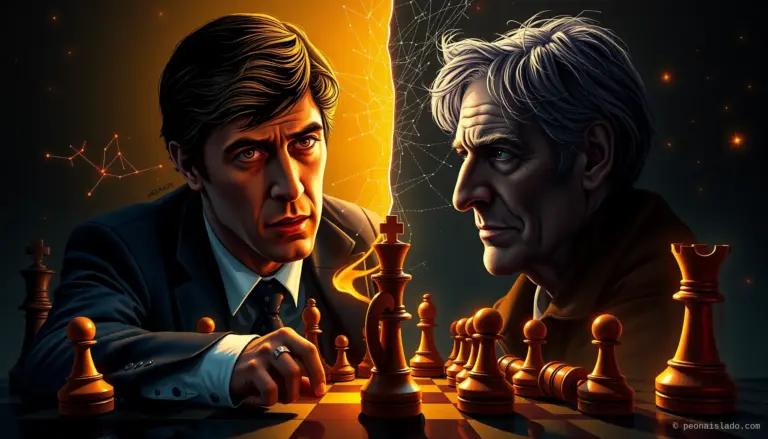
The first day of January is not just the beginning of a new year, but also the moment when the International Chess Federation (FIDE) updates its official ratings lists. This event, apparently technical, It is actually a thermometer of power on the global board. Who emerges as number one? What does it really mean to lead the ranking in an era where artificial intelligence redefines the limits of the game? Beyond the numbers, The FIDE rating is a reflection of the evolution of chess: from classic games to the influence of engines like Stockfish y AlphaZero, that have transformed the preparation of great teachers. But, what's behind that ephemeral throne? Is it just skill, or also strategy, psychology and even geopolitics?
In this article, We will unravel the meaning of the FIDE rating, We'll look at who starts the year as the leader and explore the dynamics that define modern chess.. Why, in the end, number one is not just the best player, but also the symbol of an intellectual battle that transcends the board.
El rating FIDE: more than a number, a legacy
The FIDE rating system, created by the Hungarian physicist Arpad Elo in the years 60, It is one of the most accurate metrics for measuring chess skill.. Unlike other sports, where performance may vary due to physical or external factors, chess offers a controlled scenario: two minds, a board and immutable rules. However, the rating is not static. Every match, every tournament, every mistake or success, translates into points that go up or down, reflecting not only a player's current strength, but also its consistency.
But, what does it really mean to be number one? in chess, leadership is not just about victories, but the ability to stay on top in an ultra-competitive environment. Players like Bobby Fischer o Garry Kasparov showed that the title of world champion does not always coincide with the highest rating. Fischer, For example, reached its peak 2785 in 1972, a record that stood for decades, but his reign was brief. Kasparov, instead, dominated the ranking for more than 20 years, a testament to their adaptability and resilience.
Hoy, The FIDE rating is also an indicator of how chess has evolved. The emergence of artificial intelligence has changed the way players prepare. Engines like AlphaZero don't just analyze games, but they generate innovative ideas, forcing humans to rethink strategies that previously seemed set in stone. This has led to a paradox: as technology makes gaming more accessible, It also raises the bar for excellence. Being number one is no longer just a matter of talent, but about how that talent is integrated with the available tools.
The throne in dispute: who leads the ranking in 2025
He 1 January 2025, as is tradition, FIDE updated its ratings list. Y, one more time, the name at the top was Magnus Carlsen. The Norwegian, world champion since 2013 until 2023, has redefined what it means to be the best. With a rating that exceeded 2880 points at their highest point, Carlsen not only broke records, but it also changed the perception of chess. Your style, based on versatility and the ability to turn seemingly even positions into victories, made him a reference for a generation of players.
But Carlsen is not invincible. In recent years, His dominance has been challenged by a new generation of prodigies, como el chino Ding Liren y el uzbeko Nodirbek Abdusattarov, who have shown that chess is more globalized than ever. Ding Liren, in particular, He has been a constant rival for Carlsen, even defeating him in the World Championship 2023. However, The Norwegian is still the king of the ratings, a title that does not depend on a single tournament, but a career full of consistency.
What makes Carlsen so special? Beyond your technical ability, your mentality is key. In an article about psychology in chess, explores how grandmasters not only calculate movements, but they also read their opponents. Carlsen is a master at this. His ability to remain calm under pressure and his intuition to detect weaknesses in his opponent's game have made him an almost unbeatable player in long games.. But, How long can you stay on top??
The geopolitics of chess: beyond the board
Chess does not exist in a vacuum. Behind every player there is a cultural context, political and even economic that influences its development. During the Cold War, For example, Chess became a symbolic battleground between the United States and the Soviet Union. Fischer vs. Spassky no 1972 It wasn't just a game, but an ideological confrontation that captured the world's attention. Hoy, although the cold war is over, chess continues to be a reflection of geopolitical tensions.
China, For example, has invested heavily in chess as part of its strategy to position itself as a global power. Ding Liren is not only an exceptional player, but also a symbol of China's rise on the international stage. The same goes for India., where players like Viswanathan Anand and, most recently, Rameshbabu Praggnanandhaa, They have put the country on the chess map. In a world where soft power is as important as economic power, Chess has become a tool to project influence.
But the geopolitics of chess is not limited to the great powers. Countries like Azerbaijan, with its investment in the development of youth chess, o Armenia, where play is part of the school curriculum, demonstrate that chess can be a vehicle for social and educational development. In this article, Explores how Armenia has used chess to improve academic performance and foster skills such as critical thinking and problem solving.
The future of rating: where is chess going?
The FIDE rating system has been criticized by some for not fully reflecting the evolution of chess.. With the arrival of quick games and online chess, Some argue that the classic rating is no longer sufficient to measure a player's ability.. Platforms like Chess.com or Lichess have introduced their own rating systems, which include formats such as blitz and bullet, where speed and intuition are as important as deep strategy.
Besides, Artificial intelligence has raised questions about the future of human chess. If engines like Stockfish or AlphaZero can beat any player, What's the point of continuing to compete?? The answer, however, it's not that simple. Chess is not just a game of calculations, but also creativity, emotions and, ultimately, humanity. As discussed in this analysis, AI is not done with chess, but has enriched it, offering new ways to explore the game.
El rating FIDE, therefore, still relevant, but its meaning is changing. It's no longer just a measure of who is the best player., but also who can best adapt to a constantly evolving environment. Players like Carlsen have shown that versatility is key, but the future could belong to those who know how to integrate technology without losing their human essence.
Conclusion: rating as a mirror of modern chess
He 1 January is not just a date on the calendar, but a moment of reflection for chess. The FIDE rating update reminds us that this game is a dynamic ecosystem, where the skill, Strategy and psychology are intertwined with external factors such as geopolitics and technology. Magnus Carlsen, with his dominance in the ranking, symbolizes excellence in a sport that continues to evolve, but it also invites us to ask ourselves: What does it really mean to be number one in a world where the rules of the game are changing??
chess, in the end, It is a reflection of life. It's not just about winning, but how we face the challenges, how we adapt and how we find meaning in every movement. FIDE rating is just a number, but behind him there are stories of effort, improvement and, above all, passion for the game. And so, in the end, is what really matters.