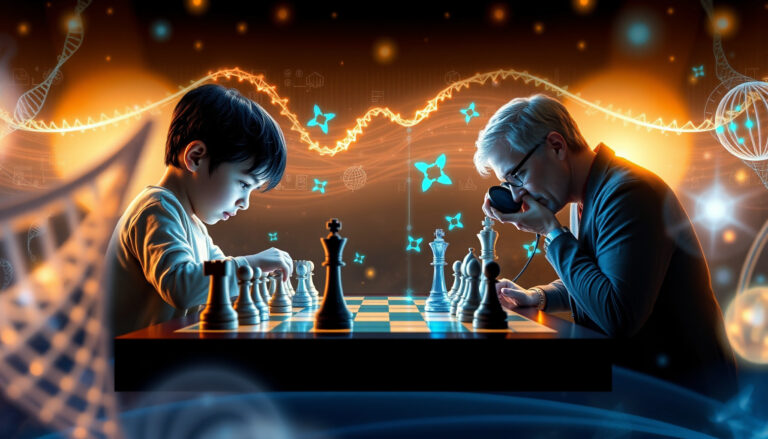
Chess is a mirror of the human mind, but also a laboratory where traditional hierarchies are blurred. When a teacher sits in front of the board with his students, not only teaches openings or endings: discover that learning is a two-way dialogue, where humility and curiosity become the most valuable pieces. This phenomenon, far from being anecdotal, reveals how the ancient game can transform educational dynamics, challenging the idea that knowledge flows in only one direction. What happens when the student, with his fresh look and his unconditional intuition, becomes the teacher?
The board as a classroom without walls
In teaching chess, The role of the teacher is not that of a unidirectional transmitter of knowledge, but that of a facilitator who recognizes that each game is an opportunity to learn. A study published in the journal Frontiers in Psychology showed that children who play chess develop a greater ability to solve complex problems, not only by memorizing patterns, but for adaptation to new situations. This cognitive flexibility is precisely what allows students to surprise their instructors with creative solutions., as unexpected sacrifices or strategic plans that defy theoretical conventions.
The case of school chess as a tool to resolve conflicts illustrates how play fosters autonomy in students. In Medellin, For example, programs such as those developed in the Isolated Pawn Club have shown that children not only learn to move pieces, but to negotiate, to listen and propose alternatives. When a teacher watches his students debate a move or defend their point of view with logical arguments, you are witnessing a lesson that goes beyond the board: building critical thinking.
The paradox of “error” as a teacher
One of the most revealing moments in the teacher-student relationship occurs when the latter makes a mistake. in chess, a wrong move is not a failure, but an invitation to analyze, to question and rethink strategies. The great teachers, as Garry Kasparov, have highlighted that errors are the basis of progress. However, in the educational context, Teachers often underestimate the pedagogical value of these moments, especially when they come from students.
A paradigmatic example is that of the therapeutic chess programs, where young people with emotional difficulties find in the game a safe space to make mistakes and learn. In these environments, teachers discover that their role is not to correct every mistake, but to guide the student to identify for himself the consequences of his decisions. This methodology, based on self-reflection, not only improves chess performance, but strengthens resilience and self-esteem.
Childhood intuition: an antidote to rigidity
Children and adolescents approach chess with a mentality free of prejudices, allowing them to see patterns that adults, conditioned by years of theoretical study, they overlook. A study from the University of California revealed that young players have a greater ability to identify plays “unconventional”, such as piece sacrifices or lateral attacks, that experts usually dismiss as risky. This intuition, combined with lower risk aversion, turns students into unexpected sources of innovation.
In the school environment, This creativity is manifested in projects such as art and chess, where students reinterpret the board as a canvas, fusing strategy and artistic expression. Teachers who participate in these initiatives not only learn new ways of teaching, but they discover that chess can be a bridge between seemingly disconnected disciplines, like mathematics and painting.
Chess as a mirror of empathy
Playing chess requires anticipating your opponent's moves, a skill that, in essence, It's an exercise in empathy.. When a teacher confronts his students, It is not only measuring your technical level, but also their ability to understand the motivations and emotions of others.. In this sense, The board becomes a stage where not only cognitive skills are tested, but also the social.
Programs like chess and empathy have shown that play can be a powerful tool to promote inclusion. In contexts of cultural or linguistic diversity, chess acts as a universal language, allowing teachers and students to communicate without words. This dynamic not only enriches the educational experience, but also challenges the teacher to adapt his methodology to connect with realities different from his own..
Humility as a key piece
The moment when a teacher recognizes that he has learned something from his student is, maybe, the most transformative. in chess, like in life, humility is the only posture that allows growth. Grandmasters such as Magnus Carlsen have admitted that some of their best moves came from ideas proposed by less experienced players.. This mental openness not only improves the level of play, but it redefines the relationship between teacher and student.
In the educational field, This humility translates into a more horizontal pedagogy, where the teacher is not the only repository of knowledge. Initiatives like chess in schools: discipline without punishment show how games can be a catalyst for more collaborative educational models. When a student proposes a move that the teacher had not considered, you are not just challenging a strategy, but also a paradigm: that intellectual authority resides exclusively in those who teach.
Conclusion: The board as a metaphor for learning
Chess is not just a game, but a microcosm where the dynamics of human learning are reproduced. When a teacher sits in front of his students, he is not teaching a lesson, but by participating in a dialogue where both sides have something to contribute. True mastery does not lie in knowing more, but in being willing to learn, even those who seem to have less experience. In this sense, the board becomes a reminder that education is not a one-way path, but a shared journey where every movement, either king or pawn, can change the course of the game.
The next time a teacher faces a student at chess, I should do it with an open mind.. Because in those 64 boxes not only a checkmate is decided, but also the possibility of learning flowing in both directions, challenging hierarchies and enriching all players, regardless of your age or level.