The phenomenon “The Queen’s Gambit” has captivated millions of viewers around the world, not only for its immersive narrative and retro aesthetic, but also for the way he approaches chess, an ancient game that many consider elitist or inaccessible. The Netflix series, based on the novel of the same name by Walter Tevis, features Beth Harmon, a chess prodigy whose life is marked by talent, addiction and self-improvement. But, To what extent does what we see on screen reflect the reality of competitive chess? Is it possible for a young woman without resources, in the middle of the cold war, reach the top of world chess in such a short time? This article explores the boundaries between fiction and reality in “The Queen’s Gambit”, analyzing everything from the plausibility of the tournaments to the psychological portrait of the players, going through the cultural impact that the series has had on the resurgence of interest in chess. Through this analysis, We seek to answer whether Beth Harmon's success is a reflection of the possible or an artistic exaggeration.
Chess on the screen: a faithfully represented game?
One of the first questions that arise when seeing “The Queen’s Gambit” is whether the chess shown in the series is an accurate representation of the game in real life. In technical terms, The series gets several key aspects right.. The games shown, although edited for cinematic rhythm, They are based on real openings and strategies, many of them played by great teachers such as Bobby Fischer or Anatoly Karpov. For example, The famous final game between Beth and Borgov reproduces moves from the “King's Indian Defense”, a complex opening that requires deep theoretical knowledge.
However, There are creative licenses that distort the reality of competitive chess. in the series, Beth wins tournaments with an ease that borders on the incredible., especially considering that in real life, Even prodigies like Magnus Carlsen or Judit Polgár needed years of intensive training to master the game at a professional level.. Besides, Chess in high competition is not a sport with immediate results: Players often spend hours analyzing a single game, something that is simplified in the series to maintain narrative tension.
Another questionable aspect is the representation of the tournaments. In “The Queen’s Gambit”, championships seem like glamorous events, with rooms full of spectators and cameras following every movement. Actually, chess tournaments tend to be more discreet, with games that can last for hours in quiet rooms, where the public is sparse and the attention is focused on the board, not in the player. The series exaggerates the drama to connect with the viewer, but loses authenticity in the process.
Beth Harmon: A realistic portrait of a chess prodigy?
Beth Harmon's character is, definitely, the heart of the series, and his construction as a chess prodigy raises questions about the plausibility of his development. in fiction, Beth learns to play chess at nine years old, in an orphanage, and in a matter of months he already defeats experienced players. This type of accelerated progression is rare, although not impossible. In the history of chess, There are cases of young people who have stood out at an early age, like the aforementioned Magnus Carlsen, who became a grandmaster at 13 years. However, Even these exceptional cases required years of methodical study, something that is omitted in the series in favor of a more agile narrative.
Beth's psychological aspect also deserves analysis. The series presents her as a genius with a photographic memory and an almost supernatural ability to visualize the board., skills that, although they exist in some players, They are not the norm. Most great teachers develop their talent through constant practice, game analysis and opening repetition, not through an innate don. Besides, Beth's emotional isolation, his addiction to pills and his relationship with alcohol are dramatic elements that, although they add depth to the character, are not representative of the majority of professional chess players. in real life, Chess is a mental sport that requires discipline and stability, and although some players have had problems with substances, It is not a common pattern.
Another point of contention is Beth's gender. in the series, her rise in a world dominated by men is a central theme, and although fiction exaggerates some obstacles, reality is not that far away. Chess has historically been a masculine space, y figuras como Judit Polgár, the best chess player in history, They had to face prejudices and barriers similar to those shown in the series. However, Beth's success in mixed tournaments, where you compete directly with men, It's more realistic than many people think.. Citizen, For example, He became among the ten best players in the world, proving that talent has no gender.
The cultural impact of “The Queen’s Gambit”: a chess revival?
Beyond its plausibility, “The Queen’s Gambit” has had an unprecedented cultural impact on the world of chess. Since its premiere in October 2020, the series has generated a massive increase in chess board sales, in downloads of applications such as Chess.com and in the registration of new players in local clubs. According to data from Chess.com, The number of active users on the platform doubled in the months following the launch of the series, and interest in chess on social networks reached record levels.
This phenomenon is not coincidental. The series has achieved something that few productions have achieved: make chess “cool”. For decades, Chess was seen as a game for intellectuals or, at worst, like a boring hobby. “The Queen’s Gambit” has transformed it into a symbol of elegance, strategy and rebellion, attracting a young and diverse audience. Platforms like Twitch have seen a boom in live game broadcasts, with streamers like Hikaru Nakamura or GothamChess gaining millions of followers. Even celebrities like Elon Musk and rapper Logic have expressed their admiration for the game., something unthinkable a few years ago.
However, it is “Renaissance” It also has its shadows. The sudden increase in players has generated saturation on platforms like Chess.com, where many beginners get frustrated when they don't see quick progress. Besides, the series has created unrealistic expectations about what it means to be a chess player, especially regarding how quickly a high level can be reached. Many new players abandon the game when they realize that, unlike Beth Harmon, They don't become teachers in a matter of months. Even so, the legacy of “The Queen’s Gambit” it is undeniable: has put chess at the center of the cultural conversation and inspired a new generation to explore this ancient game.
The Cold War and chess: a precise historical context?
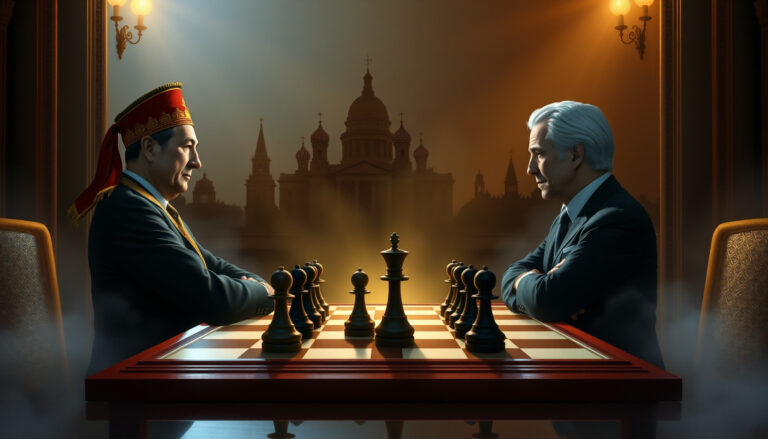
The historical context of “The Queen’s Gambit” It is another element that deserves to be examined with a magnifying glass.. The series is set in the years 50 y 60, in the middle of the cold war, a period when chess became a symbolic battleground between the United States and the Soviet Union. in fiction, Beth Harmon competes against Soviet players, represented as almost invincible rivals, which reflects a historical reality: for decades, The USSR dominated world chess, with figures such as Mikhail Botvinnik, Tigran Petrosian or Boris Spassky winning almost all major championships.
The series captures well the climate of political tension that surrounded chess at that time.. International tournaments were seen as an extension of the rivalry between the two superpowers., and each Soviet victory was celebrated as a triumph of the communist system. In this sense, the character of Vasily Borgov, the Soviet champion that Beth faces in the final, It is a faithful representation of the mentality of the time: a cold player, calculative and supported by a system that invested massive resources in the development of chess players.
Nevertheless, the series simplifies some historical aspects. For example, in real life, Soviet players were not invincible, and although they dominated chess for decades, there were notable exceptions. Bobby Fischer, the great rival of the Soviets, managed to defeat Boris Spassky in the “Match of the Century” of 1972, an event that transcended sport and became a symbol of the Cold War. In “The Queen’s Gambit”, Beth Harmon takes Fischer's place, but his victory is presented in a more individualistic way, without the political background that the real confrontation had. Besides, the series omits the role of chess federations, who in real life played a crucial role in organizing tournaments and promoting the game.
Conclusions: reality or fiction?
“The Queen’s Gambit” es, first of all, a work of fiction, and as such, take creative liberties to build an engaging narrative. However, Its success lies in the fact that, despite these licenses, manages to capture the essence of chess as a game of strategy, passion and personal improvement. The series succeeds in showing the complexity of competitive chess, although it exaggerates some aspects to maintain the viewer's interest. Beth Harmon is a fascinating character, but his progression as a chess player is more a product of dramatization than reality. Even so, His story has served to humanize chess players, showing that behind every game there are emotions, fears and dreams.
The cultural impact of the series is, maybe, his greatest achievement. “The Queen’s Gambit” has achieved what few cultural products have achieved: make chess relevant to a mass audience. Has inspired millions of people to learn the game, has revitalized chess clubs around the world and changed public perception of this mental sport. However, It has also created unrealistic expectations about what it means to be a chess player., especially regarding how quickly a high level can be reached. Ultimately, The series is a mix of reality and fiction., but his legacy is very real: has put chess on the cultural map of the 21st century and has shown that, beyond the boards, this game remains a reflection of the human condition.