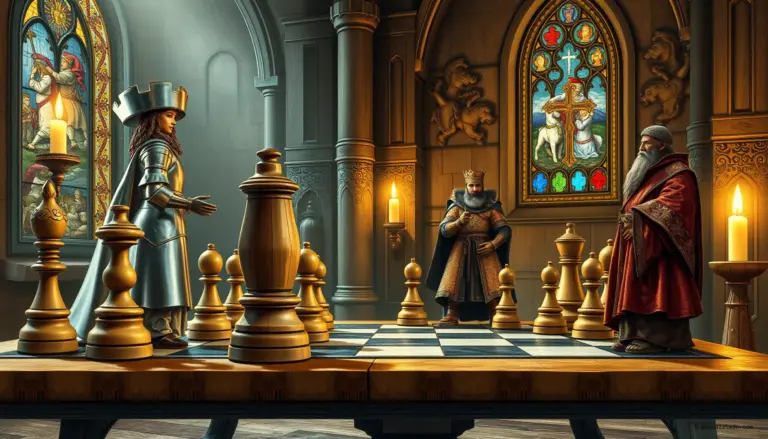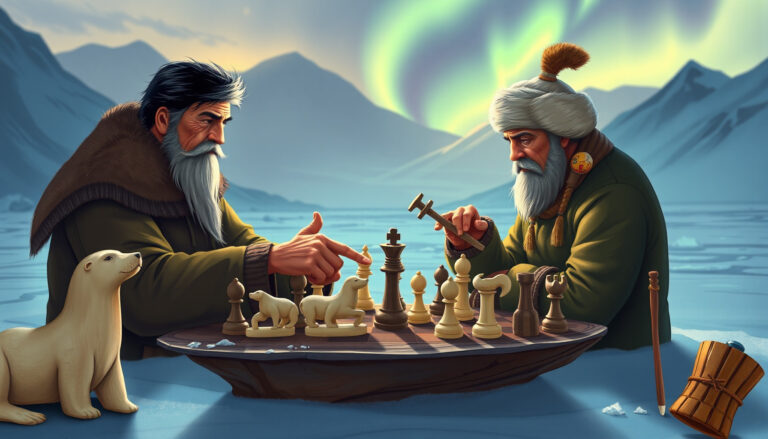
Chess and geopolitics are two disciplines that, prima facie, They seem to belong to different areas: one is an ancient strategy game, while the other is the study of power relations between nations. However, by delving into both, a fascinating connection is revealed. Chess is not only a reflection of the human mind in its search for tactical advantage, but also a mirror of the dynamics that govern the international scene. From the Cold War to contemporary conflicts, the board 64 boxes has served as a metaphor, analysis tool and even symbolic battlefield. This reflection explores how chess and geopolitics are intertwined, unraveling the lessons the game offers about power, diplomacy and strategy in an increasingly complex world.
Chess as a metaphor for geopolitical conflict
Chess has historically been used as an analogy to understand conflicts between nations.. Each piece on the board represents an actor with specific capabilities and limitations., just like States on the international stage. the king, For example, symbolizes the sovereignty of a country: His capture is equivalent to defeat, but your protection is a priority. The towers, with its rectilinear movement, evoke military and economic power, capable of projecting itself in clear lines but vulnerable to lateral attacks. The pawns, instead, represent smaller nations or civilian populations, whose strategic value is often underestimated until their sacrifice proves decisive.
During the Cold War, This metaphor reached its maximum expression. The United States and the Soviet Union were not only competing on the geopolitical chessboard., but also in literal chess. The confrontations between Bobby Fischer and Boris Spassky in 1972 They were not just a sporting duel, but a symbol of the ideological rivalry between capitalism and communism. Fischer, with his aggressive and calculating style, embodied the Western mentality of innovation and risk, while Spassky, more methodical and positional, reflected Soviet patience and planning. This meeting transcended sports to become a key episode of the propaganda of the time., demonstrating how chess can be an alternative battlefield where power conflicts are resolved.
Chess strategy and international diplomacy
Chess teaches that victory does not always depend on brute force, but the ability to anticipate movements, sacrifice minor pieces and exploit the opponent's weaknesses. These lessons are directly applicable to international diplomacy. A good chess player knows that a frontal attack can be costly and that, sometimes, It is more effective to weaken the opponent through indirect maneuvers, such as controlling key squares or creating multiple threats. Similarly, in geopolitics, economic sanctions, hybrid warfare or cultural influence can be as effective as a military invasion in achieving strategic objectives.
A clear example is the containment strategy applied by the United States during the Cold War.. Instead of directly confronting the USSR, Washington chose to surround it with military alliances (like NATO), promote democracy in key regions and use economic superiority to wear down your rival. This approach is reminiscent of the concept of “zugzwang” in chess, where a player is forced to move even though any option worsens his position. The USSR, when pressured on multiple fronts, ended up collapsing under the weight of its own contradictions, without direct armed conflict.
Another valuable lesson from chess is the importance of flexibility.. A rigid plan can be disrupted by an adversary who adapts his strategy. In geopolitics, This translates into the need to adjust foreign policies according to circumstances.. China, For example, has gone from being a regional player to a global power thanks to its ability to combine the “soft power” with strategic investments in infrastructure (such as the Belt and Road Initiative). His approach is reminiscent of a player who, without neglecting your defense, look for opportunities to expand your influence on the board.
Chess as a tool of cultural influence and propaganda
Beyond its strategic value, Chess has been used as an instrument of cultural influence and propaganda. During the 20th century, The USSR invested significant resources in promoting chess as a symbol of intellectual superiority. The Soviet chess school, that dominated the international scene for decades, It was not just a sporting achievement, but a demonstration that the communist system could produce brilliant minds. This strategy sought to counter the Western narrative that capitalism was the only system capable of fostering innovation and individual talent..
Currently, Countries like Russia and Iran have followed this model, Using chess as a tool “soft diplomacy”. Russia, For example, has promoted international tournaments and sponsored prominent players to project an image of intellectual and cultural power. Iran, for his part, has encouraged chess as a way to challenge Western stereotypes about the Islamic world, highlighting figures such as Dorsa Derakhshani, a player who has broken gender barriers in a sport historically dominated by men.
However, Chess can also be a battleground for resistance. In countries with authoritarian regimes, the game has served as a space for intellectual freedom. During the Franco dictatorship in Spain, For example, Chess clubs became places where political ideas were covertly discussed. Hoy, in contexts such as Hong Kong or Belarus, chess remains a symbol of peaceful resistance, where players use the board to express their discontent with the established power.
The limits of analogy: when chess is not enough
Despite their parallels, chess and geopolitics are not identical. The chess board is a closed system, with fixed rules and a finite number of possibilities. Instead, the international scene is chaotic, with actors that do not always follow the same rules and where factors such as the economy, technology and weather can alter the course of events in unpredictable ways. Besides, in chess, the goal is clear: checkmate the king. In geopolitics, goals are often ambiguous, and what for a country is a victory, for another it can be a defeat.
Another fundamental difference is human nature. in chess, players are rational and seek to maximize their advantage. In geopolitics, decisions are influenced by emotions, ideologies and misperceptions. The invasion of Iraq in 2003, For example, was driven by a combination of strategic interests and a misreading of the capabilities of Saddam Hussein's regime.. A chess player would not make such a costly mistake., but in the real world, Leaders often act out of fear, ambition or internal pressure.
Finally, chess does not contemplate cooperation. on the board, there is only one winner. In geopolitics, however, Cooperation is essential to solve global problems such as climate change or pandemics. The chess analogy, therefore, It is useful to understand conflicts, but insufficient to address the challenges that require collaboration between nations.
Conclusions: chess as a mirror and compass of geopolitics
Chess and geopolitics share a strategic essence that makes them complementary disciplines. The game of 64 Casillas offers a framework for understanding power dynamics, the importance of anticipation and the value of flexibility in a constantly changing world. From the Cold War to contemporary conflicts, chess has served as a metaphor, propaganda tool and symbolic battlefield, proving that lessons learned on the board can be applied, with nuances, to the international stage.
However, It is crucial to recognize the limits of this analogy. Geopolitics is more complex than a game of chess: involves irrational actors, unpredictable variables and the need for cooperation. Chess teaches competition, but not to collaborate, and in an interconnected world, the ability to work together can be as important as the ability to defeat an adversary.
Ultimately, Chess is a mirror that reflects human strategies, but also a compass that can guide leaders in decision making. Its greatest value lies in its ability to train the mind in the art of strategy., patience and adaptability. In a world where conflicts multiply and alliances are constantly reconfigured, These skills are needed more than ever. The chess board, therefore, it's not just a game: It is a school of thought that, if applied wisely, can help navigate the complexities of modern geopolitics.