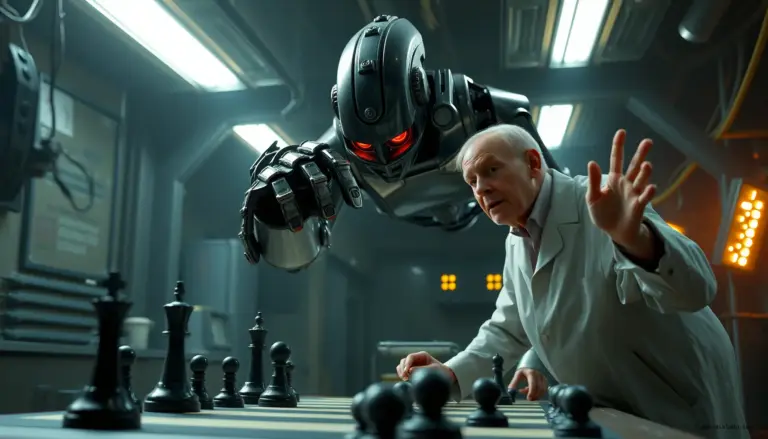
Chess has been the realm of pure strategy for centuries., an intellectual duel where creativity and logic face each other on a board 64 casillas. However, in recent years, gaming has undergone a radical transformation driven by artificial intelligence, analytics engines and digital globalization. Are we facing the twilight of the human era in chess or, on the contrary, at the birth of a new stage where technology and human ingenuity will merge to create something unprecedented? The question that arises is inevitable: Will we witness the final game?, a confrontation that marks a before and after in the history of the game.
To answer this question, It is necessary to analyze how technology has redefined the limits of chess, what role do they play (or they will play) humans in this new scenario, and if there is a possibility that the game reaches a saturation point where there is no longer any room for innovation. This article explores the future of chess from multiple perspectives: the impact of AI, the evolution of openings, the role of human players and the possibility of the game reaching a kind of “perfection” theoretical.
The artificial intelligence revolution: the end of human chess?
He 11 May 1997, the world witnessed a historic milestone: the supercomputer Deep Blue of IBM defeated then world champion Garry Kasparov in a six-game match. Although this event marked the beginning of a new era, It was just the prelude of what was to come.. Hoy, chess engines like Stockfish, Leela Chess Zero y AlphaZero They have taken the game to unimaginable levels of precision. AlphaZero, developed by DeepMind, not only did it outperform the best traditional engines, but he did it by learning from scratch, no prior knowledge beyond the basic rules, in just four hours of training.
This capacity for analysis has had profound consequences:
- The death of openings “human”: Theoretical lines that previously required decades of study by great masters are now dissected in minutes by AIs. Openings like the Sicilian Defense o to Ruy Lopez have been explored to depths of 30 o 40 movements, leaving little room for surprise.
- The end of mistakes “avoidable”: The engines have drastically reduced the number of errors in high-level games. At the World Championship 2023 between Ding Liren and Ian Nepomniachtchi, the percentage of movements “perfect” (according to AI standards) surpassed the 95%, a historical record.
- The homogenization of style: The human players, aware that any deviation from the optimal line can be punished, have adopted a more conservative style based on precision, moving away from the risky creativity that characterized players like Mikhail Tal or Bobby Fischer.
However, This does not mean that human chess is doomed. AI has opened new doors, like chess 960 (o Fischer Random), where the pieces are placed randomly at the start of the game, eliminating the memorization of openings and returning the spotlight to creativity. Besides, motors have become indispensable tools for training, allowing players to analyze their games with a depth previously impossible.
The key question is: Can AI completely replace humans in chess? The answer is complex. While the engines are superior in calculation and precision, they lack the human capacity for intuition, psychology and adaptation in real time to an opponent. chess, after all, It's still a game between two minds, and the uncertainty inherent in the human condition is what makes it fascinating.
Theoretical saturation: Is there anything left to discover??
One of the most recurring debates in modern chess is whether the game is reaching a point of theoretical saturation., where all possible lines have been explored and there is no room for innovation. This idea is not new: already in the 19th century, the german teacher Adolf Andersen warned that chess could “run out” if the openings continued to go deeper. However, Every generation has found ways to reinvent the game.
Hoy, the situation is different. Chess engines have analyzed millions of games and generated databases with precise evaluations of each position. Platforms like ChessBase o Lichess allow players to access this information in real time, which has led to a paradox: the more you know, less is innovated. Elite players avoid unnecessary risks, opting for lines “safe” that minimize the chances of error.
Some examples illustrate this phenomenon:
- The Berlin Defense: Popularized by Vladimir Kramnik in his match against Kasparov in 2000, this opening was considered “bored” but solid. Hoy, thanks to the engines, It is known that it is practically invincible in the hands of a well-prepared player., which has led to it being the preferred choice in high-level matches.
- The Queen's Gambit: One of the oldest and most respected openings, has been analyzed to such an extent that the main lines are considered “theoretical tables”. Players like Magnus Carlsen have opted for early deflections to avoid saturation.
- Chess 960: In response to saturation, This format has gained popularity. By deleting opening memorization, forces players to think from the first move, reviving the creative essence of the game.
But, Is chess really out of stock?? The answer depends on how you define “innovation”. If we refer to the creation of new openings or theoretical lines, room for maneuver is likely to become less and less. However, chess is not just theory: it is also execution, psychology and adaptation. A player like Fabiano Caruana can memorize hundreds of lines, But what makes him exceptional is his ability to handle pressure and find resources in seemingly even positions..
Besides, AI continues to discover ideas that humans had not considered. For example, in 2023, Stockfish found a theoretical novelty in the Defensa Caro-Kann that surprised the great teachers, proving that even in century-old openings there is room for surprise. This suggests that, although classical chess may be close to its theoretical limit, there will always be room for reinterpretation and creativity.
The human factor: what's left for the players?
In a world where AI dominates analysis and precision, What role do humans play in the chess of the future?? The answer is not simple, but there are several areas where the human condition remains irreplaceable.
1. The psychology of the game: Chess is not just a calculation exercise; It is also a psychological duel. Players like Magnus Carlsen have shown that the ability to handle pressure, reading the opponent's emotions and taking advantage of moments of weakness is as important as theoretical knowledge. At the World Championship 2018, Carlsen defeated Caruana in quick game tiebreakers, not because it had a theoretical advantage, but because he knew how to exploit his rival's nerves at a critical moment.
2. Intuition and creativity: Although motors can calculate millions of positions per second, they lack the ability to “to feel” a position. Players like Hikaru Nakamura o Alireza Firouzja They stand out for their ability to find resources in chaotic positions, where pure logic is not enough. This intuition, developed through years of experience, It's something AI can't fully replicate yet..
3. Adaptation in real time: In a game of chess, Players must adjust their strategy on the fly, something that engines do with difficulty. For example, if an opponent deviates from a known theoretical line, a human can improvise and find a creative solution, while an engine could remain “stuck” in your database.
4. The spectacle and the narrative: Chess is not just a game; It is also a sport and a spectacle. Humans provide drama, rivalries and memorable moments that attract audiences. The game between Bobby Fischer y Boris Spassky in 1972 It wasn't just a chess duel., but a symbol of the Cold War. Hoy, events like the Chess World Cup or the Tata Steel Chess Tournament continue to attract millions of viewers, thanks in part to the personality of the players.
However, human chess faces challenges. The dependence on technology for training has led to a generation of players who trust motors more than their own instincts.. Besides, The pressure for perfection has made the game more predictable and, in some cases, less exciting. to survive, human chess must find a balance: take advantage of technological tools without losing their creative and psychological essence.
The final game: a myth or a real possibility?
The idea of a “final game” has fascinated chess players for decades. Is there a perfect sequence of movements that guarantees victory from the beginning? ¿O, on the contrary, Chess is an infinite game where there will always be room for surprise?
From a theoretical point of view, chess is a finite game: There are a limited number of possible positions (although astronomical, estimated at 10^120). This means that, in theory, a perfect game could exist. However, until now, no one has been able to prove it. Chess engines have found lines that lead to forced draws in many openings, but they have not discovered a sequence that guarantees victory from the first move.
Some milestones in this search include:
- He “Immortal Game” (1851): The game between Adolf Andersen y Lionel Kieseritzky It is considered a masterpiece of creativity, but it's far from perfect. Anderssen sacrificed pieces in a spectacular way, but modern analysis reveals errors that an engine would have avoided.
- The game Kasparov vs. Topalov (1999): Known as the “Millennium Game”, This work of chess art is studied for its strategic depth, but it also contains inaccuracies that the AI would have corrected.
- The theoretical tables: In openings like Petroff Defense o to Defense Berlin, the engines have found lines where white cannot gain advantage, suggesting that chess could be a game of “forced draws” in its purest form.
So, Is the final game possible? The answer depends on how you define. If we refer to a sequence of movements that guarantees victory from the beginning, it is unlikely to exist, since chess is a game of perfect and symmetric information (both players have the same opportunities). However, If we talk about a game where both players execute movements “perfect” according to AI standards, so yes it is possible, although it would be a boring and predictable game, no errors or surprises.
Most likely, the “final game” not be a sequence of movements, but a philosophical concept: the moment when chess reaches its maximum expression, where technology and human ingenuity merge to create something unique. In this sense, the final game is already happening, not on a board, but in the way the game evolves and adapts to new times.
Conclusions: chess at the crossroads
Chess is at a fascinating crossroads. On the one hand, artificial intelligence has redefined the boundaries of gaming, taking precision and analysis to levels never seen before. On the other, humans are still the protagonists, contributing creativity, psychology and emotion to a game that, otherwise, it would be cold and mechanical. The question of whether we will witness the “final game” there is no simple answer, But we can draw some clear conclusions.
First of all, classical chess is close to reaching its theoretical limit. The openings have been explored to unsuspected depths, and the engines have drastically reduced the margin for surprise. However, This doesn't mean the game is dead.: it has simply evolved. Formats like chess 960 or quick and blitz games show that there is always room for innovation, especially when dependency on memorization is removed.
In second place, AI will not replace humans, but it will change its role. The players of the future will not only be experts in theory, but also in psychology, adaptation and creativity. Technology will be another tool, as the chess board or clock was in its time, but the essence of the game will remain human: a duel of minds where uncertainty and emotion are as important as calculation.
Finally, the “final game” it's not a myth, but it is not a sequence of movements either. It is a concept in constant evolution, a reflection of how chess adapts to technological and cultural changes. We may never see a perfect game in the strict sense, but we will witness moments where the game reaches new heights of beauty and depth, thanks to the fusion between human and artificial intelligence.
The future of chess is not written, but one thing is for sure: as long as there are humans willing to sit in front of a board, the game will live on, challenging the limits of the known and exploring new forms of creativity. The final game, ultimately, It's not a destination, but a trip.