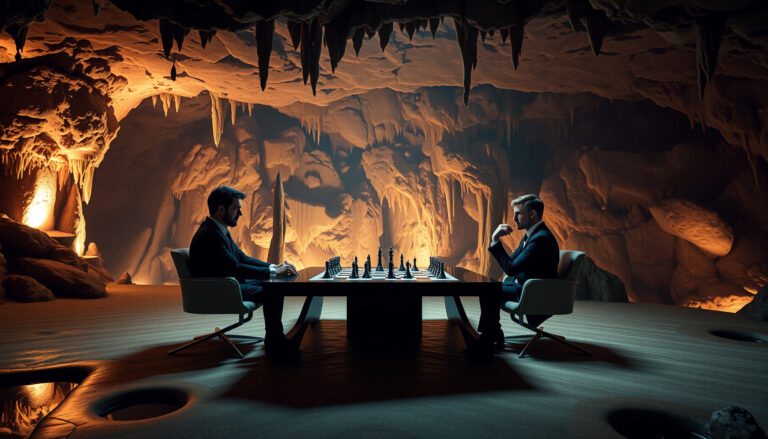
In a fast-paced world where stress and mental saturation are commonplace, Finding tools to maintain cognitive health has become a priority. While yoga has been the benchmark for balancing body and mind for decades, an ancient discipline is gaining ground as an alternative—or complement—to cultivate calm and intellectual acuity: chess. But, Why is this strategy game increasingly compared to mental yoga? Beyond being a simple hobby, chess requires concentration, patience and a deep connection with the present, qualities that bring you closer to meditative practices. However, Its impact goes beyond: strengthens memory, improves decision making and even reduces anxiety. In this article, We will explore how chess has become the new ally to train the mind, analyzing its scientific benefits, its ability to develop emotional skills and its growing popularity as a therapeutic tool. Can it really replace yoga or is it a practice that, in combination with other, offers a comprehensive approach to mental well-being?
Chess as a brain gym: science behind the board
The human brain is a plastic organ, able to adapt and get stronger with proper training. Neuroscience studies have shown that playing chess activates multiple brain areas simultaneously, creating what experts call “comprehensive cognitive exercise”. According to research published in *Frontiers in Human Neuroscience*, Experienced chess players show greater gray matter density in regions such as the parietal lobe and hippocampus, associated with memory and strategic planning. This is no coincidence: Each game requires analyzing patterns, anticipate moves and make decisions under pressure, which stimulates neurogenesis—the creation of new neurons—and strengthens synaptic connections.
But chess doesn't just improve cognition; It also acts as a shield against mental deterioration. A longitudinal study from the University of Edinburgh, which followed more than 1,000 older adults during 15 years, found that those who played chess regularly had a 35% less risk of developing dementia. The reason lies in its ability to keep active the “executive system” of the brain, responsible for functions such as care, self-control and mental flexibility. Unlike other board games, chess does not depend on chance: Each movement is a conscious decision that forces the brain to work in normal mode. “high demand”, similar to how an athlete would do it in full training.
Besides, chess encourages *metacognition*, that is to say, the ability to reflect on one's own thinking. Players learn to identify errors, correct strategies and adapt to unforeseen situations, skills that transcend the board and are applied in everyday life. In this sense, chess works like a mirror of the mind: reveals thought patterns, cognitive biases and even hidden emotions, making it a self-knowledge tool as powerful as meditation.
From concentration to mindfulness: chess as a meditative practice
Yoga and meditation promote mindfulness (*mindfulness*), a state of consciousness in which the mind focuses on the present without judging. Curiously, chess requires a similar concentration, but with an additional component: immersion in a complex problem. When a player sits in front of the board, enters a state of *flow*—a term coined by psychologist Mihály Csíkszentmihályi—where time seems to stop and the mind is freed from external distractions. This phenomenon not only reduces stress, but also improves the ability to solve problems under pressure.
A study from the University of California at Berkeley revealed that expert chess players activate the *default mode network* (DMN, by its acronym in English) more efficiently than beginners. The DMN is a set of brain regions that activate when the mind wanders, but in advanced players, this network is synchronized with areas related to attention, creating a balance between relaxation and focus. This explains why many describe chess as a “meditation in motion”: requires internal silence, but also strategic action.
Another parallel with yoga is its ability to regulate emotions. In a game, Players must manage frustration when faced with an error, anxiety about a risky move or euphoria after a victory. According to sports psychologist Barry Hymer, chess teaches *cognitive resilience*: the ability to regain calm after a setback. This quality is especially valuable in a world where information overload and constant interruptions fragment our attention.. While yoga uses postures and breathing to anchor the mind, chess does it through logic and strategy, offering an alternative way to achieve mental serenity.
Beyond the board: chess as a therapeutic tool
Chess has transcended its role as a game to become a therapeutic tool in various areas.. In the field of mental health, It is used to treat disorders such as ADHD, depression and autism. A pioneering program in Spain, *Therapeutic Chess*, has shown that children with ADHD who play chess improve their ability to concentrate in a 40% after only three months of training. The reason is simple: the game structures thought, teaches to follow rules and rewards patience, skills that these children often have difficulty developing.
In older adults, Chess has been implemented as part of therapies to prevent Alzheimer's. A study from the University of Valencia found that patients in early stages of the disease who played chess twice a week showed a slowdown in the deterioration of short-term memory. Researchers attribute this effect to the stimulation of the *prefrontal cortex*, a key region for planning and decision making. Even in prisons, Programs like *Chess for Freedom* have reduced levels of violence between inmates, by teaching them to channel aggression through strategy instead of physical confrontation.
But its most surprising impact could be in the educational field. Countries like Armenia and Spain have included chess as a mandatory subject in schools, with notable results: students improve their performance in mathematics and reading comprehension, but they also develop social-emotional skills. A UNESCO report points out that chess fosters *strategic empathy*, that is to say, the ability to anticipate the intentions of others. In a polarized world, This skill is more valuable than ever. So, chess not only trains the mind, but also builds bridges between people, cultures and generations.
Can chess replace yoga?
Although chess and yoga share goals—improving mental health and concentration—, their approaches are different. Yoga works from the physical to the mental: through postures (*asanas*) and breathing (*pranayama*), releases bodily tensions that later translate into mental clarity. chess, instead, operates in reverse: exercises the mind to influence the emotional state. While yoga seeks stillness, chess embraces dynamism; while yoga teaches to let go, chess teaches planning.
However, This difference does not make them exclusive., but complementary. A study published in *Journal of Health Psychology* found that combining both practices enhanced their benefits: participants who alternated yoga and chess sessions showed a reduction in 50% in cortisol levels (stress hormone) compared to those who only practiced one of the two disciplines. The key is in balance: Yoga provides tools to manage anxiety in the moment, while chess trains the mind to anticipate future challenges.
Besides, chess has a practical advantage: is accessible. Does not require physical flexibility, not a specific space, not even an opponent in person (thanks to digital platforms). This makes it an ideal option for those looking for a “yoga mental” without the barriers to entry that traditional practice may have. Nevertheless, Its greatest virtue—constant stimulation of the brain—can also be its Achilles heel.: for some people, Chess can generate frustration if not approached with the right mindset. This is where yoga brings its wisdom: teaches to accept the process without obsessing about the result, a lesson that every chess player should internalize.
Conclusions: chess as a path to a stronger mind
Chess is not a substitute for yoga, but it is a powerful alternative for those who seek to train the mind in an active and strategic way.. Its ability to improve memory, reducing stress and developing emotional skills positions it as a unique tool in the landscape of mental well-being. While yoga teaches us to flow with the present, Chess prepares us to navigate the future with clarity and resilience. Both, however, share a common goal: cultivate a stronger mind, flexible and conscious.
The benefits of chess are backed by science, but its true value lies in its accessibility and versatility. From children with ADHD to older adults seeking to prevent cognitive decline, passing through professionals who need to improve their decision making, Chess offers mental training adaptable to any age and context. It is not about choosing between one practice or another, but to integrate them according to our needs. In a world where mental health is increasingly a priority, chess emerges as an unexpected ally, proving that, sometimes, The most effective solutions are in the least obvious places.
Perhaps the greatest lesson that this comparison leaves us with is that mental well-being does not depend on a single tool., but rather a set of practices that reinforce each other. chess, with its mix of logic and creativity, reminds us that the mind also needs challenges to grow. And in that growth, we find not only better players, but people more prepared to face life's challenges with serenity and strategy.