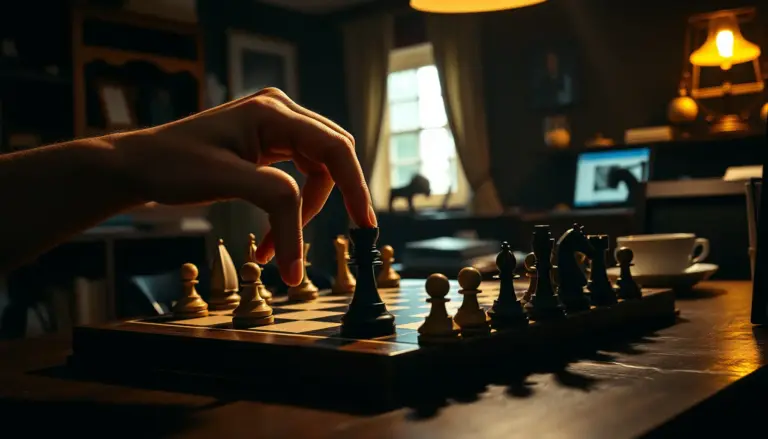
In the silence of a library, between the creaking of old pages and the murmur of ancient strategies, an object comes to life: the Staunton set. It is not just a set of pieces carved in wood or ivory, but a symbol of order in chaos, a standardization that allowed chess to transcend borders and become the universal language that we know today. Your design, apparently simple, contains a revolution: the democratization of a game that, until the middle of the 19th century, It was reserved for elites with boards as extravagant as they were incomprehensible. How some chess pieces managed to unify a world divided by languages, cultures and hierarchies?
The chaos before Staunton: when chess was a labyrinth of designs
Imagine sitting in front of a board in 1840. The pieces could be baroque porcelain figures, grotesque wooden carvings or even abstract representations that had little to do with their function. In the origin of chess, each region adapted the game to its aesthetics and available materials, creating a Tower that in Paris looked like a medieval castle, while in Moscow it was reminiscent of a Slavic fortress. This diversity, far from enriching the game, turned it into a logistical puzzle. International tournaments were a challenge not only because of the skill of the players, but because of the confusion that the pieces generated. How to calculate a Queen sacrifice if its shape varied so much that it was sometimes confused with a Bishop?
The problem was not trivial. In it London tournament 1851, considered the first international chess championship, The organizers were forced to improvise rules to identify the pieces during the games. This event, which marked the birth of modern chess, exposed the urgency of universal design. The solution would not come from a chess master, but from an architect and a game maker: Nathaniel Cook y John Jaques.
Staunton: the design that made chess a global standard
The Staunton set, patented in 1849, It was not a random creation.. Its design responded to three fundamental principles: clarity, hierarchy y functionality. The pieces, inspired by neoclassical architecture, They presented clean geometric shapes that made them instantly distinguishable.. The Tower, For example, adopted the silhouette of a stylized medieval fortress, while the Bishop was identified by his episcopal miter, a nod to his name in English (bishop). But the true genius of the design lay in the Lady: are corona, more elaborate than that of the King, reflected his power on the board, a detail that many previous sets overlooked.
The name “Staunton” it was not coincidental. Howard Staunton, the best English chess player of the time, lent his prestige to the project, becoming the face of the marketing campaign. His influence was such that, in less than a decade, The Staunton team won tournaments in Europe and America. However, His adoption was neither immediate nor peaceful.. In medieval Europe, chess had been a status symbol, and many nobles refused to abandon their handcrafted pieces for a modern design. “industrial”. The fiercest resistance came from traditional manufacturers, who saw Staunton as a threat to their businesses. But history proved standardization right: hoy, Any player can sit in front of a board in Tokyo, Buenos Aires or Cairo and instantly recognize each piece.
The hidden legacy: How Staunton shaped chess culture
Beyond its practical impact, The Staunton set had profound consequences on the evolution of chess. By standardizing parts, facilitated the dissemination of openings and strategies, as players could focus on the game instead of figuring out the pieces. This accelerated the development of chess theory, allowing games like “The Immortal” (1851) were analyzed and replicated around the world. Besides, Staunton's minimalist design influenced the perception of chess as a game of pure logic, moving it away from its past as aristocratic entertainment and bringing it closer to science and mental sports.
But his influence was not limited to the board.. The Staunton became a cultural icon, appearing in literary works, movies and even in conceptual art. In cinema and literature, Staunton pieces symbolize order in the midst of chaos, as in “The seventh seal” de Ingmar Bergman, where the chess game between the knight and Death acquires a metaphysical weight thanks to the familiarity of the pieces. Even in the digital age, where chess is played on screens, analysis engines like Stockfish or AlphaZero use virtual representations of Staunton, proving that its design transcends the physical.
Staunton in the digital age: An eternal design or a legacy at risk?
In the 21st century, chess faces a new revolution: digitization. Platforms like Lichess or Chess.com allow you to play with custom designs, from futuristic pieces to movie themed versions. Is the Staunton in danger of becoming a relic? The answer is complex. On the one hand, Its design remains the standard in official competitions, from the Candidates Tournament until the Chess Olympiads. On the other, Digital flexibility has allowed casual players to explore alternative styles, which could erode its hegemony in the long term.
However, the real challenge is not the competition from other designs, but the loss of your materiality. The Feel of a Staunton Boxwood Piece, the sound of a pawn advancing on the board, They are experiences that no screen can replicate. In a world where the chess online domina, the physical Staunton becomes a reminder that the game is, first of all, a human ritual. Maybe that's why, in 2024, Collectors pay thousands of dollars for original Staunton sets, not only as art objects, but as symbols of an era in which chess was tangible, strategic and deeply human.
Conclusion: Staunton as a mirror of chess evolution
The Staunton set was not just an aesthetic advance, but a catalyst that transformed chess into a global phenomenon. Your design, apparently simple, solved a problem that had limited the game for centuries: the lack of a common language. Hoy, when a child in Medellín and an old man in Tokyo move a Staunton pawn, They are participating in a tradition that unites generations, cultures and continents. But his legacy goes beyond the practical. Staunton embodies the essence of modern chess: a balance between tradition and progress, between art and science, between the individual and the collective. In a world where technology threatens to dehumanize the game, These pieces remind us that, in the end, chess is still a dialogue between two minds, a board and 32 pieces that, against all odds, they managed to change history.