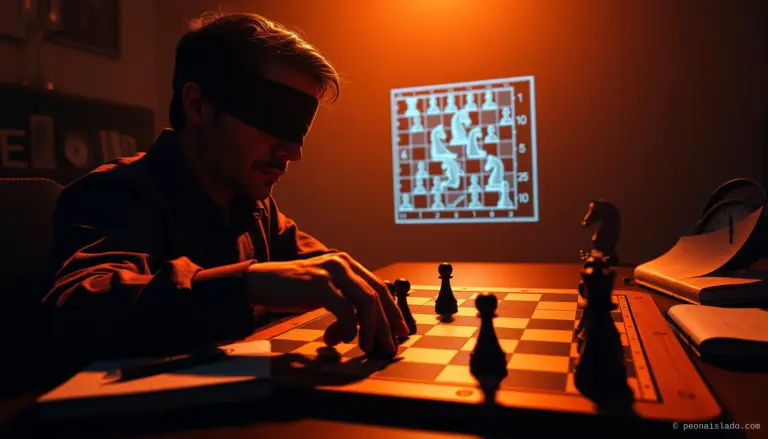
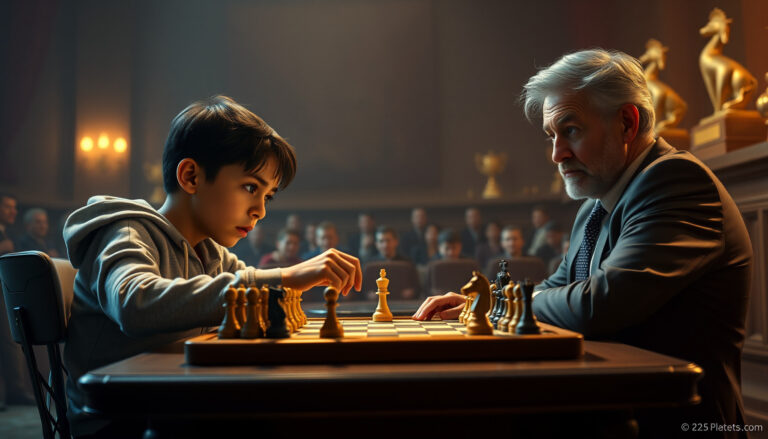
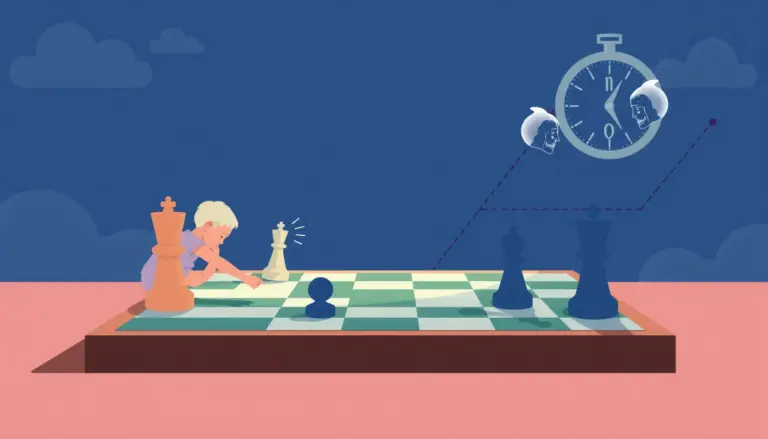
In a world dominated by digital hyperstimulation, constant notifications and fragmentation of care, a fascinating question arises: Is chess the last refuge of pure concentration? This ancient game, that has challenged brilliant minds throughout history, demands something increasingly scarce in the modern era: the ability to immerse yourself in a state of absolute focus. Unlike other activities that promise relaxation or productivity, chess does not allow distractions. Every move requires deep analysis, anticipation and an almost meditative connection with the board. But, why this game, and not others, seems to resist the cognitive chaos that surrounds us? Is it really an oasis of concentration or just a romantic illusion? In the following lines, We will explore how chess stands as a unique laboratory for the mind, analyzing its impact on cognition, its contrast with the culture of immediacy and its role as a tool to train attention in a world that seems determined to sabotage it.
Chess as a mental gym: how to train concentration
Chess is not just a game; it's a systematic training of sustained attention. Studies in neuroscience, such as those carried out by the United States National Institute of Health, have shown that playing chess activates brain areas associated with working memory, strategic planning and inhibitory control, such as the prefrontal cortex and basal ganglia. Unlike passive activities, like watching TV or scrolling through social media, chess requires a selective attention: the player must filter out irrelevant information (such as environmental noise or intrusive thoughts) to focus on patterns, Tactics and possible moves of the opponent.
A classic experiment, published in the magazine Nature in 1991, compared the brain activity of chess players with that of non-players while they solved mathematical problems. The results showed that the chess players not only processed information faster, but they also did so with greater metabolic efficiency, that is to say, your brain consumed less energy to achieve the same level of performance. This suggests that chess optimizes concentration by forcing the brain to operate in a state of flow, that psychological state described by Mihaly Csikszentmihalyi in which the person is completely immersed in a task.
However, It's not just about focusing on the present. Chess also trains the divided attention, since the player must alternate between tactical analysis (immediate movements) and the strategic (long term planning). This duality makes it a unique tool: while activities like meditation work on full attention on a single object, chess requires a dynamic concentration, able to adapt to constant changes on the board.
The paradox of the digital age: why chess resists distraction
We live in the attention economy, a term coined by philosopher Matthew Crawford to describe a system that competes fiercely for our time and focus. Social networks, Recommendation algorithms and addictive app design are optimized to capture our attention in increasingly shorter fragments. According to a Microsoft study in 2015, The human attention span has decreased 12 seconds in the year 2000 alone 8 seconds today, a span shorter than that of a goldfish (9 seconds).
In this context, chess emerges as a act of cognitive resistance. Unlike platforms like TikTok or Instagram, that reward instant gratification, chess does not offer immediate rewards. A player can spend hours analyzing a position without finding a clear solution, and success does not depend on “I like” or algorithms, but of the ability to sustain mental effort. This characteristic aligns it with what psychologist Anders Ericsson called deliberate practice: a training that requires leaving the comfort zone to improve specific skills.
Besides, chess contrasts with digital multitasking, a myth that has been debunked by science. A study from Stanford University in 2009 revealed that people who consider themselves “multitask” They are actually worse at filtering out irrelevant information and switching from one task to another.. chess, instead, punishes distraction: An error due to lack of concentration can cost you the game. This selective pressure makes it an antidote to mental fragmentation., forcing the player to commit to a single activity for long periods.
Beyond the board: How chess shapes the mind outside of the game
The benefits of concentration trained with chess are not limited to the board. Research in education, like those carried out by the program Chess in Schools in New York, have shown that students who learn chess improve their academic performance, especially in mathematics and reading comprehension. This is because the game develops transferable skills, like the problem solving, the decision making under pressure and the strategic patience.
An emblematic case is that of the elite players, like Magnus Carlsen or Garry Kasparov, whose minds have been studied for their ability to process complex information. In an experiment at the University of California, Kasparov's brain activity was measured while he played quick games. The results showed that his brain activated neural networks associated with episodic memory (to remember past games) and the mental simulation (to anticipate future movements), skills that are also crucial in fields such as engineering or medicine.
But chess's most profound impact may be in its ability to reconfigure the relationship with time. In a society obsessed with speed, chess teaches to value reflective pause. As the great teacher Jonathan Rowson wrote: “Chess is a game of active waiting, where patience is not passivity, but a form of intelligence”. This mentality contrasts with the culture of immediacy, where impatience is rewarded with digital dopamine. By forcing the player to slow down their thinking, chess acts as a cognitive corrective, reminding us that depth takes time.
Is chess really the last refuge? Criticisms and limitations
Despite its virtues, Chess is not a panacea for the modern attention crisis. First of all, are accessibility is limited. Although platforms like Chess.com or Lichess have democratized the game, Competitive chess requires a level of dedication that not everyone can afford. Besides, Its learning curve is steep.: master openings, Tactics and endings require hundreds of hours of study, something difficult to reconcile with everyday life in the era of accelerated productivity.
Another criticism is that chess, in its purest form, can become insulating. Unlike sports or social activities, classical chess is played in silence, facing an opponent, no external stimuli. This makes it an almost monastic experience., which can be therapeutic for some but overwhelming for others. As psychologist Barry Schwartz points out, author of The Paradox of Choice, “extreme concentration can be as exhausting as constant distraction”.
Finally, chess is not exempt from the vices of the digital age. The rise of fast chess (blitz o bullet) on online platforms has led many players to prioritize speed over depth, replicating on the board the same patterns of immediate gratification that the game was intended to combat. A study from the University of Oxford in 2020 found that rapid chess players showed higher levels of cortisol (stress hormone) than those who played classic games, suggesting that even this refuge can become contaminated with anxiety about immediacy.
Conclusions: chess as a mirror and tool
Chess is not, strictly speaking, he “last refuge” of pure concentration, but it is one of the more effective laboratories to train her in a world that seems designed to sabotage her. Its greatness lies in the fact that, unlike other activities, does not offer shortcuts: Every game is a reminder that depth takes time, effort and, above all, the willingness to resist distractions. In this sense, chess acts as a mirror of our cognitive capacity, revealing both our strengths and our limitations.
However, Its value goes beyond the board. In an era where attention has become a scarce resource, Chess teaches us that concentration is not just a skill, but one form of resistance. It's not about isolating yourself from the world, but to learn to navigate it with greater clarity. As the philosopher Walter Benjamin wrote, “attention is the soul's natural form of prayer”. Maybe, in a future dominated by artificial intelligence and hyperconnectivity, Chess continues to be one of the few spaces where human beings can exercise this act of rebellion.: choose to focus.
Is chess the definitive solution to the attention crisis? No. But it is, definitely, one of the most powerful tools to remind us that concentration is not a luxury, but a necessity. And in a world that pushes us to the opposite, that's already a lot.