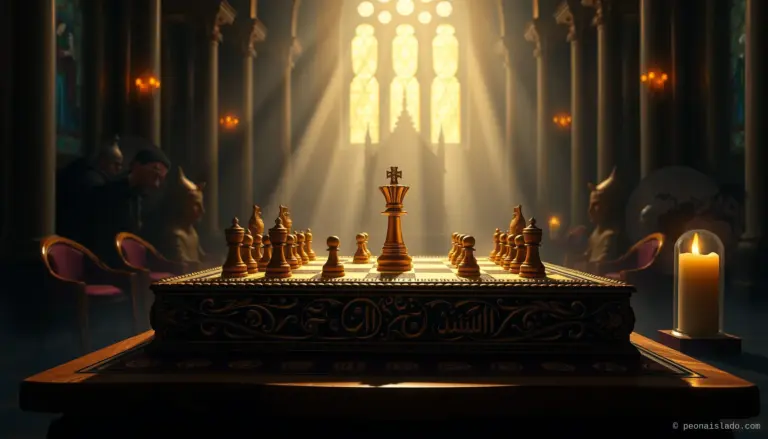
Chess has transcended its status as an ancient game to become a cultural phenomenon that fuses strategy, aesthetics and spectacle. In recent years, Its presence at global festivals has redefined its perception, transforming it into a form of performance art where the intellectual and the visual intertwine. From live choreographed games to urban interventions that challenge conventions, Chess is exhibited as a universal language capable of dialogue with disciplines such as dance, theater and visual arts. This article explores how this evolution not only enriches the viewer's experience, but also raises questions about the future of chess as an artistic expression. Can a game 1.500 years to reinvent itself without losing its essence? What role do festivals play in this metamorphosis?? Through concrete examples and in-depth analysis, We will unravel the keys to this expanding phenomenon.
Chess as performance: beyond the board
The idea that chess can be an artistic performance is not new, but its adoption in global festivals has accelerated its transformation. Unlike traditional games, where silence and concentration dominate, chess performances incorporate elements such as live music, multimedia projections and choreographed movements. A paradigmatic example is the Chess in Concert, a show created by the composer and chess player Tim Fain and the violinist Joshua Bell, where classical music accompanies games in real time, synchronizing notes with plays. This format not only attracts chess fans, but also to audiences seeking complex sensory experiences.
Another relevant case is the Human Chess, a tradition that dates back to the 15th century in Italy and that today is reinvented in festivals such as the Burning Man or the Edinburgh Festival. In these representations, Players wear elaborate costumes and their movements are accompanied by narrators who explain strategies as if it were a play.. The key here is theatricalization of thought: the spectator not only watches a game, but is witness to a mental process in action, where each piece acquires its own personality. According to a study by the Oxford University (2021), These types of performances increase audience retention in a 40% compared to conventional games, since they activate multiple senses simultaneously.
However, This evolution is not without criticism.. Chess purists argue that the incorporation of external elements distracts from the essence of the game.: the intellectual struggle between two minds. But defenders like the artist Yoko Ono, who in 2016 presented Play It by Trust —a facility where players must communicate verbally before moving—, They maintain that performative chess “free the game from its cage of silence”. The tension between tradition and avant-garde is, precisely, what makes this phenomenon fascinating.
Global festivals: the perfect setting for reinvention
Art and culture festivals have become laboratories where chess experiments with new formats. Events like the Avignon Festival in France, he SXSW in the United States or Festival of Lights in Lyon they have included chess in their programs, not as a complement, but as the protagonist. The reason is clear: These spaces offer the infrastructure and diverse audience necessary to explore the possibilities of chess beyond conventional tournaments..
A notable case is the Chess and Music Festival in Reykjavík, Iceland, where it is celebrated annually since 2018. This festival combines high-level games with concerts by artists such as Ólafur Arnalds, who composes pieces based on the emotions that the games evoke. The synergy between music and chess is not coincidental: studies of the University of California (2020) show that classical music, especially that of Bach o Mozart, improves the concentration of players in a 23%. En Reykjavík, this connection is taken to the extreme: the musicians improvise based on the plays, creating a unique soundtrack for each game.
But it's not just music festivals that bet on chess. He Cannes Film Festival surprised in 2022 con Chess on the Croisette, a facility where film directors like Wim Wenders y Agnès Varda They reinterpreted historical games through short films projected on giant screens. The idea was to show chess as a “cinematographic language”, where each movement is a plane and each strategy, a script. This approach attracted more than 50.000 spectators, many of whom were not chess players, demonstrating that the game can be a bridge between disciplines.
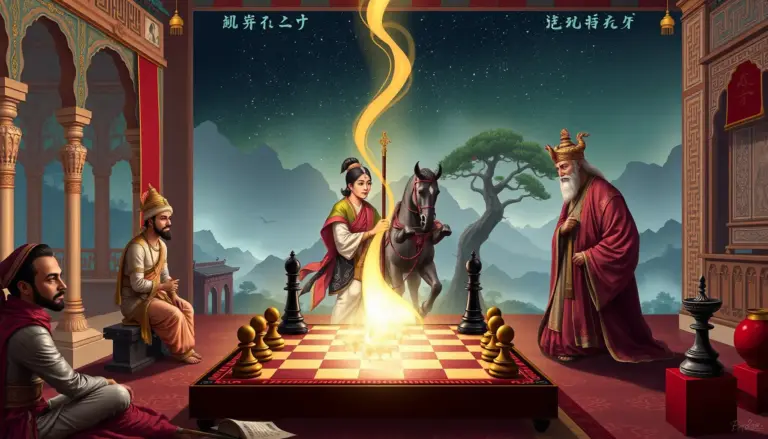
The globalization of these festivals has also allowed chess to adapt to diverse cultural contexts.. In it Shanghai Contemporary Art Festival, For example, showed up Chess as Calligraphy, a performance where the movements of the pieces were translated into ink strokes on rice paper, fusing chess with Chinese calligraphy tradition. These types of proposals not only enrich the repertoire of performative chess, but they also make it a cross-cultural phenomenon.
Technology as an ally of performative chess
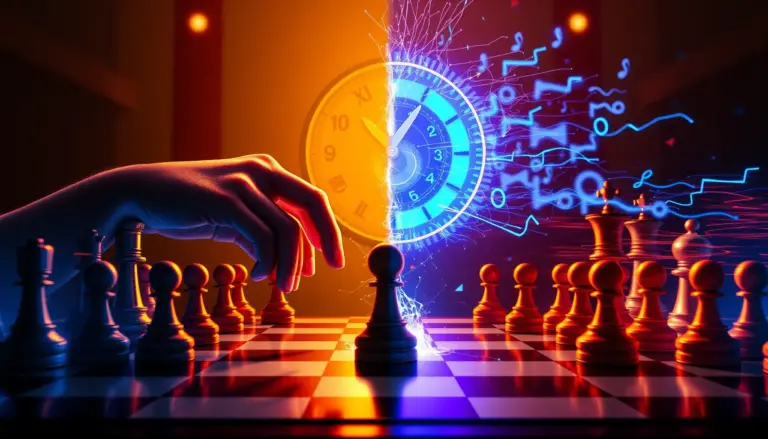
The integration of technology has been a key factor in the evolution of chess as a performance art. Tools like augmented reality (RA), artificial intelligence (IA) and interactive projections have made it possible to create immersive experiences that were previously unthinkable. A pioneering example is Chess: The Exhibition, presented in the Museum of Modern Art, New York (MoMA) in 2019. This exhibition used AR so that visitors could “to enter” in historical games, like that of Match of the Century between Bobby Fischer y Boris Spassky in 1972. Spectators could see the pieces move in 3D and hear feedback from players in real time, as if they were witnessing the event.
AI has also played a revolutionary role. In it London Innovation Festival of 2021, showed up DeepMind vs. Humanity, a performance where the public could challenge the chess engine AlphaZero on a giant board. The innovative thing was not the game itself, but the fact that AlphaZero explained its movements through holographic projections, breaking down your thought process visually. This not only democratized access to elite chess, but also turned it into a educational show. According to data from the International Chess Federation (FIDE), These types of events have increased youth participation in chess by a 30% in the last five years.
Another growing trend is the use of interactive boards at festivals. In it Tokyo Digital Art Festival, a board was installed 20 square meters where the players' movements activated sensors that generated visual and sound effects. For example, every time a piece was captured, an abstract animation inspired by the artist's style was projected TeamLab. This approach not only attracts a younger audience, but also redefines chess as a “multisensory experience”.
However, technology also poses challenges. Some critics argue that reliance on digital tools can dehumanize the game, reducing it to a mere visual spectacle. But defenders like the artist Rafael Lozano-Hemmer, known for its interactive installations, They maintain that technology “does not replace chess, but it amplifies it”. In his work Pulse Chess (2020), the players' heartbeats determined the speed of the pieces, creating an emotional connection between the audience and participants. These types of innovations show that technology is not an end in itself, but a means to explore new dimensions of chess.
The future of chess: until, sport or something else?
The growing popularity of performance chess at global festivals raises a fundamental question: Where is this phenomenon heading?? for some, like the great teacher Garry Kasparov, chess will always be a “mental sport”, and his foray into art is just a passing phase. For others, like the choreographer Sidi Larbi Cherkaoui, who in 2023 premiere Chess Dance in it Avignon Festival, chess is a “human conflict metaphor” that deserves to be explored in all its forms.
One of the most promising trends is the hybridization with other disciplines. In it Berlin Theater Festival, showed up Chess Opera, a work where the movements of the pieces determined the plot and the music. This format, known as “algorithmic opera”, could be the future of performance chess: an experience where the game, narrative and music merge in real time. According to a report from the UNESCO (2022), These types of proposals have the potential to attract audiences that are not traditionally interested in chess., like theater or dance lovers.
Another possibility is the expansion of urban chess. Cities like Berlin, Lisboa y Buenos Aires They have already organized giant games in public squares, where spectators can interact with players. In 2023, he London Public Art Festival took this idea a step further with Chess in the Sky, an installation where pieces were moved by drones, creating a visual spectacle in the night sky. These types of events not only democratize chess, but they also make it a community symbol.
But the biggest challenge will be maintaining the balance between innovation and tradition.. As the chess historian points out Harold James, “Chess is a game with immutable rules, but its cultural meaning is constantly evolving”. Global festivals have shown that chess can be many things at once: a sport, an art, a show and even an educational tool. The challenge now is to ensure that this reinvention does not dilute its essence, but enrich it. In the words of the artist Marcel Duchamp, who was a passionate chess player: “Chess is a game, but it's also a way of thinking. and the thought, when shared, becomes art”.
Chess as performance art at global festivals is not just a fad, but a natural evolution of a game that has accompanied humanity for centuries. From its origins as a royal pastime to its transformation into a multidisciplinary show, Chess has demonstrated a unique ability to adapt to the times without losing its essence.. The examples analyzed—from choreographed performances to technological installations—reveal that this reinvention is not superficial., but it responds to a cultural need: that of finding new ways to connect with the public.
Global festivals have been the catalyst for this transformation, offering a space where chess can dialogue with other disciplines and reach diverse audiences. However, This phenomenon also raises important questions: To what extent can chess stretch its limits without breaking?? How to balance innovation with respect for its ancient tradition? The answer, as we have seen, it is not simple, but yes clear: performative chess does not seek to replace classical chess, but to expand your possibilities.
In a world where public attention is increasingly fragmented, chess has found a way to stay relevant in performance art. It's no longer just about winning or losing., but to create experiences that excite, inspire and, above all, invite reflection. As the philosopher said Walter Benjamin, “art is the ability to make the invisible visible”. In the case of chess, This means revealing the hidden beauty in every movement., in each strategy, in every game. And global festivals, with its ability to bring together the best of art, technology and culture, They are the perfect setting to achieve it.
The future of chess as a performance art is promising, but also uncertain. It will depend on the creativity of the artists, the opening of festival organizers and, above all, of the public's willingness to accept new ways of experiencing this eternal game. One thing is for sure: chess is no longer just a board and 32 parts. It is a universal language, a performance in constant evolution and, maybe, the oldest art in the world.