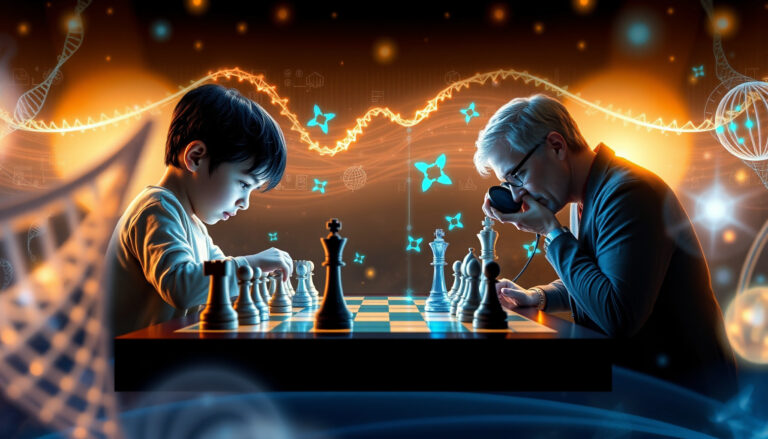
In a world where geopolitical conflicts seem to divide people to the core, There is a space where Israeli and Palestinian children can meet without flags or borders: the chess board. This ancient game, more than just a hobby, has become a symbolic bridge in the midst of tension, demonstrating that even in the most adverse contexts, humanity can find points of connection. But, How does chess transcend the barriers of conflict? What lessons of peace, resilience and empathy can be drawn from these shared experiences? Through real stories, testimonies and psychological analysis, We will explore how chess not only teaches strategy, but also the ability to see others beyond the stereotype. From inter-community tournaments to educational programs that challenge prejudices, This article delves into the transformative power of a game that, in times of war, becomes an act of peaceful resistance.
Chess as a universal language in conflict zones
chess, with its precise rules and symmetrical structure, works like a language that does not require translation. In regions such as Israel and Palestine, where political and social dialogue is often loaded with mistrust, This game offers a neutral framework where participants can interact without the historical or ideological burdens that usually cloud other spaces.. Studies in cognitive psychology, like those made by Institute for the Study of Conflict Transformation, suggest that strategy games activate brain areas associated with empathy and perspective taking, essential conflict resolution skills.
In cities like Jerusalem or Hebron, where tensions are palpable, organizations like Chess4Peace have implemented programs that bring together children from both sides of the conflict. These meetings do not seek to ignore the differences, but to create a space where the rules of the game—and not those of hate—dictate the pace of interaction. For example, in a tournament organized in 2022 in the city of Ramallah, Israeli and Palestinian children played games while their families, initially skeptical, They watched from the stands. What started as a sporting event ended up being an exercise in mutual trust., where participants learned that, beyond political narratives, everyone shares the desire to win, but also respect for the rules.
However, chess is not a magic solution. Its effectiveness depends on how it is implemented. Poorly designed programs can fall into tokenismo, where meetings are reduced to symbolic gestures with no real impact. To avoid this, successful initiatives combine play with dialogue workshops, where children reflect on their experiences on the board and how these relate to their lives outside of it. So, chess becomes a tangible metaphor for negotiation, patience and emotional management, key tools to navigate a conflict that, in many cases, have inherited without having chosen.
From rivals to colleagues: how chess redefines relationships
One of the biggest challenges in conflict zones is the dehumanization of the other. The media, Political narratives and even everyday conversations often reduce Israelis and Palestinians to simplistic stereotypes: he “oppressor” and the “oppressed”, he “terrorist” and the “colonist”. chess, by requiring players to sit face to face, break this dynamic. When a Palestinian child and an Israeli child share a board, They stop being symbols and become individuals with names., strategies and, above all, emotions.
An emblematic case is that of Mohammed and Daniel, two teenagers who met at a tournament in Tel Aviv. Mohammed, East Jerusalem Palestinian, He came to the event with the idea that all Israelis were equal: soldiers or colonists. Daniel, for his part, I had grown up hearing that the Palestinians were a threat. During your departure, Mohammed made a tactical error that left him at a disadvantage. Instead of gloating, Daniel offered him advice: “If you move your bishop here, you can defend yourself better”. that gesture, apparently small, changed the perception of Mohammed. “I didn't expect you to help me”, he later confessed. “I thought I just wanted to win”.
Experiences like this show that chess not only teaches you to think several moves ahead, but also to anticipate the emotions of the other. In a context of conflict, where violence is usually the immediate response, Learning to read your opponent's intentions—without assuming the worst—is a revolutionary skill.. Organizations like PeacePlayers International, who adapted his basketball methodology to chess, have documented how these encounters reduce levels of anxiety and hostility in participants. A study published in the Journal of Conflict Resolution in 2021 found that children who participated in cross-community chess programs showed a 30% more willingness to interact with the “other” compared to control groups.
But the real change occurs when these interactions transcend the board. In some cases, Children who meet at tournaments end up visiting their rivals' houses, sharing meals and discovering that, beyond political differences, They share tastes in music, video games or even the football team itself. These moments of normality are subversive in a context where normality is usually the exception.
Chess as a pedagogical tool: teaching peace in the classrooms
If chess can be a bridge between communities in conflict, Its potential as an educational tool is even more promising. In schools in Israel and Palestine, where curricula are often loaded with exclusive national narratives, Chess has been integrated as a subject that teaches cognitive and social skills without entering into political debates. The International Chess Federation (FIDE) has promoted programs such as Chess in Schools, that not only improve academic performance—studies in Spain and Türkiye have linked chess with better results in mathematics and reading—, but they also promote values such as respect, patience and resilience.
In the Israeli city of Sderot, a few kilometers from the Gaza Strip, the school ORT Sderot implemented a chess program after the rocket attacks 2021. The teachers noticed that the children, many of them with symptoms of post-traumatic stress, They found in the game a space of control in the midst of chaos. “when you play chess, you know that if you lose, It's not because someone shot you., but because you made a mistake”, a teacher explained. “That gives them a sense of agency that they don't have in other aspects of their lives.”.
On the Palestinian side, Schools in the West Bank have adopted chess as part of a pedagogical approach called peace education. In the city of Nablus, the organization Palestinian Chess Federation works with teachers to design lessons where chess is used to discuss topics such as negotiation, sacrifice and the importance of thinking before acting. For example, in a class, Students analyze historical games—such as Bobby Fischer against Boris Spassky in 1972—and debate how the political tension between the United States and the USSR was reflected on the board. Then, apply those lessons to everyday situations, how to resolve conflicts in the schoolyard.
The challenge, however, is to scale these programs without losing their essence. In a context where education is usually an ideological battlefield, Some parents and authorities view chess with suspicion. “Why teach our children to play with the enemy?”, asked a Palestinian father at a school assembly. The response of educators is clear: it's not about playing con the enemy, but to learn to play despite of the differences. chess, in this sense, It is not an end in itself, but a means to develop critical minds capable of questioning hate narratives.
The limits of chess: when the board is not enough
Despite its potential, chess is not a panacea. In a conflict as deep-rooted as the Israeli-Palestinian, where historical wounds and structural injustices persist, a game cannot solve problems that require political solutions. Critics of these programs point out that, at best, chess offers a temporary respite, but it does not address the root causes of the conflict: the occupation, the settlements, the blockade of Gaza or the lack of a Palestinian state.
An illustrative example is that of Children, a Palestinian girl 12 years he participated in a tournament in Haifa. Although he enjoyed playing with Israeli children, returning home to a refugee camp in the West Bank, reality hit her hard: his father had been detained by the Israeli army without charge, and his older brother had been injured in a protest. “What's the point of winning at chess if I can't win at life??”, he asked his mother. This testimony reflects an uncomfortable truth: chess can teach strategic thinking, but it cannot change the rules of a political game that, for many, it's rigged from the beginning.
Besides, There is a risk that these programs will be exploited. Governments or international donors can use them to show an image of “paz” without committing to real changes. In 2019, a report of Human Rights Watch criticized some NGOs for organizing meetings between Israeli and Palestinian children while ignoring human rights violations in the occupied territories. “You cannot talk about peace when there are Palestinian children who cannot go to school because of the checkpoints”, one activist warned.
This does not mean that chess should be abandoned, but must be complemented with concrete actions. Some organizations, as Combatants for Peace, They combine chess with political advocacy campaigns, using children's stories to push for changes to occupation policies. Others, as Hand in Hand, They integrate chess into bilingual schools where Israelis and Palestinians study together, demonstrating that coexistence is possible when there is political will.
chess, so, It is a powerful tool, but limited. Its true value lies in its ability to sow seeds of empathy in younger generations., but these seeds will only flourish if they find fertile soil. In a conflict where every gesture of peace is met with skepticism, chess offers modest hope: the one that, even in the darkest moments, there is room to move a piece and change the course of the game.
Conclusions: the checkmate of hate
Chess in times of conflict is not a magic solution, but a powerful metaphor for what peace could be: a game where the rules are clear, where every movement has consequences and where, in the end, the important thing is not just to win, but to play with dignity. Throughout this article, we have seen how Israeli and Palestinian children, separated by physical walls and narratives of hate, They find a space on the board where they can be simply that: children. Not soldiers, not victims, not symbols of a conflict they did not choose, but strategists, rivals and, sometimes, friends.
However, chess also reminds us of its limits. Can't stop a bullet, nor tear down a wall, nor return the land to those who lost it. Its power lies in something more subtle: the ability to humanize the other. When a Palestinian child and an Israeli child sit in front of a board, They stop being enemies to become two people who share the same desire to win., the same frustration when faced with a mistake and the same joy when faced with a brilliant play. In a context where dehumanization is a tool of war, this simple act is revolutionary.
But the most important lesson that chess leaves is that peace is not a destiny, but a process. Every game is an opportunity to practice patience, negotiation and respect, skills that, if they are grown, can transcend the board. The challenge now is to scale these experiences without losing their essence, integrating them into educational systems and public policies that prioritize coexistence over division. As Grandmaster Garry Kasparov said: “Chess is life in miniature”. In Israel and Palestine, where life is marked by conflict, chess offers a miniature of what could be: a game where everyone has the same opportunities, where the rules are fair and where, in the end, what matters is not who wins, but how it was played.
Maybe, so, the true checkmate is not against the rival, but against hate. and in that game, Every child who chooses to move a piece instead of building a wall is winning..