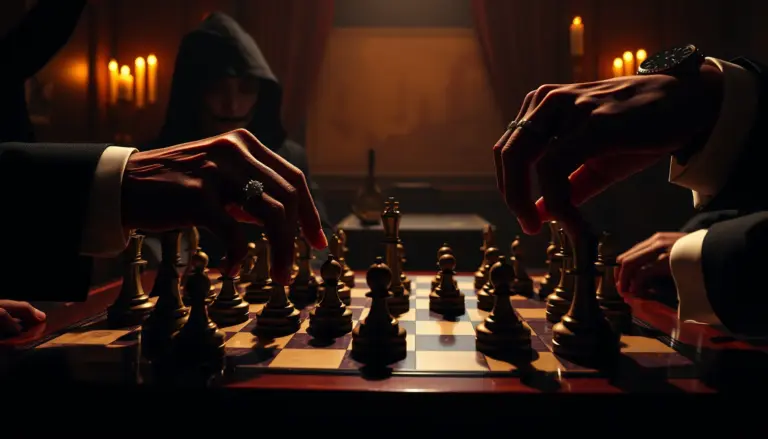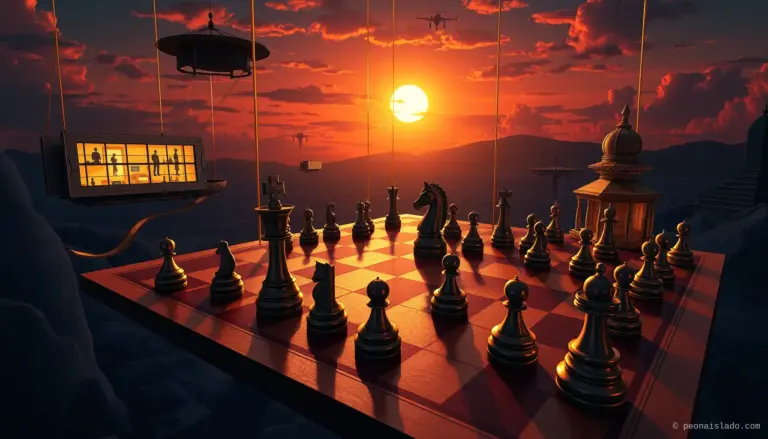
Chess is an ancient game that has transcended borders, cultures and even times. But, What happens when this mental sport is taken beyond the limits of the earth?? He chess played in space It's not just a scientific curiosity, but a milestone that combines strategy, technology and human exploration. From the first symbolic games to the logistical challenges of moving pieces in zero gravity, This topic opens up a whole range of questions.: How does lack of gravity affect tactical thinking? What role does artificial intelligence play in games thousands of kilometers from Earth? And what meaning does this game have in the lives of astronauts?, where the insulation and pressure are constant?
In this article, We will explore the historical origins of this practice, the technical challenges involved, its psychological impact on the crew and the innovations that could define the future of chess outside our planet. Why, after all, space is not just the last limit of exploration, but also the most extreme scenario to test the human mind.
The first movements: chess as a symbol of space conquest
The relationship between chess and space began as a symbolic gesture, almost poetic. In 1970, during the mission Apollo 13, astronauts Jim Lovell and Fred Haise played a game against the NASA control center in Houston. Although the game was never completed due to the emergency that the mission faced, This moment set a precedent: chess as a tool to maintain the connection between Earth and the cosmos. It wasn't just a game, but a way to humanize technology and remember that, even in the vacuum of space, creativity and strategy remained essential.
But the real milestone came in 1975, when Soviet cosmonauts Anatoly Filipchenko and Nikolai Rukavishnikov, on board the station Salyut 4, They played the first official chess game in space against the control team in Moscow. This game, broadcast live, showed that chess could be a bridge between cultures and political systems, even in the middle of the Cold War. The board used was an adapted version, with magnetic pieces to prevent them from floating, and the movements were communicated by radio. Although the game ended in a draw, Its true value was intangible: proved that, in space, Human ingenuity was still as important as technology.
These first attempts were not only public relations exercises, but also proofs of concept. They showed that, even in extreme conditions, Human beings could maintain complex intellectual activities, something crucial for long duration missions. Besides, laid the foundation for future innovations, such as the use of digital boards and the integration of artificial intelligence in spatial play.
Technical challenges: how to play chess in zero gravity
Playing chess in space is not as simple as taking a conventional board to the International Space Station (EEI). Zero gravity poses unique problems that require creative solutions, from the design of the parts to the way in which movements are recorded. One of the biggest obstacles is preventing parts from floating and getting lost in the cabin, which could become a danger to the ship's systems. To solve this, engineers have developed several strategies:
- Magnetic parts: Early versions of space boards used magnets on the bases of the pieces to keep them stationary.. However, This method had limitations, such as interference with other electronic equipment or difficulty moving parts accurately.
- Velcro: In some missions, Velcro has been used to adhere the pieces to the board. Although it is a simple solution, not ideal for quick games, as the velcro can wear out or collect dust over time.
- Digital boards: The most advanced solution so far is the use of touch screens or tablets with chess software. These devices allow you to record movements with a simple touch, eliminating the risk of parts moving unintentionally. Besides, can be integrated with communication systems to play against opponents on Earth in real time.
Another challenge is communication. In the first games, movements were transmitted by radio, which could cause confusion due to latency or audio quality. Hoy, with internet connections on the ISS, astronauts can play on platforms like Chess.com o Lichess, although latency is still a factor to consider. On more distant missions, like those planned to Mars, delay in communications (which can be up to 20 minutes) will force you to rethink how games are developed, possibly turning to artificial intelligence as an opponent.
Finally, there is the issue of ergonomics. in zero gravity, astronauts cannot sit in a conventional chair, so they must adapt their posture to play. Some have chosen to be strapped in or float freely while interacting with the board.. This not only affects comfort, but also concentration, since the human body is not designed to maintain a stable posture in these conditions.
Chess as a psychological tool in space missions
Life in space is a challenge not only physical, but also mental. Astronauts spend months in confined spaces, away from their families and under high levels of stress. In this context, Chess has become a valuable psychological tool, capable of offering benefits that go beyond entertainment.
First of all, chess acts as a cognitive exercise. Studies have shown that playing chess regularly improves memory, concentration and problem-solving ability, critical skills in missions where a mistake can have serious consequences. For astronauts, Keeping your mind active is as important as keeping your body in shape., and chess offers a structured way to do it.
In second place, the game encourages socialization and teamwork. On the ISS, where crew members of different nationalities live together, Chess has been used as an icebreaker activity and to strengthen bonds between crew members.. Friendly games or internal tournaments help relieve tension and create a sense of community, essential in prolonged isolation environments. Besides, play against opponents on Earth, whether other astronauts or fans, provides an emotional bond with the planet, reducing the feeling of disconnection.
Finally, chess can be a emotional escape valve. In high pressure situations, like the ones astronauts face, the game offers a space of control and predictability. Unlike the unpredictable variables of space, chess has clear rules and a finite board, allowing players to focus on something tangible and manageable. This is especially useful on long-duration missions., where monotony and anxiety can affect performance.
However, not everything is benefits. Chess can also be a source of frustration if players become obsessed with winning or if games become too competitive.. That's why, on the ISS, a playful and collaborative approach is encouraged, where the main objective is enjoyment and not extreme competition. Besides, variants of the game have been developed, such as team chess or blitz chess, to adapt to the psychological needs of the crew.
The future of chess in space: artificial intelligence and extraterrestrial colonies
Chess in space won't stop at the ISS. As humanity moves toward more ambitious missions, such as the colonization of Mars or the construction of lunar bases, the game will evolve to adapt to these new scenarios. One of the most promising innovations is the integration of artificial intelligence (IA), that could transform the way astronauts interact with chess.
On missions to Mars, where communication with Earth will be delayed by several minutes, playing against a human opponent in real time will be impossible. This is where AI comes into play. Systems like Stockfish o Leela Chess Zero could be installed in on-board computers, allowing astronauts to play challenging games without relying on an external connection. Besides, AI could be customized to suit each player's skill level, offering constant training and avoiding the frustration of games that are too difficult or too easy.
Another possibility is the development of holographic boards. Instead of relying on touch screens or physical parts, astronauts could interact with three-dimensional projections that simulate a real board. This would not only solve the problem of zero gravity, but it would also add a layer of immersion to the game, making the experience closer to playing on Earth. Companies like Microsoft y Magic Leap They are already exploring similar technologies for terrestrial applications, so its adaptation to space could be a matter of time.
But chess in space will not be limited to being a hobby. In extraterrestrial colonies, could become a educational and cultural tool. Imagine schools on Mars where children learn chess as part of their curriculum, not only to develop cognitive skills, but also to keep alive a terrestrial tradition. Besides, Gaming could serve as a universal language in multiethnic communities, where people from different backgrounds can connect through a shared activity.
Finally, chess could play a role in robotic exploration. On unmanned missions, like those sent to the moons of Jupiter or Saturn, robots could be programmed to play chess against each other or against operators on Earth. This would not only serve as proof of your cognitive abilities, but also as a way to keep ground teams mentally active during long waits between communications.
Conclusions: chess as a mirror of humanity in the cosmos
Chess played in space is much more than a curious anecdote: It is a reflection of the human capacity to adapt, innovate and find meaning even in the most hostile environments. From its humble beginnings as a symbolic gesture during the Cold War to its evolution as a psychological and technological tool on the International Space Station, This game has proven to be a faithful companion in the exploration of the cosmos. It has not only served to keep the astronauts' minds active, but also to remember that, even thousands of kilometers from Earth, Creativity and strategy continue to be pillars of the human experience.
As we move towards an era of extraterrestrial colonies and interplanetary missions, chess will continue to evolve. artificial intelligence, Holographic boards and new game variants will become essential elements of life in space, not just for entertainment, but as tools for education, socialization and mental well-being. In a future where humanity expands beyond Earth, chess could become a symbol of our collective identity, a reminder that, no matter where we are, Pursuing intellectual challenges and connecting with others will continue to be part of what makes us human..
But beyond technology and innovation, chess in space leaves us a profound lesson: in a vast and indifferent universe, Human beings still need games, art and activities that give meaning to our existence. The board, whether physical or digital, thus it becomes a small universe where, at least for a moment, we can feel like we are in control. and maybe, in that gesture as simple as moving a piece, let's find the key to continue exploring, not just space, but also the limits of our own mind.