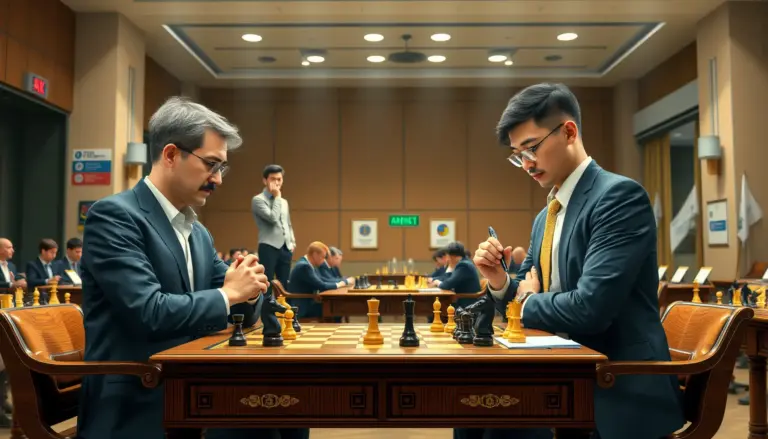
In the heart of West Africa, where creole languages weave the cultural identity of their people, a fascinating initiative emerges: the translation of chess into these languages. Guinea-Bissau, a country with a rich linguistic diversity, has become a unique scenario where the ancient game is adapted to break barriers and strengthen social cohesion. More than just a hobby, chess in creole languages like creole becomes a tool of inclusion, community education and empowerment. This article explores how this innovative proposal not only preserves oral traditions, but also redefines the role of chess as a bridge between generations and cultures.
Chess as a universal language in a multicultural context
Guinea-Bissau is a mosaic of ethnicities and languages, where the creole —a creole language based on Portuguese—acts as lingua franca among its inhabitants. However, Linguistic diversity has historically been a challenge for education and communication. chess, with its universal rules, emerges as an ideal means to transcend these differences. When translating its technical terms—such as “jack dead” (land mat a Creole) o “castling” (year)— something deeper than a simple adaptation is achieved: the cultural identity of the communities is validated.
This translation is not a mechanical process, but a reinterpretation that respects the essence of the game. For example, in some local variants, the movement of the horse is described with metaphors linked to African fauna, as “jump like an antelope”. These adaptations not only facilitate learning, but they also enrich chess with their own narratives, making it a reflection of the Guinean worldview.
Education and empowerment: chess as a pedagogical tool
In a country where access to formal education is limited, Chess in Creole languages is presented as an accessible alternative to develop cognitive skills. Programs like Xadrez na Kriol (Chess in Creole) have shown that, when teaching the game in the students' native language, understanding of abstract concepts such as strategy and anticipation is improved. This is especially relevant in rural areas., where the creole is the dominant language.
Besides, chess promotes values such as patience, discipline and critical thinking, essential competencies in contexts of poverty and inequality. Non-governmental organizations have implemented workshops in schools and community centers, where children and adults learn not only to move pieces, but to solve everyday problems with a logical approach. A study conducted in Bissau revealed that participants in these programs showed a 30% improvement in your ability to concentrate and make decisions.
A bridge between generations: cultural preservation and transmission of knowledge
Chess in Creole languages not only benefits new generations, but also revitalizes the interest of the elderly in sharing their knowledge. Not Guinea-Bissau, where orality is a cultural pillar, Elders play a crucial role in passing down stories and traditions. By incorporating chess into this legacy, a unique intergenerational dialogue is created.
For example, In communities like those of the balance sheet oh go flower, grandparents teach their grandchildren not only the rules of the game, but also proverbs and sayings that accompany every movement. Phrases like “Si ku ta pensa ku kabesa, you will lose at chess” (“Who thinks with his head, does not lose at chess”) They encapsulate life lessons that transcend the board. This dynamic strengthens family and community ties, while preserving linguistic heritage.
Challenges and opportunities: the path to sustainability
Despite its benefits, the implementation of chess in creole languages faces obstacles. The lack of economic resources and the scarcity of teaching materials in creole are significant barriers. However, collaborative initiatives between the government, NGOs and the Guinean diaspora are beginning to change this panorama. Projects such as the creation of illustrated manuals and the training of local monitors have proven to be effective in scaling the proposal.
Another challenge is the standardization of chess terms in creole, since there are dialect variations between regions. To address this, Participatory workshops have been organized where linguists, Players and community members agree on common terminology. This process not only unifies the language, but also reinforces the sense of belonging.
Looking to the future, the potential of chess in creole languages is immense. Your ability to combine education, culture and social cohesion positions it as a key tool for sustainable development. If it can be consolidated, This model could be replicated in other countries with linguistic diversity, proving that chess is much more than a game: It is a catalyst for change..
Conclusions: chess as a symbol of unity and cultural resistance
Guinea-Bissau's experience with chess in creole languages is a testament to the transformative power of culture. In a world where linguistic differences often divide, This initiative demonstrates that play can be a common language that unites. By adapting chess to creole and other local languages, Not only is learning easier, but rather the identity of historically marginalized communities is vindicated.
The benefits are tangible: from improving cognitive skills to revitalizing oral traditions. However, The true value of this project lies in its ability to generate dialogue and collaboration between generations, ethnicities and social classes. In a country with structural challenges, chess becomes a symbol of resistance and hope.
For this proposal to reach its maximum potential, The continuous support of institutions and civil society is essential. Only in this way will chess in creole languages stop being an isolated innovation and become a lasting legacy. Ultimately, This effort reminds us that culture is not an obstacle, but a bridge to a more inclusive and cohesive future.