In the heart of West Africa, where tradition and creativity masterfully intertwine, Guinea emerges as a reference in the art of ebony carving. Among its most fascinating manifestations is chess., not only as a strategic game, but as an artistic expression that transcends the functional to become a cultural legacy. Conakry, the vibrant Guinean capital, houses workshops where artisans transform ebony wood into unique pieces, loaded with symbolism and precision. This article explores how ebony-carved chess in Guinea is not just a hobby, but a bridge between ancestral craftsmanship and contemporary art, reflecting the identity of a town and its connection with nature. From the secrets of wood to the cultural and economic impact, We will discover why these pieces are much more than simple objects: They are testimonies of a heritage that lasts.
The Guinean Ebony: a wood with soul
The ebony, scientifically known as Diospyros crassiflora, It is one of the most valued woods in the world for its density, deep black color and wear resistance. In Guinea, This species grows in the forested regions of the southeast, especially in the prefecture of Nzérékoré, where trees can reach heights of up to 20 metros. However, Its exploitation is not without challenges: Indiscriminate logging and lack of regulation have put its sustainability at risk, leading artisans to look for alternatives such as plantation ebony or similar woods such as Dalbergia melanoxylon (african ebony).
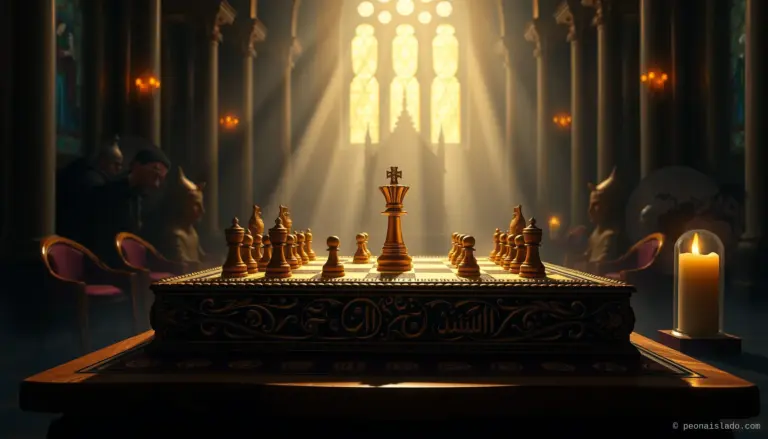
What makes Guinean ebony unique is its ability to absorb centuries of artisanal techniques.. Local carvers, many of them heirs of family lineages, They work wood with traditional tools such as gouges, chisels and manual sanders. The process begins with drying in the open air for months, followed by meticulous carving that can extend for weeks. each piece, either a pawn or a queen, It is polished to a shine that highlights the natural grains of the wood., creating a hypnotic visual contrast.
Beyond its aesthetic beauty, Guinean ebony carries with it deep cultural meaning. In many communities, Wood is believed to have spiritual properties., acting as a link between the earthly world and the ancestral world. This belief is reflected in the designs of the chess boards., where geometric motifs inspired by local cosmogony are often incorporated, such as spirals that symbolize the cycle of life or triangles that represent the connection between the sky, the earth and the underworld.
Chess as a canvas: techniques and symbolism in Conakry
In the workshops of Conakry, chess is reinvented as a narrative art form. Unlike standardized Western parts, those carved in Guinean ebony usually incorporate elements that tell stories. For example, Horses can take on the shapes of local animals such as antelope or leopard, while the bishops transform into human figures with stylized features that evoke Mandinka warriors. This customization is not arbitrary: Every detail responds to a symbolism rooted in the history of Guinea.
One of the most prominent techniques is relief carving, where artisans sculpt scenes on the bases of the pieces. On some boards, It is common to find representations of historical battles, like the resistance of Samori Touré's empire against French colonization, or everyday scenes such as markets and traditional ceremonies. These visual narratives turn each game into a journey through time, where the player not only moves pieces, but it interacts with the collective memory of a people.
Another fascinating aspect is the use of scale. Some artisans incorporate materials such as ivory (although its use is regulated), bone or metals such as brass to create color and texture contrasts. For example, the eyes of the pieces may be made of small ivory fragments, while the crowns of kings sometimes have details in gold or silver. These techniques, inherited from traditional goldsmithing, They elevate chess to the category of functional jewelry, where each piece is a work of art in itself.
The symbolism also extends to the board. Instead of the classic black and white squares, Some Guinean artisans choose designs that reflect the duality present in many African cultures. For example, boards with red and black patterns can be found, colors that represent life and death, or with divisions that imitate traditional fabrics such as to the city. These details not only beautify the game, but they invite a deeper reflection on the meaning of strategy and conflict.
From workshops to markets: the economic and cultural impact
The production of ebony carved chess in Guinea is not just an artistic expression, but also an economic engine for hundreds of families. In Conakry, Neighborhoods like Dixinn and Ratoma are home to artisan cooperatives where new generations are trained in the trade. These initiatives not only preserve traditional techniques, but they also generate employment in a country where youth unemployment exceeds the 60%. According to data from the Ministry of Crafts and Tourism of Guinea, The artisanal sector represents around 5% of national GDP, with ebony as one of the most exported products.
However, the path is not without obstacles. Competition with massive products manufactured in China or India, that imitate the African style at low cost, has forced Guinean artisans to innovate. Many have opted for fair trade certifications or partnering with international designers to create exclusive pieces.. An example is the collaboration between Guinean carvers and the French brand The Southern Workshops, which has brought ebony chess to art galleries in Paris and New York, with prices ranging between 500 and the 5.000 euros per game.
The cultural impact is equally significant. In Guinea, chess is not just an elite game, but a tool of social cohesion. In public squares like the Independence Square in Conakry, It is common to see old people and young people gathered around carved boards, sharing strategies and anecdotes. Besides, The government has promoted school tournaments as part of educational programs, using chess to teach logic, patience and critical thinking. In 2022, Guinea participated for the first time in the World Chess Olympiad, with a team made up in part of players who learned the game in these community workshops.
Nevertheless, globalization also poses challenges. International demand has led to overexploitation of timber resources, and although there are laws that regulate the felling of ebony, its application is irregular. Organizations like Greenpeace Africa have warned about deforestation in the Nzérékoré region, urging artisans to adopt sustainable practices. Some workshops are already experimenting with alternative woods, like him horror or the wenge, that offer similar properties to ebony but with a lower environmental impact.
Guinean chess on the global stage: between tradition and innovation
In recent years, Chess carved from Guinea ebony has gained recognition on the international art scene. Galleries like Galerie 38 in Casablanca or the African Art Gallery Exhibitions have been dedicated to these pieces in London., highlighting their value as collectibles. In 2021, a Guinean chess board was acquired by the Paris Museum of Decorative Arts, where it is exhibited as an example of the fusion between crafts and contemporary art.
This recognition has opened new opportunities for artisans, but it has also generated debates about the authenticity and commercialization of culture. Some critics argue that international demand is leading to standardization of designs, where traditional motifs are simplified to suit Western tastes. For example, Pieces that previously incorporated local symbols are now produced in more generic shapes to facilitate their sale on markets such as Etsy or Amazon Handmade..
Faced with this dilemma, many carvers have opted for a hybrid approach: maintain the traditional essence in their works while exploring new forms of expression. An outstanding case is that of the artisan Mamady Keita, who combines ebony carving with modern techniques such as laser engraving to create pieces that pay tribute to the history of Guinea. Your series “Kings of Africa”, where each piece represents a historical leader such as Sundiata Keïta or Alpha Yaya Diallo, has been acclaimed for its conceptual depth and impeccable execution.
Innovation also extends to the use of materials. Some craftsmen are experimenting with eco-friendly resins to create lighter, stronger boards., or with natural paints derived from local plants to add color without damaging the wood. These adaptations not only respond to market demands, but they also reflect a natural evolution of the craft, where tradition and modernity coexist.
In the digital sphere, Platforms like Instagram and TikTok have allowed Guinean artisans to reach global audiences. Accounts like @EbonyChessGuinea show the carving process in high quality videos, attracting collectors and chess enthusiasts. This phenomenon has led to an increase in direct sales, reducing dependence on intermediaries and allowing carvers to obtain a greater profit margin. However, has also created challenges, such as design piracy or unfair competition from cheap copies.
The future of ebony-carved chess in Guinea looks promising, but it depends largely on how market forces are balanced with cultural preservation. Initiatives like the Conakry School of Crafts, offering free courses in carving and design, They are a step in the right direction.. Besides, Growing environmental awareness is leading artisans to explore sustainable alternatives, such as the use of recycled wood or the reforestation of degraded areas.
Ultimately, Guinean chess is much more than a game: It is a testament to resilience., creativity and cultural pride. In a world where the artisanal is often displaced by the industrial, These carved ebony pieces represent silent resistance, a way to keep alive a heritage that has survived centuries of change. Whether at a local tournament or at an art gallery in Europe, Each game played with a Guinean chess is a tribute to the skill of its creators and the richness of a culture that continues to inspire the world..
Conclusions: chess as legacy and future
The journey through ebony-carved chess in Guinea reveals a fascinating reality: that of an art that transcends its original function to become a symbol of identity, resistance and creativity. From the forests of Nzérékoré, where the ebony grows with patience, to the workshops of Conakry, where artisans give life to pieces steeped in history, Each stage of the process reflects a deep connection between humans and nature.. The ebony, with its density and dark color, It's not just a wood, but a canvas where centuries of tradition and a future to build are captured.
Guinean chess challenges the Western notion of the game as a purely intellectual activity.. Here, each piece is a narrative, each board a map of symbols, and each game an opportunity to honor the past while navigating the present. Conakry artisans not only carve wood; sculpt memory, transmit knowledge and, in many cases, economically support their communities. His work is a reminder that art is not a luxury, but a necessity, especially in contexts where globalization threatens to homogenize cultural expressions.
However, this legacy faces significant challenges. The sustainability of ebony, Competition with mass products and the pressure to adapt to international tastes are obstacles that require creative solutions. Fortunately, The response of Guinean artisans has been innovative: from the adoption of alternative woods to collaboration with global designers, through the use of digital platforms to reach new markets. These strategies not only ensure the survival of the trade, but they also enrich it, proving that tradition and modernity are not opposites, but complementary.
For the reader, This article is an invitation to look beyond chess as a simple game.. It is a call to value manual work, to recognize the effort behind each piece and to support initiatives that promote sustainable craftsmanship. Whether acquiring a carved ebony board, visiting a workshop in Conakry or simply sharing the story of these artisans, Every action contributes to preserving a heritage that, otherwise, could be lost. In a fast-paced world, where the ephemeral dominates, Guinean chess reminds us of the beauty of what endures: objects that are not only used, but they are hoarded, are inherited and celebrated.
Ultimately, chess carved in ebony in Guinea is a mirror of humanity itself: complex, diverse and full of contradictions. It is an art that is born from the earth, It is molded by hands and enriches over time. Y, like all great art, transcends borders, connecting those who create it with those who admire it, and those who play it with those who contemplate it. In each game, in each piece, beats the heart of a town that, against all odds, continues to carve his future with the same passion with which he sculpts his past.