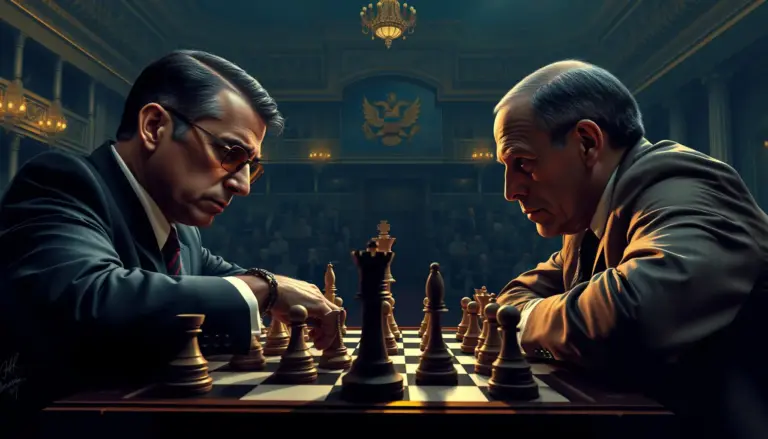
In the shadows of Kabul, Herat and Kandahar, where the wind carries the echo of ancient traditions and the weight of a regime that has erased fundamental rights with the stroke of a pen, a chess board becomes an act of rebellion. It's not a game, not even a sport: it's resistance. Afghan girls, condemned to silence and confinement, With every movement they defy the rules imposed by a system that denies them a future.. chess, in your hands, becomes a secret language, a code of freedom that not even the Taliban can decipher. Because while the world debates algorithms and artificial intelligence engines, They show that the true strategy is not in technology, but in the human capacity to dream, even when the board seems lost.
Chess as a mirror of oppression: when gambling is a crime
In Afghanistan, Chess is not just a game of kings and pawns; It is a reflection of the power structures that have governed the country for decades. After the fall of the previous government in 2021, the Taliban imposed draconian restrictions on women, prohibiting them from accessing education, work or even leave their homes without a male companion. In this context, the simple act of holding a bishop or moving a knight becomes a political gesture. It is no coincidence that chess, a game that symbolizes strategy and power, be persecuted in a country where control over minds and bodies is absolute.
Girls who secretly play chess aren't doing it for fun., but for survival. Each game is a memory exercise, of concentration and, above all, of hope. In an environment where female education has been eradicated, chess becomes a clandestine learning tool. They learn mathematics by calculating variants, develop critical thinking by anticipating plays and, the most important thing, They keep alive the idea that your mind cannot be imprisoned. This phenomenon is not isolated: in other contexts of oppression, like prisons or refugee camps, chess has served as refuge and hope, demonstrating that his power transcends 64 casillas.
The strategy of silence: how chess teaches resistance
chess is, in essence, a game of silence. there are no words, only movements that reveal intentions, plans and, sometimes, despair. In Afghanistan, this silence becomes even more eloquent. Girls who play secretly cannot talk about their games, not even with her classmates (if they still have access to one). Every chess encounter is an act of complicity, a support network that is woven in secret. This forced silence, far from being a limitation, becomes a strategic advantage. They learn to read their opponents' body language, to interpret looks and gestures, and to develop an intuition that goes beyond what any chess engine could calculate.
But chess also teaches them something deeper.: patience. In a world where opportunities evaporate overnight, These girls understand that victory doesn't always come with a quick checkmate.. Sometimes, it is necessary to sacrifice pieces, stand back and wait for the right moment to attack. This lesson, applicable to life itself, It is one of the reasons why chess has been used as a therapeutic tool in trauma contexts.. As he explains therapeutic chess, the game helps rebuild self-esteem, to manage frustration and find meaning in the midst of chaos.
The board as a metaphor: when the pieces are people
in chess, each piece has a value and a specific role. The queen is powerful, pawns are expendable, and the king, although fragile, It is the center of everything. In Afghanistan, This hierarchy takes on a tragic meaning. Girls who play chess secretly know that, in the society that surrounds them, They are considered pawns: expendable, without voice or rights. But on the board, they decide who is queen, who is a bishop and who is a simple pawn. This role reversal is revolutionary. for the first time, they have control.
Chess also teaches them that, even in the most desperate positions, there is room for creativity. In the history of the game, There are legendary games where a player, at a clear disadvantage, manages to turn the board with an unexpected move. These girls, faced with a system that wants them invisible, They find in chess a parallel with their own struggle. No matter how many restrictions they put on them: there will always be a play that they have not foreseen, a move that can change the course of the game. This mentality, cultivated clandestinely, It is the same that has allowed other women in adverse contexts to break barriers. As explored in the article on women in chess, Figures like Judit Polgár or the Polgár sisters showed that gender does not define talent.
Technology as an ally and threat: chess in the digital age
In a hyperconnected world, where platforms like Lichess or Chess.com allow you to play from any corner of the planet, Afghan girls face a dilemma: How to access these resources without being detected? The technology, which in other contexts has democratized chess, in Afghanistan it becomes a double-edged sword. On the one hand, offers them the opportunity to learn, to compete and connect with a global community that values their talent. On the other, every click can be tracked, every game played online can give them away.
However, human creativity always finds a way. In some cases, These girls have resorted to improvised boards, made with stones or pieces of cloth, to avoid leaving a digital trace. In others, have used VPN connections or private networks to access chess platforms without being identified. This ingenuity is reminiscent of other forms of chess resistance, like him chess with stones in refugee camps, where the lack of resources does not stop the passion for the game.
But technology also raises an uncomfortable question: Is modern chess losing its human essence? In a world where AI engines like Stockfish or AlphaZero can analyze millions of positions per second, the game has become more technical, colder. For Afghan girls, however, chess remains deeply human. They don't play against machines, but against a system that wants to silence them. Each game is an act of faith in your own ability, a reminder that, even in the dark, the human mind can shine.
The future of chess: an elite game or a liberation tool?
The case of the Afghan girls who secretly play chess raises a fundamental question: Who is chess really for?? In the West, the game has become a mass phenomenon, driven by series like *The Queen’s Gambit* and digital platforms that make it accessible. But in other corners of the world, chess is still a luxury, a privilege or, at worst, an act of resistance.
The history of chess is full of examples of how the game has been used as a tool for social change.. Since the prison programs that help the reintegration of prisoners to projects in schools that improve academic performance, chess has proven its ability to transform lives. But its potential goes further. In contexts of oppression, like Afghanistan, chess can be a catalyst for change, a space where girls learn that their voice, although silenced, still has power.
The challenge now is how to take this message to the rest of the world.. How can we support these girls without exposing them to greater risks? How can we use chess not only as a game, but as a tool of empowerment? The answer may lie in the very essence of chess: in the strategy, in patience and the ability to see opportunities where others only see obstacles.
On the dusty streets of Kabul, between the sound of engines and the murmur of prayers, a group of girls move chess pieces with trembling but firm hands. They don't know if they will ever be able to compete in an international tournament., not even if they will be able to leave their homes without fear. But they know one thing: as long as there is a board and two minds willing to play, the game is not over. and in chess, like in life, The last word always goes to those who refuse to give up..
Chess in Afghanistan is not just a game. It's a silent scream, a strategy of resistance and, above all, a promise: the one that, even in the darkest places, the light of human intelligence never goes out. These girls, with every movement, They are rewriting the rules of a game that the world thought it understood. and maybe, just maybe, They are teaching us all that true victory is not in checkmate, but in the ability to continue playing, against all odds.