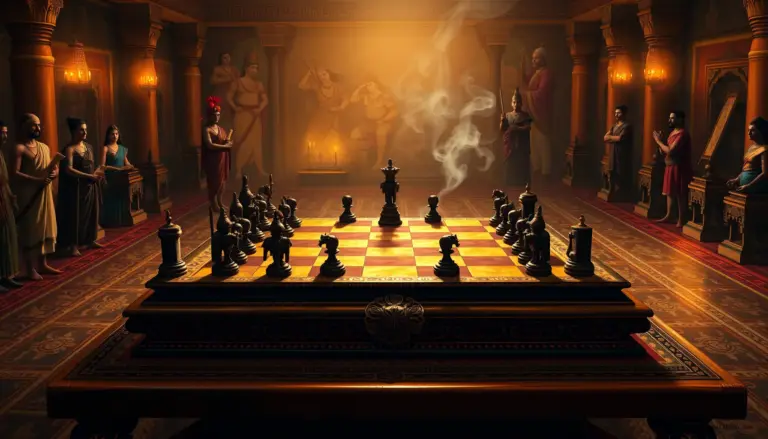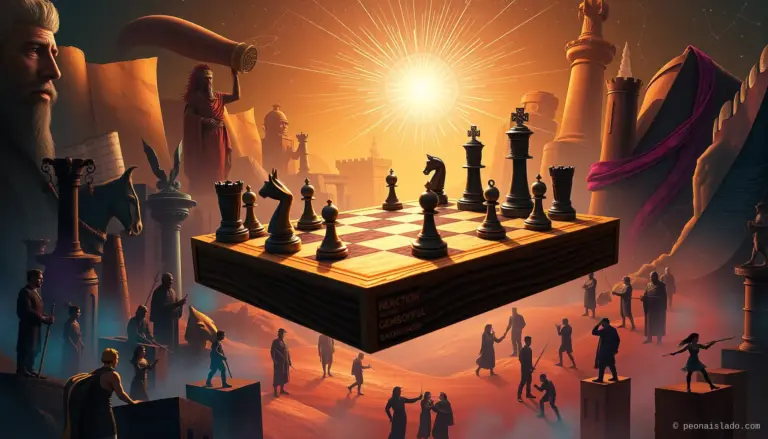
Imagine for a moment going back thousands of years, to a time when humanity did not yet know writing, metals or great civilizations. In that primitive setting, where survival depended on hunting, gathering and cunning, a fascinating question arises: What would it have been like to play chess in prehistoric times?? Although this strategy game, as we know it today, came much later, its essence—intellectual competence, planning and anticipation—could have found a place even in the most ancient societies. Exploring this idea not only allows us to speculate about human ingenuity in its earliest stages, but also reflect on how board games, in its most rudimentary form, could have served as tools to develop cognitive skills, social and even rituals. In this article, we will travel through time to rebuild, based on archaeological and anthropological evidence, How chess – or something similar – could have been born in prehistory, adapting to the materials, the beliefs and needs of those first humans.
The origins of the game: beyond modern boards
Modern chess is the result of an ancient evolution that began in India with the Chaturanga, a war game that simulated battles between four military divisions. However, The idea of competing with pieces on a board is much older.. Archaeological evidence suggests that board games existed since the Neolithic, like him promissory note in ancient egypt (toward 3500 a.C.) or the Royal Ur Game in Mesopotamia (2600 a.C.). These were not simple hobbies, but symbolic representations of life, death and destiny, linked to religious beliefs.
In prehistory, before these documented examples, It is likely that humans already experimented with primitive forms of strategy games. As? Using materials available in your environment: piedras, palos, bones or even drawings on the ground. For example, los rock panels found in caves like those of The Pasiega (Spain) o Lascaux (France) show geometric patterns that some researchers interpret as possible games or counting systems. Although there is no conclusive evidence that they were used for chess, They do demonstrate that prehistoric human beings had the capacity for abstraction necessary to create rules and compete..
A key aspect would be simplicity. In prehistory, and “chess” I wouldn't have 64 squares or pieces with complex movements, but a basic design, maybe 4×4 o 8 casillas, with elements such as colored stones (to distinguish sides) and limited movements. The purpose would not be the same as today: rather “give jack mate”, the objective could be linked to rituals, how to tell the future, resolve tribal conflicts or even prepare young people for hunting, simulating ambush strategies.
Materials and tools: Stone Age chess
If chess had existed in prehistory, Its manufacture would have depended entirely on natural resources. The most likely materials would be:
- Stones and pebbles: Easy to carve or paint with natural pigments (like ocher or charcoal) to differentiate pieces. In deposits like Flower forest (South Africa), Stones engraved with geometric patterns from ago have been found. 70.000 years, suggesting an early ability to create symbolic objects.
- Bones and antlers: Animal remains could have been carved to create pieces with recognizable shapes, like animal heads (similar to how in Chaturanga there were elephants and cars). The bones were also used to mark boxes on the ground or on animal skins..
- Wood and bark: Although less durable, the wood would have been useful for portable boards or lightweight parts. In places like Schöningen (Germany), wooden spears have been found 400.000 years old, which shows that prehistoric humans mastered their manipulation.
- Clay and mud: In regions with access to these materials, rudimentary pieces could have been molded, although their fragility would make them impractical for prolonged use.
The board, instead of being a flat, decorated surface, it would probably be a ephemeral representation: drawn on the ground with a stick, traced in the sand of a beach or even marked on the skin of an animal. This would reflect the nomadic nature of many prehistoric societies., where objects had to be portable or easy to recreate. Besides, the absence of writing would imply that the rules would be transmitted orally, which would lead to local variants and constant adaptations.
A fascinating detail is how these materials would influence the game strategy. For example, on a sand board, the pieces could move by dragging them, which would limit precision and add a physical component (as in the bike, an african seed set). Instead, on a stone board, the pieces would be more stable, allowing longer and more complex games. This leads us to ask: Would prehistoric chess have been a quick game, immediate bets or challenges, or a contemplative activity reserved for moments of leisure?
Chess as a social and ritual tool
In prehistoric societies, games were rarely mere entertainment. They fulfilled social functions, educational and even spiritual. chess, in this context, could have been used to:
- Resolve conflicts: Instead of resorting to violence, tribes could have used games to decide disputes over territory, resources or leadership. A modern example is the go in ancient China, where generals used it to plan bloodless battles.
- Teach hunting and war strategies: Piece movements could mimic ambush tactics, how to surround prey (similar to how in modern chess “encloses” to the king). This would prepare young people for key roles in the tribe.
- Shamanic rituals: Some researchers, as Mircea Eliade, suggest that board games in ancient cultures were linked to divination. A game could be interpreted as a “dialogue with the gods”, where the result determined important decisions, like when to migrate or hunt.
- Reinforce hierarchies: Winning a game could grant social prestige, as it happened in promissory note Egyptian, where the pharaoh played to demonstrate his connection with the divine.
An intriguing case is that of the prehistoric gambling. In deposits like Hohle Fells (Germany), bone dice from ago have been found 30.000 years, indicating that humans already combined luck and strategy. Could prehistoric chess have included random elements, like throwing a bone to decide moves? This would bring it closer to games like backgammon, where chance and tactics intertwine.
Besides, chess would have been a universal language in a world without writing. Tribes from different regions could have used variants of the game to communicate, trade or even establish alliances. This would explain why, despite cultural diversity, many older games share similar structures (squared boards, pieces that move in straight lines).
Cognitive evolution: why would chess have been possible?
So that chess existed in prehistory, humans had to possess certain cognitive abilities. Fortunately, Archeology and neuroscience have shown that our ancestors already developed them:
- abstract thinking: The engravings on bones and stones, like those of Flower forest, show what it does 70.000 years humans could represent non-tangible ideas. This is essential to understand rules and movements in a game.
- Long term planning: Hunting big prey, like mammoths, required coordination and anticipation, key skills in chess. Studies of Homo neanderthalensis suggest that even species before us could plan complex actions.
- theory of mind: The ability to anticipate the opponent's intentions is crucial in chess. Experiments with primates and children show that this ability emerges in early stages of human development.
- Memory and learning: Oral societies depended on the transmission of knowledge through stories and rituals. A game like chess would have been a way to preserve and teach strategies from generation to generation.
A revolutionary aspect is how chess could have shaped human evolution. Some anthropologists, as Brian Boyd, They argue that games are a form of “simulation” which allows humans to practice skills without real risk. In prehistory, where a mistake in hunting could be fatal, a strategy game would have been an invaluable tool for training the mind. It could even have given evolutionary advantage to those who mastered it, favoring the selection of individuals with greater analytical capacity.
Besides, prehistoric chess would have been a worldview mirror of each culture. For example, in matriarchal societies, the pieces could represent female roles (as in the alquerque, a medieval game with ancient origins). Instead, in warrior cultures, the pieces could symbolize weapons or military tactics. This brings us to a key question.: Would chess have been an equal game, where men and women competed, or would be restricted to certain groups, as shamans or leaders?
Conclusions: chess as a mirror of humanity
Reconstructing what it would have been like to play chess in prehistoric times is an exercise in imagination based on evidence.. Although there is no direct evidence that our ancestors moved pieces on a board with rules similar to the current ones, There are indications that strategy games were part of their daily life. From geometric patterns in caves to bone dice, prehistoric humanity demonstrated an innate ability to create systems of competition, symbolism and learning.
prehistoric chess, in its most primitive form, it would have been a reflection of the needs and beliefs of each society. It wouldn't be a standardized game, but an amalgamation of local variants, adapted to available materials and cultural values. Its function would go beyond entertainment: would have served to resolve conflicts, teach survival strategies, connect with the divine and reinforce social hierarchies. In this sense, chess would not just be a precursor to modern games, but one tool for social cohesion and cognitive evolution.
Hoy, when we sit in front of a chess board, We are participating in a tradition that, in essence, could date back to the dawn of humanity. every movement, each strategy, every game won or lost, It is an echo of those first humans who, with stones and sticks, They challenged their rivals in a game that transcended time. Maybe, in the background, chess has always been more than a game: is a manifestation of our ability to create order in chaos, to compete without destroying and to imagine possible futures. And so, after all, It's what makes us human.