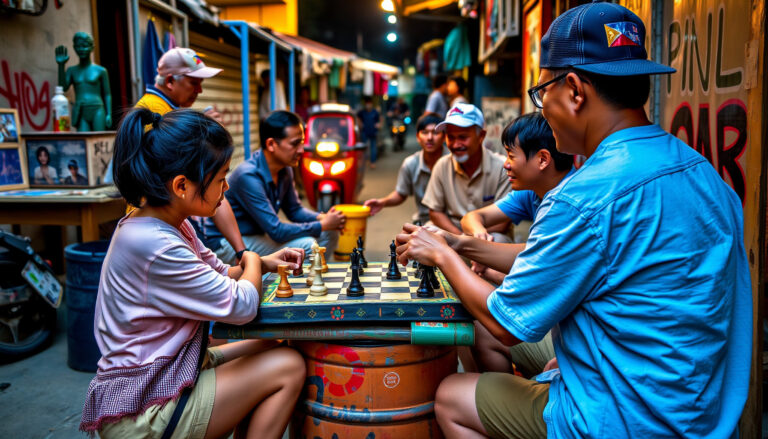
In the heart of Ethiopia, where history and spirituality intertwine with dream landscapes, if he raises Lalibela, a World Heritage treasure that challenges the limits of architecture and faith. This rock-cut church complex, carved more than eight centuries ago under the reign of King Lalibela, It is not only a symbol of Ethiopian Orthodox Christianity, but also a unique setting where chess comes to life within its sacred walls. How is it possible that an ancient game, associated with strategy and reflection, find your place in a space designed for devotion? This article explores the fascinating connection between chess and the churches of Lalibela, unraveling its cultural significance, its historical evolution and the role it plays in the daily life of its visitors and inhabitants. From improvised games between pilgrims to tournaments organized in honor of tradition, We will discover how this game transcends the playful to become a bridge between the earthly and the divine.
The architectural legacy of Lalibela: a stage carved into the rock
Lalibela is not simply a group of churches; It is a masterpiece of medieval engineering that defies logic. Carved from monolithic blocks of volcanic rock, The complex's eleven churches were designed to be a “New Jerusalem” on Ethiopian land, a pilgrimage site that would replicate the sanctuaries of the Holy Land. Each structure, like the iconic Biete Medhane Alem (House of the Savior of the World) o Poor Ghiorgis (House of Saint George), was dug from top to bottom, creating interior spaces that combine the austerity of stone with ornamental details that reflect the Ethiopian Christian cosmogony.
The most surprising thing is that these churches were not built with bricks or mortar, but sculpted directly into the living rock, a process that, according to local chronicles, took more than 20 years and required the work of thousands of workers. The precision of the cuts, Hidden passageways and integrated drainage systems reveal advanced knowledge of geology and hydraulics for the time. This architectural context is not coincidental: churches were conceived as a sacred microcosm, where every corner—from the altars to the patios—has a liturgical and symbolic purpose. It is in this scenario, where the human and the divine seem to merge, where chess finds an unexpected space.
Chess in Ethiopia: roots of a game with an African soul
Chess arrived in Ethiopia through trade and cultural routes that connected the Horn of Africa with the Arab world and, later, with Europe. However, Its adoption in the country was not a simple transplant of foreign rules, but an adaptation that enriched it with local nuances. Unlike other regions where chess was associated with elites or royal courts, in Ethiopia it was quickly integrated into daily life, from markets to monasteries. Historical documents, like the emperor's 16th century manuscripts Liquify, they mention games played in court, but also between monks and peasants, demonstrating its democratic character.
A peculiarity of Ethiopian chess is its traditional variant, known as centre, which differs from Western chess in aspects such as the movement of pawns (who can advance two squares at any time, not only in his first move) and the absence of castling. This version, still practiced in some communities, reflects the creativity with which Ethiopians reinterpreted the game. A Lalibela, Chess is not only played for entertainment, but it becomes a metaphor for spiritual life: every movement requires patience, strategy and faith, core values in the Ethiopian Orthodox worldview. The boards, carved in wood or drawn on the ground with chalk, They are as humble as the spaces where the games take place, but its meaning transcends the material.
Sacred matches: when chess meets devotion
A Lalibela, chess is not just any hobby; It is a practice that intertwines with spirituality in profound ways. During religious festivals, like the Genna (Orthodox Christmas) or the Tim (Epiphany), It is common to see pilgrims and monks playing improvised games in church courtyards.. These games are not competitive in the conventional sense, but rather they function as an act of meditation and communion. The players, often sitting on the ground under the shade of rock walls, They see in every movement an opportunity to reflect on life, faith and destiny, concepts that chess, with its duality of strategy and chance, symbolizes perfection.
A notable example is the annual tournament held in the square in front of Poor Ghiorgis, where participants from all over the country compete in timed matches. The curious thing is that the winner does not receive a material prize., but the honor of placing an offering on the church altar, a gesture that links play with devotion. Besides, The boards used are usually decorated with religious motifs, such as orthodox crosses or biblical scenes, reinforcing the idea that chess is an extension of the liturgy. Even the names of the pieces have spiritual connotations: the king associates himself with Christ, the queen with the Virgin Mary, and the pawns with the faithful who advance towards salvation.
This fusion between the playful and the sacred is not exclusive to Lalibela. In other Ethiopian monasteries, like those of Duty Damo o Gondar, Chess is also practiced as a pedagogical tool to teach values such as humility and perseverance.. The monks, For example, They use games to illustrate passages from the Bible, like the battle between David and Goliath, where the cunning (represented by the bishop or the rook) triumphs over brute force (the horse). So, Chess becomes a universal language that transcends cultural and religious barriers.
Chess as a cultural bridge: tourism and preservation of tradition
In recent decades, Chess in Lalibela has transcended its local dimension to become a unique tourist attraction. Travelers from all over the world come to the place not only to admire its architecture, but also to participate in games with locals or witness tournaments that combine tradition and modernity. This interest has generated initiatives to preserve and promote Ethiopian chess., such as workshops for children in the region's schools or the creation of clubs that teach both Western rules and those of the centre. However, This process is not without challenges..
One of the main challenges is balancing authenticity with commercialization. While some see chess as an opportunity to promote sustainable tourism, Others fear that the spiritual essence of the game will be diluted in favor of visitor spectacles.. To avoid it, organizations like the Ethiopian Chess Federation They work in collaboration with local communities to design experiences that respect tradition. For example, have been established “guided games”, where a monk or village elder explains the symbolism behind each movement, connecting the tourist with the living history of Lalibela.
Besides, Chess has become a tool for community empowerment. In 2018, the project was launched “Chess for Change”, that uses games to teach critical thinking skills to young people at risk of exclusion. The boards, Made by local artisans with recycled materials, They not only generate income, but also reinforce the link between the community and its heritage. This holistic approach shows that chess in Lalibela is not just entertainment, but a key element for cultural identity and social development.
Final thoughts: chess as a mirror of humanity
Lalibela is much more than a tourist destination or a set of churches carved into rock; It is a symbol of resistance, faith and human creativity. In this scenario, Chess emerges as a common thread that unites the past with the present, the sacred with the profane, and the local with the global. Through his games, Ethiopians not only preserve an ancient tradition, but they also offer a universal lesson: that even in the most unexpected places, like a church carved into the rock, spaces of reflection can flourish, connection and beauty.
Chess in Lalibela reminds us that games, far from being frivolous, They are mirrors of the culture that welcomes them. in every movement, in each strategy, stories of faith are hidden, fight and hope. For visitors, Participating in a game in this sacred place is an opportunity to immerse yourself in an experience that transcends tourism.: It is a dialogue with history, an invitation to think beyond the obvious. And for the Ethiopians, chess remains a living legacy, a bridge between generations that ensures that the magic of Lalibela endures.
In an increasingly fast-paced world, where the spiritual and the playful are usually separated, Lalibela and his chess teach us that true wisdom lies in finding harmony in duality. What, in the end, Every game played within its walls is not just a game, but an act of cultural resistance, a tribute to human creativity and, above all, a celebration of life in all its forms.