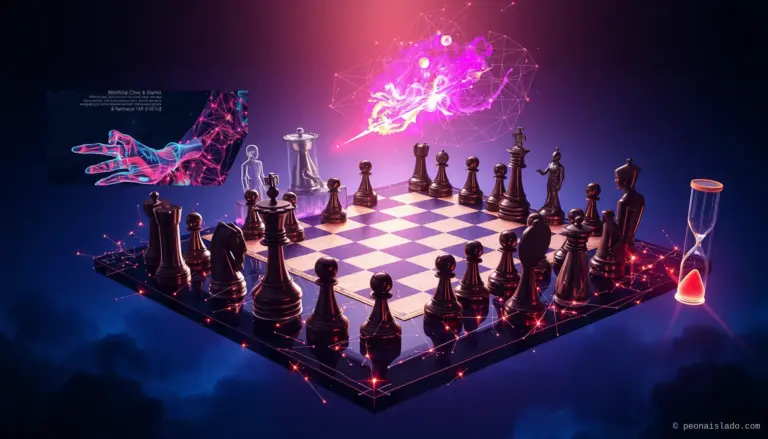
Chess has been a reflection of the human mind for centuries.: his capacity for strategy, creativity and, in some cases, its fragility. But what happens when the obsession to dominate the game transcends the limits of rationality?? The story of those who memorized thousands of games to achieve mastery is as fascinating as it is disturbing.. Some achieved greatness; others, instead, they lost touch with reality. This article explores the extreme case of a player whose dedication led him to a psychological abyss., revealing the dangers of a mind caught between genius and madness.
The board of 64 Casillas can be an intellectual battlefield, but also a mirror that reflects the limits of the human psyche. How far can the mind go in its search for perfection?? And what price are you willing to pay??
The myth of absolute memory: when chess becomes an obsession
Memory is an essential tool in chess. Great masters like Bobby Fischer and Garry Kasparov were known for their ability to remember entire games., openings and tactical patterns with almost supernatural precision. However, There is a fine line between rote mastery and pathological obsession.. The most extreme case is that of an anonymous player—whose identity has been lost in the annals of chess—who, according to stories from the time, memorized more than 10,000 games before suffering a mental breakdown.
This individual, whose history is intertwined with urban legends and fragmentary testimonies, He dedicated years of his life to studying chess games with an almost religious intensity. His method was simple but insane: analyzed every movement, each variant, each error, until the games became a kind of genetic code that his mind absorbed without filters. I wasn't just trying to understand the game.; wanted to internalize it, turn it into an extension of your own consciousness. But, As usually happens with obsessions, the result was devastating.
Symptoms began with insomnia and hallucinations. In his last months, as it is told, the player saw chess moves in the shadows of his room, in the patterns of the tiles or even in the faces of people. His mind no longer distinguished between the board and reality. Finally, He was admitted to a psychiatric hospital, where he spent his last days repeating openings out loud, as if he were trying to decipher an enigma that only he could see.
This case, although extreme, is not unique. Chess has historically been a fertile ground for brilliant but fragile minds.. How we explore “What your chess style says about your personality”, the game not only reflects our strengths, but also our vulnerabilities. The obsession with perfection can become a prison, especially when memory becomes a burden instead of a tool.
The science behind obsession: why chess can become dangerous?
The human brain is not designed to process unlimited amounts of information without consequences.. Neuroscience studies have shown that excessive memorization—especially of complex patterns like chess—can overwhelm the prefrontal cortex., the region responsible for logical thinking and decision making. When this area becomes overloaded, the brain looks for shortcuts, which can lead to perceptual distortions, paranoia and even hallucinations.
In the case of the player who memorized 10,000 matches, His mind entered a state of hyperassociation, where each external stimulus was automatically linked to chess. This is not very different from what occurs in disorders such as Cotard syndrome., where patients believe they are dead or have lost parts of their body. In your case, the board had become an all-consuming obsession, blurring the lines between game and reality.
But why chess, in particular, It has this effect on some minds? The answer could be in its very nature. Chess is a game of infinite patterns, where each movement opens a range of possibilities that, in turn, generate more variants. For an obsessive gamer, This complexity can become an addiction, similar to that experienced by video game players or gamblers. As we point out in “Why is chess so addictive? Science explains it”, the brain releases dopamine every time it solves a tactical problem, creating a reward cycle that can be difficult to break.
Besides, chess requires absolute concentration, which can lead to a state of flow —that moment when the mind is completely immersed in an activity—. However, when this state lasts for years, can deplete cognitive resources, leaving the player in a state of mental exhaustion. In extreme cases, like the one we are dealing with, the mind collapses under the weight of its own obsession.
The geniuses who lost the battle: other cases of chess players and madness
Chess has witnessed other cases of players whose genius brought them to the brink of sanity.. One of the best known is that of Wilhelm Steinitz, the first official world champion, who in his later years developed severe paranoia. Steinitz believed that he could communicate with God through chess pieces and that, through specific movements, could control the weather or even prevent earthquakes. His obsession with proving his theory led him to challenge players in games where the bets were not money., sino “divine tests”.
Another notable case is that of Paul Morphy, Considered by many to be the best player of the 19th century. Morphy mastered chess with astonishing ease, but his career was brief. After retiring undefeated, He fell into a deep depression and began to show signs of schizophrenia.. He spent his last years wandering the streets of New Orleans, convinced that his rivals were after him to poison him. Some historians suggest that his mental breakdown was accelerated by the pressure of being a prodigy at a time when chess was not recognized as a serious sport..
These cases raise an uncomfortable question: Is chess a dangerous game for exceptional minds? The answer is not simple. chess, in himself, is not the cause of madness, but its absorbing nature can exacerbate pre-existing psychological tendencies. How we explore “Chess and philosophy: the board as a mirror of the world”, the game is a microcosm of life, where every decision has consequences. for some, This responsibility can be overwhelming..
The fine line between mastery and self-destruction
The story of the player who memorized 10,000 games is a reminder that genius and madness often walk hand in hand. But it also raises a deeper question: Is it worth pursuing perfection at any cost? in chess, like in life, control obsession can become a trap. The human mind is not made to function like a machine; need balance, rest and, above all, connection with the real world.
Hoy, with the arrival of artificial intelligence and chess engines such as Stockfish or AlphaZero, the obsession with memorization has lost part of its relevance. Modern players focus more on positional understanding and creativity than mass game storage. However, the risk of falling into the trap of hyperspecialization is still present. As we point out in “Chess and AI: how machines redefined gaming”, Technology has changed the way we understand chess, but it has not eliminated the psychological dangers inherent in its obsessive practice.
For current players, the lesson is clear: chess should be a means to enrich the mind, not to enslave her. Memory is a valuable tool, but it should not become an end in itself. True mastery does not lie in how many games you can recite by heart, but in how you apply that knowledge to create something new, to surprise your rival and, above all, to enjoy the game.
Conclusion: chess as a mirror of the human condition
The story of the player who memorized 10,000 games and lost his sanity is a warning, but also a metaphor for the human condition. chess, in its essence, It's a game of limits: the limits of the mind, the limits of the strategy and, ultimately, the limits of what we are willing to sacrifice in the name of excellence. This extreme case reminds us that, although obsession can lead us to greatness, It can also destroy us if we don't know when to stop.
The chess board is a miniature universe, where every move is a decision and every game a lesson. But, like in life, the real challenge is not winning, but finding the balance between ambition and sanity. The next time you sit in front of a board, Remember that chess is not just a game of memory or strategy; It is a reflection of who you are and how you face challenges.. Y, above all, remember that madness is not the price of genius, but his shadow.
If this article resonated with you, We invite you to explore other related topics in Penalty, as “Psychological errors in chess that ruin your game” o “Ajedrez and mindfulness: calm for the modern mind”, where you will find tools to enjoy the game without falling into its traps.