In the bustling streets of Manila, between the hustle and bustle of the jeepneys and the aroma of *kare-kare*, There is a cultural phenomenon that transcends generations and social classes: neighborhood chess. Known locally as *Barrio Chess*, This ancient game has become a symbol of resistance, ingenuity and community in the Philippines. Far from international tournaments or digital boards, chess here is played with hand-carved pieces, on improvised tables in corners, markets or under the shadow of a century-old *balete*. But, How did this European game manage to take root so deeply in Filipino culture?? What makes it different from other versions of chess in the world? Y, above all, What stories hide those games that last hours under the scorching sun or by the light of a lantern??
In this article, We will explore the *Chess Neighborhood* not only as a hobby, but as a reflection of Filipino identity: his creativity in the face of scarcity, your competitive spirit and your ability to turn the ordinary into the extraordinary. From the origins of its popularity to its role in training community leaders, going through the anecdotes of the most legendary players, We will unravel how chess became a universal language in every corner of Manila.
From Europe to the streets: how chess conquered the Philippines
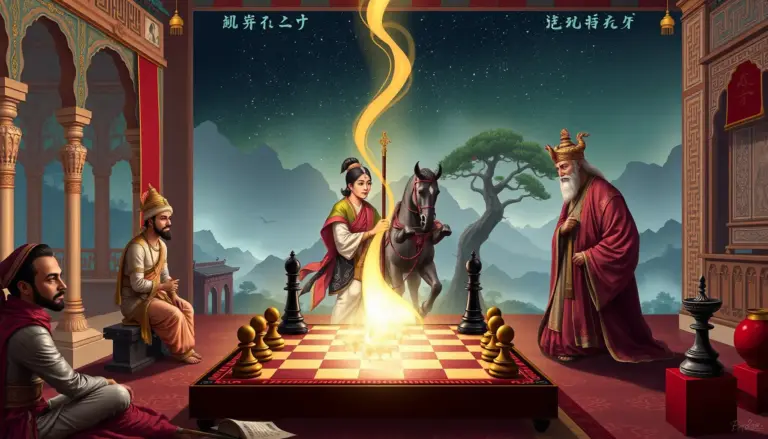
Chess came to the Philippines from the Spanish colonizers in the 16th century., but its mass adoption was not immediate. For centuries, the game was limited to the enlightened elites and military circles, where it was used as a tool to train war strategies. However, It was in the 20th century when chess began to filter into the popular classes, thanks to two key factors: American influence and the need for accessible entertainment.
After the American occupation (1898-1946), Chess was introduced into schools as part of educational programs that promoted logical thinking. But the real turning point came with World War II.. During the Japanese occupation, Filipinos sought ways to evade oppressive reality, and chess, with its low cost and portability, became a refuge. It was played in internment camps, in neighborhoods destroyed by bombing and even in the trenches, where Filipino and American soldiers shared games between combats.
In the postwar, chess became even more democratized. The lack of material resources led to the creation of boards and handcrafted pieces: from bottle caps turned into pawns to boards drawn with chalk on the floor. This adaptation not only demonstrated Filipino inventiveness, but also removed economic barriers to play. For the years 60 y 70, *Chess Neighborhood* was already an institution in Manila, with informal tournaments that attracted hundreds of spectators in squares such as Quiapo or Tondo.
The board as a school of life: lessons beyond the game
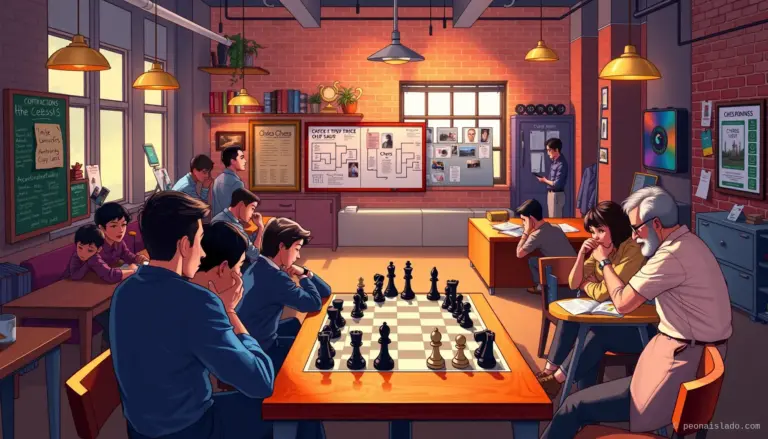
In the slums of Manila, where educational opportunities are limited, Chess has become an unconventional pedagogical tool. Players like *Mang Tony*, a veteran from Tondo who has been teaching chess to street children for 30 years, they explain it like this: *”Here we not only learn to move pieces; we learn to think, to plan, to fall and get up”*.
Studies conducted by the University of the Philippines have shown that children who play chess regularly improve their ability to concentrate., your memory and problem-solving skills. But the impact goes beyond the cognitive. In communities where violence and gangs are a constant threat, chess offers an alternative. Organizations like *Chess for Peace* work in conflict areas like Payatas, where former gang members teach chess to at-risk youth, using the game as a metaphor for life: *”on the board, like in the street, every move has consequences. If you don't think, you lose. But if you learn to anticipate, you can win”*.
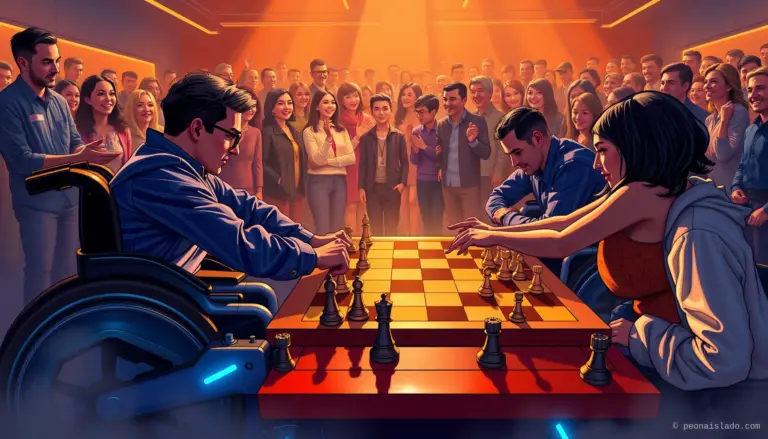
Chess also promotes values such as patience and respect. In neighborhood tournaments, It is not unusual to see a child 10 years defeat an adult, and let the latter applaud his victory. This dynamic contrasts with the culture of *”saving face”* (keep up appearances) so rooted in the Philippines, where pride can be an obstacle. chess, instead, teaches humility: *”There are no excuses here. If you lose, It's because the other one was better. And that's okay”*, comment *Which Maricel*, a mother who takes her children to play at Rizal Park on Sundays.
The kings of the neighborhood: stories of legendary players
Behind every game of *Barrio Chess* there are characters who have elevated the game to legendary status.. One of them is *Ka Eddie*, a former jeepney driver 72 years that, as they say, He has never lost a game in the Plaza de Santa Cruz. Your secret: *”I play with the heart, not with the head. Each piece has a soul, and I listen to them”*. Although his romantic style clashes with the modern school of chess, His charisma has made him a revered figure. Young people look for it to learn not only openings, but also life lessons: *”Chess is like driving a jeepney: you have to know when to accelerate, When to brake and when to let others pass”*.
Another iconic figure is *Jenny “The Queen of Tondo”*, a woman who challenged gender stereotypes in a world dominated by men. In the years 80, when women rarely participated in street tournaments, Jenny started playing secretly, hiding his identity under a cap. Her skill led her to win the Manila informal championship in 1995, a milestone that inspired other women to join the game. Hoy, to their 60 years, He runs a chess school for girls in his neighborhood, where he teaches that *”the board has no gender: what matters is how you move the pieces”*.
But not all players are celebrities.. In markets like Divisoria, It is common to find *Mang Bert*, a fruit vendor who plays quick games between customers. Your record: 120 games in one day, with only 3 defeats. *”Chess keeps me awake. If I didn't play, I would fall asleep in the position”*, joke. These stories, although less known, They are what give soul to the *Chess Neighborhood*: It's not about great teachers., but of ordinary people who find an escape in the game, a challenge and, sometimes, a reason to keep going.
The future of *Chess Neighborhood*: between tradition and modernity
In the digital age, where online chess dominates with platforms like Chess.com or Lichess, the *Chess Neighborhood* faces a dilemma: How to preserve its street essence without being left behind? The answer is not simple. On the one hand, Technology has brought chess closer to new generations. Not Manila, young people like *Mark*, a student of 19 years, They combine traditional gaming with app analysis: *”I play in the square with my friends, but then I review the games on my phone to improve”*. This hybridization has allowed the *Chess Neighborhood* not to die, but evolve.
However, There are those who view this modernization with suspicion.. *Don Pepe*, an old man who has organized tournaments in Malate since the years 70, warns: *”Chess is not just about moving pieces; is looking into the eyes of your rival, feel the sweat in your hands, listen to the hustle and bustle of the neighborhood. If we take it to a screen, we lose that”*. for him, The true value of *Barrio Chess* is in its humanity: in the gesture of a child who offers a *halo-halo* to his rival after a defeat, or in the spontaneous applause of the spectators when someone sacrifices his queen to give checkmate.
Given this scenario, initiatives emerge to balance tradition and modernity. The *Philippine Chess Federation* has launched programs such as *”Chess in the Streets”*, that takes boards and pieces to remote neighborhoods, while groups like *Barrio Chess PH* organize tournaments with rules adapted to local culture, as games with a time limit 5 minutes or games in which you can “comprar” extra moves with symbolic coins. These proposals seek to keep the community spirit of the game alive, even in an increasingly individualistic world.
The biggest challenge, however, It's not technological, but social. In a city where poverty and inequality remain urgent problems, chess can seem like a luxury. But as *Mang Tony* says: *”Chess is not a luxury; it's a necessity. In a country where everything seems chaotic, The board is the only place where the rules are clear and merit decides who wins”*. Maybe that's why, yet, the *Chess Neighborhood* is still alive: because in an uncertain world, offers something we all crave: order, justice and the possibility of reinventing ourselves with each game.
Conclusions: chess as a mirror of the Philippines
*Chess Neighborhood* is much more than a game: It is a microcosm of Filipino society. Their games reflect the resilience of a people that has turned scarcity into creativity., adversity in strategy and competition in community. From its humble colonial origins to its reinvention on the streets of Manila, chess has proven to be a universal language, capable of uniting people of all ages, genders and social classes under the same board.
The stories of players like *Ka Eddie*, *Jenny* or *Mang Bert* remind us that the true value of *Chess Neighborhood* is not in the trophies or rankings, but in the lessons it leaves: the importance of thinking before acting, the value of humility and the ability to find beauty in everyday life. In a country where the challenges are many, chess offers something invaluable: the certainty that, with patience and strategy, even pawns can become kings.
Looking to the future, The *Chess Neighborhood* faces the challenge of adapting without losing its essence. Technology can be an ally, but it should never replace human contact, the sweat of a game under the sun or the emotion of a checkmate celebrated among friends. Ultimately, chess on the streets of Manila is a reminder that, in an increasingly fast-paced world, there are things that should not change: the passion for the game, respect for the rival and the joy of sharing a moment, even if it is on a board drawn on the ground.
So the next time you walk through a Manila neighborhood and hear the sound of pieces colliding, stop for a moment. Observa. maybe there, between chaos and life, find not just a game, but a story of struggle, ingenuity and hope. Because in the Philippines, chess is not played only in corners: you live.