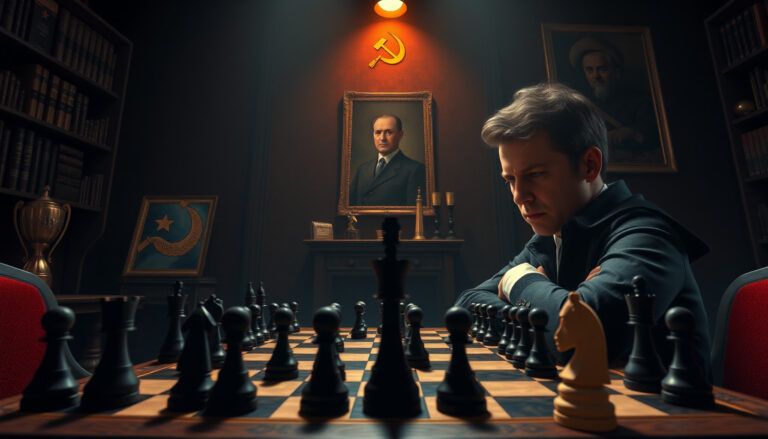
Chess has been the realm of human strategy for centuries., an intellectual duel where creativity, patience and intuition made the difference between victory and defeat. However, in recent decades, artificial intelligence (IA) has burst into this ancient game with transformative force, redefining not only how to play, but also how to understand, taught and competed. What began as a technological curiosity has become a revolution that has left an indelible mark on modern chess.. From the historic confrontation between Garry Kasparov and Deep Blue to the rise of engines like Stockfish and Leela Chess Zero, AI has demonstrated an analytical and creative capacity that far exceeds human limits. But beyond the mere superiority in the calculation, His influence has permeated the preparation of the players, chess pedagogy and even in the psychology of competition. This article explores how AI has changed chess forever., analyzing its impact on the evolution of the game, the training of chess players, the ethics of its use and the future of a sport that now navigates between the human and the artificial.
The emergence of AI in chess: from Deep Blue to modern engines
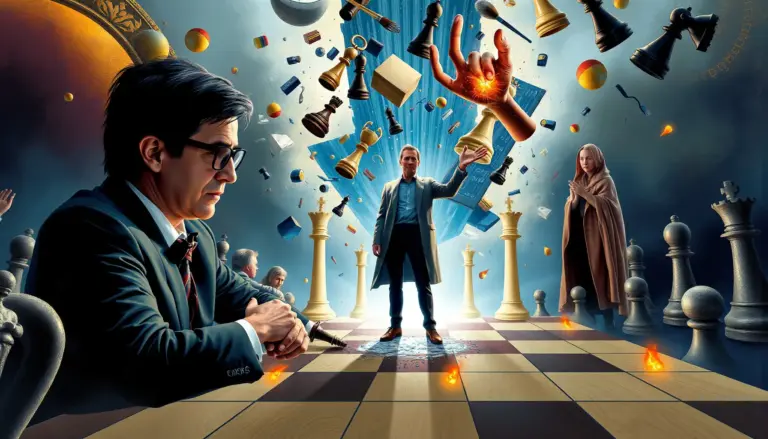
He 11 May 1997 marked a turning point in the history of chess. that day, the supercomputer Deep Blue, developed by IBM, defeated then world champion Garry Kasparov in a six-game match. Although the result was adjusted (3.5 a 2.5), the symbolic impact was immense: for the first time, a machine had beaten a human in a game considered the epitome of strategic intelligence. However, Deep Blue It was not an AI system in the modern sense, but a brute force machine, capable of evaluating up to 200 millions of positions per second thanks to its specialized hardware. His victory was based on calculation ability, not in positional understanding or creativity.
The real change came with the development of chess engines based on machine learning algorithms.. Programs like Stockfish, launched in 2008, combined heuristic evaluations with an unprecedented depth of analysis. but it was AlphaZero, created by DeepMind in 2017, the one who revolutionized the paradigm. Unlike its predecessors, AlphaZero did not depend on human databases or pre-programmed rules; learned to play chess from scratch, through the reinforcement learning, playing millions of games against himself. In just four hours of training, surpassed Stockfish, proving that AI could discover innovative strategies, as positional sacrifices or long-term plans that humans rarely considered.
Hoy, engines like Leela Chess Zero (based on AlphaZero) o Komodo dominate the scene, with a precision that borders on the superhuman. Their influence is such that grandmasters can no longer compete without resorting to them to analyze games or prepare openings.. But this dependence raises an uncomfortable question: Is chess losing its human essence in favor of mechanical perfection?
The preparation of the players: how AI redefined training
Before the age of AI, The preparation of a professional chess player was an artisanal process. The players studied classic games, They memorized opening variants and developed their intuition through experience. However, with the arrival of engines like Stockfish o AlphaZero, training has been transformed into a collaborative exercise between human and machine. Hoy, a grandmaster not only analyzes his games with an engine, but also uses databases such as ChessBase o Lichess to identify patterns in your rivals' play, detect weaknesses and optimize your opening repertoire.
One of the most significant changes is the opening preparation. Before, players depended on books and manual analysis, which limited the depth of its variants. Now, with engines that evaluate millions of positions in seconds, it is possible to discover theoretical lines that previously went unnoticed. For example, the Defense Berlin in Ruy López, considered for decades a solid but passive line, was revitalized thanks to AI analysis, who demonstrated their potential to even the game even against the best opponents. Magnus Carlsen, current world champion, has recognized that his preparation is largely based on the use of engines to find theoretical novelties.
But AI has not only changed that is studied, but also as is studied. Platforms like Chessable use spaced repetition algorithms to help players memorize openings and endings more efficiently. Besides, tools like Chess.com o Lichess offer real-time analysis during games, allowing players to fix errors instantly. This has democratized access to knowledge, but it has also generated a dependency that some critics consider dangerous. Are players losing the ability to think for themselves?
Chess as a laboratory: what AI teaches us about the game
Beyond its practical usefulness, AI has turned chess into a ideas laboratory, revealing aspects of the game that humans had never explored. One of the most fascinating findings is the reevaluation of traditional concepts. For example, for centuries, Chess players believed that control of the center was essential to dominate a game. However, engines like AlphaZero have shown that, in certain positions, giving up the center can be a winning strategy, as long as it is compensated with activity on the wings or with a dynamic game of pieces.
Another revolutionary discovery is the parts appraisal. In classical chess, a standard material value is assigned: pawn (1), bishop/knight (3), torre (5) and lady (9). However, AI has shown that these values are relative and context-dependent. For example, in closed positions, a knight can be more valuable than a bishop, while in open positions, the opposite happens. AlphaZero has even shown that, in certain situations, Sacrificing a rook for a bishop or knight may be the best option, challenging conventional wisdom.
AI has also changed our understanding of end of game. Before, endings were studied using general rules, like the “square rule” for pawns or the importance of passed pawns. However, engines like Stockfish have discovered that many endings considered theoretical tables are, In fact, winnable with precise play. A famous example is the rook and bishop versus rook ending., which for decades was considered tables, but that AI has shown that it can be won with a perfect game. This has led to the creation of databases of late, like the tablebases South Syzygy, containing all possible positions with up to seven pieces and their optimal result.
These advances have not only enriched chess as a discipline, but they have also raised a philosophical question: Whether AI can discover strategies that humans would never have imagined, What does that tell us about the limits of human creativity??
The ethical dilemmas: How far should AI go in chess??
The integration of AI in chess has not been without controversy. One of the hottest debates is use of engines during games. Although it is prohibited in official competitions, cases like that of Hans Niemann, accused of cheating in a tournament against Magnus Carlsen in 2022, have highlighted the challenges of detecting fraud. Tools like Chess.com They use algorithms to analyze the playing style of the participants and compare it with that of engines such as Stockfish, but even so, It is difficult to prove with certainty whether a player has received outside help.
Another ethical dilemma is impact on human creativity. If players rely too much on AI to prepare their games, Are they losing the ability to innovate?? Some critics argue that chess is becoming increasingly predictable, with openings and plans that are simple replicas of what the engines consider optimal. For example, the King's Indian Defense, a dynamic and creative opening, has lost popularity because engines evaluate it as slightly inferior to other options. Are we sacrificing the beauty of chess for the sake of efficiency?
There is also the issue of inequality in access to technology. While elite players have teams of analysts and access to the latest engine versions, amateur chess players or players from developing countries may be left behind. This has led to a growing gap between professionals and the rest, what some see as a threat to diversity in chess.
Finally, There is the question of whether AI should compete against humans. some tournaments, like him TCEC (Top Chess Engine Championship), pit engines against each other, but others, like him Freestyle Chess, allow humans and machines to play as a team. However, the idea of an AI competing directly against a human in a world championship remains controversial. Should chess remain a human sport, Or is it inevitable that AI will end up completely dominating??
The future of chess: between the human and the artificial
Chess is at a crossroads. On the one hand, AI has opened up possibilities unimaginable just a few decades ago: real time analysis, personalized preparation and strategic discoveries that enrich the game. On the other, poses challenges that could alter its essence forever. The future of chess will depend on how these two worlds are balanced.
One of the most promising trends is the collaborative chess, where humans and machines work together to create new ideas. Initiatives like Chess960 (o Fischer Random), where the pieces are placed randomly at the start of the game, They seek to reduce dependence on memorization and encourage creativity. AI can help analyze these variants, but the human touch remains essential to interpret the results.
Another possibility is the development of engines “humanized”, that they not only seek victory, but also imitate the playing style of grandmasters. For example, Maia Chess, a research project, trained an AI to play like a human, making typical mistakes but also showing similar thought patterns. This could help players better understand their own weaknesses and strengths..
However, The biggest challenge will be to preserve the human element of chess. The game is not just a sequence of optimal moves, but also a psychological battle, a duel of wills and an expression of creativity. If AI ends up dominating all aspects of chess, what will be left for humans? Perhaps the answer lies in accepting that chess is no longer just a game, but also a tool to explore the limits of intelligence, both artificial and human.
In conclusion, AI has changed chess in profound and irreversible ways. From the way players prepare to the theoretical discoveries that have redefined the game, its influence is omnipresent. However, This change has not been without ethical and philosophical challenges.. The dependence on engines, the possible loss of creativity and inequality in access to technology are problems that the chess community will have to address in the coming years.
But beyond the dilemmas, AI has shown that chess is a constantly evolving field, where the human and the artificial can coexist and enrich each other. The future of chess will not be a battle between humans and machines, but a collaboration where each one contributes the best of themselves: AI precision and calculation, and intuition, the passion and creativity of the players. In this new scenario, chess will not only continue to be a game, but also a mirror of our own intelligence, a reminder that, even in the machine age, the human remains irreplaceable.