Jorge Luis Borges and chess: a dialogue between infinity and 64 casillas
chess is, for many, a game of strategy and calculation. But for Jorge Luis Borges, it was much more: a mirror of the universe, a metaphor for eternity and a labyrinth where the human mind is lost and found at the same time. The Argentine writer, whose work is woven with threads of philosophy, mathematics and literature, He saw on the board a microcosm where time converged, destiny and creation. How an ancient game could inspire one of the literary geniuses of the 20th century? The answer is not just in the parts, but in what they represent: the fight between order and chaos, finitude and infinity, logic and mystery.
Borges was not a professional chess player, but his fascination with the game transcended the playful. in his stories, poems and essays, chess appears as a recurring symbol, an obsession that reflects your own worldview. for him, Each game was a narrative in itself, a story where the characters—kings, pawns, bishops—moved according to immutable rules, but with an always uncertain ending. This duality between structure and freedom is, in essence, the heart of his work. And it's also what makes his relationship with chess so revealing.: It's not just a game, but of a way of understanding existence.
Chess as a mirror of the Borgesian universe
Borges imagined the universe as an infinite library, a place where every possible combination of letters and words existed on some lost shelf. chess, with his 64 boxes and 32 parts, is a miniature version of that library. Each game is a unique sequence of moves, a story that is written in real time and that, once finished, fades into memory or note. in his story “The Garden of Forking Paths”, Borges explores the idea of a temporal labyrinth where each decision creates a new future. chess, with its infinite variants, It's that same labyrinth: a game where each play opens doors to alternative realities.
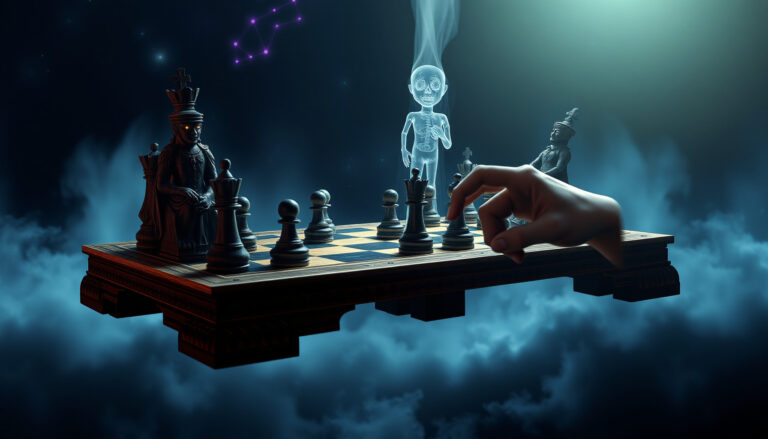
This connection between chess and Borges' conception of time is not accidental.. For Borges, time is not linear, but a network of possibilities where the past, the present and the future coexist. chess, with its cyclical nature—games that are repeated, openings that are studied over and over again—, reflects that idea. in his poem “Chess”, included in The maker, Borges writes: “God moves the player, and this one, the piece. / What god behind God the plot begins / of dust and time and sleep and agonies?”. Here, the board becomes a divine setting, where the pieces are puppets of a destiny written by invisible hands. This almost mystical vision of the game elevates it beyond the earthly, making it a symbol of the human condition.
But Borges is not limited to the abstract. Also explores chess as a game of power and strategy, where every move is a bet for control. in his story “The secret miracle”, A man condemned to death asks God for one more year of life to finish his work. During that year, which actually lasts only a moment, the protagonist plays a game of chess in his mind, moving parts with surgical precision. chess, in this case, It is a metaphor for human resistance in the face of the inevitable.. Es, In the words of Borges, “a game that is also a discipline, a science and an art”.
Chess as narrative: stories inside the board
For Borges, chess was not just a game, but a way of telling stories. Every match, every opening, every gambit, It was a story in itself., with their own characters, conflicts and outcomes. In his essay “Pascal's sphere”, Borges mentions chess as an example of how man has created closed systems - such as language or mathematics - to try to understand the infinite.. The board, with its rules and limits, It's one of those systems: a miniature universe where the finite and the infinite meet.
This idea is reflected in his story “Abenjacán el Bojarí, dead in his labyrinth”, where a man is murdered in a labyrinth, In fact, It's a giant chess board. The murderer, a political rival, use the game as a weapon, proving that chess can be as dangerous as any real battle. Here, Borges plays with the duality of chess: It's a game of peace, but also a battlefield where power conflicts are settled. This ambiguity is key to his work., where the playful and the tragic constantly intertwine.
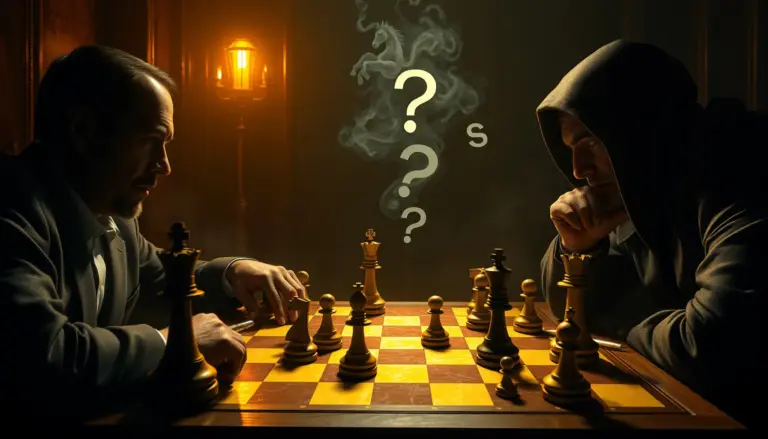
Another notable example is his poem “Chess II”, where he describes a game as a “duel of two blind men” what “they don't know that the hand / that governs them is that of a god”. This image evokes the idea that, although the players believe they have control, They are actually part of a larger design, a narrative written by forces beyond your understanding. chess, in this sense, It's a metaphor for life: a game where we believe we make decisions, but where destiny—or chance—has the last word.
This connection between chess and narrative also extends to its relationship with other strategy games.. In his essay “Circular time”, Borges mentions the shatranj, the persian version of chess, as an example of how games evolve, but they retain their essence. El Shatranj, with its simpler rules and slower pace, It is a reminder that chess is not just a game of calculation, but also patience and creativity. Borges, with his love for the ancient and the mysterious, found in these variants a source of inspiration to explore topics such as time, memory and identity.
Chess as an act of rebellion: Borges and creativity
Borges was not a conventional chess player. He was not interested in tournaments or theoretical openings, but chess as an expression of human creativity. for him, the game was an act of rebellion against the predictable, a way to challenge the rules without breaking them. This idea aligns with his vision of literature: a space where norms exist to be reinterpreted, where classic and modern merge into something new.
in his story “the south”, one of the protagonists plays a game of chess in a cafe in Buenos Aires, a setting that evokes the intellectual bohemianism of the time. chess, in this context, It's more than a hobby: It is a symbol of cultural resistance, a way to preserve tradition in a rapidly changing world. This idea resonates with the notion that chess, like literature, It is a bridge between the past and the present, a universal language that transcends borders and eras.
Borges also explored chess as an act of pure creation. in his poem “Chess”, describes how the pieces “They move in time and space”, suggesting that each game is an ephemeral work of art, a moment of beauty that disappears as soon as it is completed. This idea is connected to his fascination with the ephemeral., so it exists only in the instant and then fades away. chess, in this sense, It's like literature: a creation that lives in the minds of those who experience it, but it's never exactly the same twice.
This vision of chess as a creative act is also reflected in his relationship with other artists.. Borges admired figures such as Marcel Duchamp, who abandoned art to dedicate himself to chess, y a Vladimir Nabokov, who wrote a novelThe defense— inspired by the game. For Borges, chess was not just a literary topic, but an art form in itself, a discipline that required both imagination and logic. In his essay “The art of insulting”, He even compares writing to a game of chess., where every word is a strategic move, a move calculated to surprise the reader.
Chess and philosophy: the board as a mirror of the world
Borges could not separate chess from philosophy. for him, the game was a tool to explore fundamental questions: what is time? Does free will exist? Is the universe a closed system, like a chess board? These questions, that run through all his work, They find in chess a perfect scenario to be raised. The board, with its immutable rules and its infinite possibilities, It is a reduced model of the cosmos, a place where logic and mystery clash without resolution.
In his essay “Pascal's sphere”, Borges mentions chess as an example of how man has tried to domesticate the infinite.. The game, with his 64 boxes and their 32 parts, It is a finite system, But the possible combinations are so vast that they are incomprehensible.. This paradox—the finite containing the infinite—is central to Borges' work.. chess, in this sense, It's a metaphor for the human condition.: we are limited by rules and circumstances, but within those limits, the possibilities are unlimited.
This idea is also related to his fascination with labyrinths.. in his story “Death and the compass”, Detective Lönnrot is lured into a death trap through a game of clues that, In fact, It's a chess game. The murderer, Red Scharlach, use the board as a maze, proving that chess is not just a game of strategy, but also deception and manipulation. For Borges, Chess is a labyrinth where each move is a choice, and each choice brings us closer or further away from the truth.
This connection between chess and philosophy also extends to its relationship with lateral thinking. Borges was a master of paradox and intellectual play, and chess, with its mix of logic and creativity, It was the perfect setting for his explorations. in his poem “Chess II”, For example, describes how the pieces “They don't know that they are the mirror / of an order that they do not understand”. This idea—that the player is part of a system that transcends them—is a reflection on free will and destiny., recurring themes in his work.
Borges and chess: a legacy that transcends the board
Borges's relationship with chess was not just a hobby, but an intellectual obsession that left a deep mark on his work. for him, the game was much more than a hobby: It was a metaphor for life., a labyrinth of possibilities, a mirror of the universe. through chess, Borges explored themes such as time, destiny, creativity and human resilience, turning each game into a narrative, every movement in an existential decision.
But his legacy goes beyond literature.. Borges showed that chess is not just a game of calculation, but also imagination. In a world where technology and artificial intelligence have transformed the game, your vision is still relevant. chess, how he understood it, It's not just a mental sport, but an art form, a philosophical discipline and an act of creative rebellion. In your own words: “Chess is a game that is also a discipline, a science and an art”. and it is, above all, a reflection of what it means to be human.
Hoy, when chess is experiencing a global renaissance thanks to digital platforms and series like The Queen’s Gambit, Borges' vision reminds us that the game is much more than a competition. It is a way of understanding the world, to explore our own minds and connect with the infinite. On a board 64 casillas, Borges found an entire universe, and in that universe, a perfect metaphor for the human condition. Maybe, in the end, chess is not just a game, but a form of poetry.
If chess is, as Borges said, “a game that is also a discipline, a science and an art”, So every game we play is an opportunity to explore the limits of our own mind.. And in that sense, Borges' legacy lives on in every movement, in each strategy, in every checkmate that reminds us that, in the end, the real game is not on the board, but in life itself.