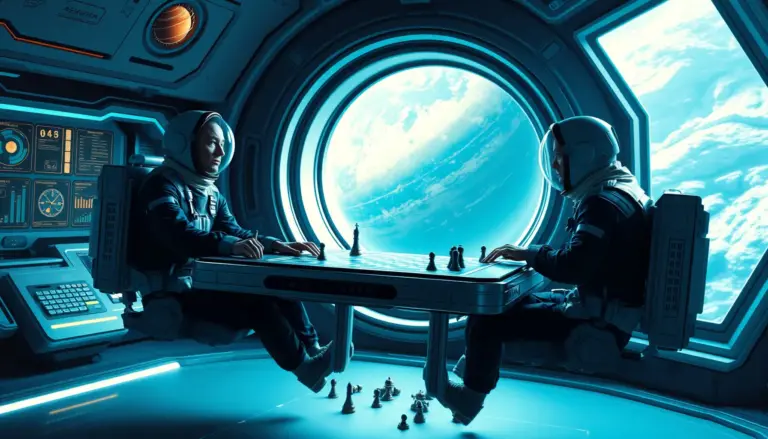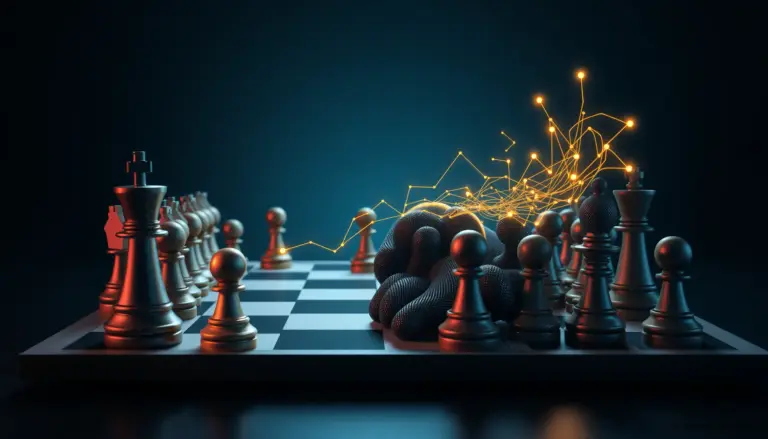
chess, more than just a strategy game, has been for centuries a mirror in which philosophers, thinkers and leaders have reflected their visions of the world. From ancient times to modernity, figures like Marcus Aurelius, Benjamin Franklin, Vladimir Lenin or Jorge Luis Borges have found on the board 64 boxes a powerful metaphor to understand life, the power, war and even the human condition. Why has an ancient game fascinated such diverse minds? The answer lies not only in its technical complexity, but in its ability to condense, in precise movements and immutable rules, the fundamental dilemmas of existence: free will versus determinism, ethics in competition, chance versus calculation, and the search for order in chaos.
This article explores how chess became a philosophical laboratory, where thinkers from different eras projected their theories on society, politics and the mind. We will analyze not only the ideas that arose from this connection, but also the contradictions that it reveals: Is chess a model of pure rationality or, on the contrary, a trap that simplifies reality? Can a game teach us something about human freedom, or is it just an illusion of control? Through historical examples and contemporary reflections, we will unravel why the board remains, for many, the perfect setting to think about the world.
Chess as a mirror of war and power
The association between chess and war is almost as old as the game itself. Originating from India in the 6th century under the name of Chaturanga —which means “four divisions” in reference to the military units of the time—, chess was born as a battle simulation. However, Its evolution in Persia and Europe transformed it into something more than a tactical exercise: became a symbol of political order. In the Middle Ages, For example, chess treatises such as book of games (1283) of Alfonso X the Wise not only taught the rules, but rather they presented the board as a microcosm where each piece represented a social class.: the king, the nobility, the clergy and the people.
But it was in the Renaissance when chess acquired a deeper philosophical dimension.. Niccolo Maquiavelo, in The Prince (1532), He compared the government to a game of chess, where success depended on anticipating the opponent's movements and adapting to the circumstances. For Machiavelli, chess was not just a game, but one realpolitik lesson: conventional morality had to give way to strategic effectiveness. This idea resonated with later thinkers, as Thomas Hobbes, who in Leviathan (1651) described human life as a “war of all against all”, a metaphor that evokes the constant fight for control of the center of the board.
In the 20th century, chess became even more linked to geopolitics. Vladimir Lenin, a passionate player, I saw in the game a representation of the class struggle: the proletariat (the pawns) had to advance in an organized manner to overthrow the bourgeoisie (the king). Even during the Cold War, chess became a symbolic battlefield between the United States and the USSR, with figures like Bobby Fischer and Anatoli Karpov embodying ideological rivalry. As the great teacher wrote Garry Kasparov: “Chess is war in miniature, but it is also peace in miniature, because it teaches that even in the fiercest confrontation there are rules to respect”.
The human mind under the microscope: chess and psychology
If chess has served to understand power, It has also been a key tool for exploring the limits of the human mind.. At the beginning of the 20th century, the psychologist Alfred Binet —known for developing the first intelligence test—studied chess players to analyze how memory and perception influenced their play. Binet discovered that teachers not only calculated more movements than beginners, but they saw the board differently: they perceived patterns, not individual pieces. This finding laid the foundation for understanding the expert cognition, a concept that cognitive psychology would later apply.
But chess also revealed the blind spots of human rationality. In 1946, the philosopher and mathematician Norbert Wiener, father of cybernetics, compared a chess player's brain to a feedback system, where every decision is based on the constant evaluation of risks and rewards. However, Wiener warned that, unlike a machine, humans are subject to emotional biases: the fear of losing, overconfidence or analysis paralysis can cloud our judgment. This idea was later developed by Daniel Kahneman, Nobel Prize in Economics, who in Think fast, think slowly (2011) showed how even the best players fall into cognitive traps, like him anchoring effect (give too much importance to the first information received) or the confirmation bias (look only for what confirms our hypotheses).
chess, so, It's not just a game of pure logic, but a laboratory of human irrationality. As the Argentine writer wrote Jorge Luis Borges in his poem Chess: “God moves the player, and this one, the piece. / What God behind God the plot begins / of dust and time and sleep and agonies?”. Borges' question—who really controls the pieces?— reflects the tension between determinism and free will, a debate that chess has fueled for centuries.
Chess as a metaphor for life: from Marcus Aurelius to Benjamin Franklin
While some philosophers used chess to analyze power or the mind, others saw it as a existential metaphor. In ancient Rome, the emperor and stoic Marcus Aurelius He compared life to a game where each move must be accepted with equanimity. In their Meditations, wrote: “Life is like a game of chess: what matters is not winning, but play well”. For the Stoics, Chess taught that control only exists over our actions, not about the results. This idea resonates in modern philosophy, especially in the existentialism, where authors like Jean-Paul Sartre they saw in the game a representation of the anguish of freedom: Every movement is a choice that defines our destiny, but it also confronts us with the responsibility of our decisions.
In the 18th century, Benjamin Franklin took this metaphor one step further. In his essay The Morals of Chess (1786), Franklin argued that chess was not just a hobby, but one school of virtues. According to him, the game taught:
- The forecast: anticipate the consequences of actions.
- The circumspection: analyze all options before deciding.
- The caution: do not act on impulse.
- The perseverance: not giving up in the face of adversity.
For Franklin, chess was a microcosm of civilized life, where the competition could be fierce, but always within a framework of mutual respect. This optimistic vision contrasted with that of other thinkers, as Arthur Schopenhauer, who in The world as will and representation (1818) saw in the game a manifestation of eternal conflict that defines existence: “Life is like a game of chess where, in the end, all parts are returned to the box”.
The paradox, so, it's clear: chess can be both a order model like a chaos metaphor. for some, It is a reflection of human rationality; for others, a test of your limits. The fascinating thing is that both visions coexist on the same board.
Can chess teach us something about freedom?
One of the most intriguing questions chess raises is whether, in a system of fixed rules and predictable movements, there is space for freedom. Prima facie, the game seems like a perfect example of determinism: each piece has a limited set of moves, and the strongest plays are usually those that follow established principles (control the center, develop the parts, protect the king). However, The history of chess is full of games that defy this logic., where creativity and intuition break with the expected. The great teacher Mikhail Tal, For example, he was famous for his sacrifices “irrational” what, against all odds, led to victory. Aren't these movements a form of freedom within the rules?
This tension between structure and creativity has been explored by philosophers such as Ludwig Wittgenstein, who in Philosophical investigations (1953) compared language to a game whose rules can be reinterpreted. For Wittgenstein, Chess illustrates how freedom is not about breaking the rules, but in play with them. This idea connects with the concept of human agency in contemporary philosophy: even in a closed system, Individuals can find ways to exercise their will.
But there is an ironic twist: the more you master chess, the more its nature is revealed illusionist. Artificial intelligence engines like Stockfish o AlphaZero have shown that, at the highest level, the game comes down to mathematical patterns. This raises an awkward question.: If even human creativity can be replicated by algorithms, where is freedom? chess, so, becomes a mirror of the human condition: we are free within limits, But those limits are narrower than we think.
As the philosopher wrote Byung-Chul Han in The fatigue society (2010), We live in an era obsessed with optimization and performance, where even leisure becomes a productive task. chess, in this context, It is a reminder that true freedom is not in winning, but in play to play. Maybe that's why, despite its rigidity, continues to fascinate those who look for something more than a victory in their boxes: a way of understanding the world.
Conclusions: the board as a mirror and as a prison
Chess has been, for philosophers, psychologists, leaders and artists, much more than a game: has been a spring through which to observe human complexity. From Marcus Aurelius to Benjamin Franklin, from Machiavelli to Kahneman, the board 64 Casillas has served to explore the power, the mind, freedom and the limits of rationality. But this metaphor is not innocent. As we have seen, chess can be both a mirror that reflects our aspirations for order and control as a prison that reminds us how little we control chaos.
The central paradox of chess is that, while promising us clarity—fixed rules, predictable movements, a definite ending—, It also confronts us with the unpredictable: the creativity of the opponent, our own mistakes, the shadow of chance. This duality explains why gaming remains relevant in the digital age., where algorithms like AlphaZero play games “perfect”, but humans continue to be fascinated by the imperfection of the great masters. As the writer said Stefan Zweig in chess novel (1942), chess is “the only game that belongs to all peoples and all times, and no one knows which god gave it to Earth to kill boredom, sharpen the ingenuity and stimulate the soul”.
So, What does chess teach us about the world?? Perhaps the most valuable lesson is this: life, like a game, It's made of rules we didn't choose, but also of movements that we can decide. Freedom is not in breaking the rules, but in play with them so that, in the end, the board—and the world—be a little more ours. and maybe, like in chess, the important thing is not to win, but to understand that each play, no matter how small, has the power to change the course of the game.