chess, a game that today is synonymous with strategy, intelligence and even mental sports, It did not always enjoy the universal acceptance it has today.. During the Middle Ages, This pastime of oriental origin found itself at the center of intense moral debates, religious and social that led to its prohibition on multiple occasions. Why did a seemingly innocent game spark so much controversy? What fears and prejudices were hidden behind ecclesiastical condemnations and secular laws?? Beyond simple fun, chess became a symbol of deeper tensions: the struggle between leisure and virtue, the influence of foreign cultures and the power of the Church to shape the customs of society.
In this article, We will explore the reasons behind the banning of chess in medieval Europe, unraveling the religious arguments, social and political that led to his censorship. We will analyze how this game, that came to the West through the Arabs, It challenged established norms and became a reflection of the cultural conflicts of the time. From criticism from clerics to royal bans, going through its association with vice and heresy, We will discover why chess was seen as a threat and how, yet, managed to survive and evolve into the game we know today.
Chess comes to Europe: a game of controversial origin
Chess was not born in Europe, but in India around the 6th century, under the name of Chaturanga, a game that simulated battles between four military divisions. Thence, expanded into Persia, where he adopted the name shatranj and developed many of the rules that still exist. With the spread of Islam, the game reached the Iberian Peninsula in the 10th century, introduced by the Arabs, who spread it throughout southern Europe. This eastern origin already generated distrust in a Christian Europe that, after the Crusades, He viewed everything related to the Islamic world with suspicion..
However, chess was not just a war game; It was also a reflection of the culture that transmitted it. The Arabs considered it a tool to develop the intellect, patience and strategy, values that contrasted with the medieval European mentality, more focused on faith and submission to God than on logical reasoning. Besides, chess was played in public spaces, like squares and taverns, where people from different social classes mixed, something that the Church and secular authorities viewed with a bad eye. The association of the game with the Islamic world and its practice in considered environments “dangerous” laid the groundwork for his future conviction.
The Church and chess: a conflict between faith and reason
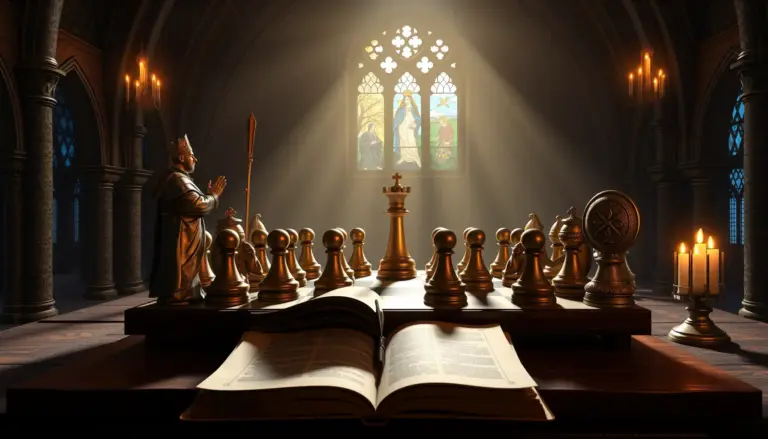
The main opposition to chess in the Middle Ages came from the Catholic Church, who considered it a sinful distraction and a threat to Christian morality. Clergymen argued that gambling encouraged idleness, a vice that, according to medieval doctrine, distanced the faithful from prayer and work. Saint Peter Damian, an influential 11th century cardinal, He was one of the first to condemn chess, calling it “invention of the devil” and comparing it to games of chance, that were already prohibited by the Church. For Damian, chess not only distracted believers from their spiritual duties, but also promoted vanity and excessive competition, values contrary to Christian humility.
But ecclesiastical criticism went beyond the moral. chess, with its emphasis on strategy and logical thinking, represented a challenge to religious dogmatism. At a time when the Church controlled knowledge and education, a game that required independent reasoning could be seen as a threat to the established order. Besides, Chess was associated with astrology and divination, practices that the Church considered heretical. Some clerics even believed that the board 64 Casillas was related to black magic, since the number 64 was considered “damn” for its connection with the magic square of the Pythagoreans.
Not all religious people shared this vision.. some monks, like Abbot Odo of Cluny, They defended chess as a tool to teach discipline and patience, as long as it was played in moderation. However, These voices were a minority compared to the official position of the Church, that at the Council of Paris 1212 explicitly prohibited gambling by clerics, under penalty of excommunication. This prohibition set a precedent that influenced the secular laws of the time..
Royal bans and the criminalization of chess
The ecclesiastical condemnation of chess had a direct impact on the laws of the European kingdoms. During the 12th and 13th centuries, several monarchs issued edicts prohibiting or restricting its practice, especially among the nobles and soldiers. In 1195, King Alfonso X of Castile, in his work book of games, included chess as one of the permitted games, but with warnings about excessive use. However, other rulers were stricter. In 1254, King Louis IX of France, known for his piety, he banned chess throughout his kingdom, arguing that it distracted the knights from their military and religious duties.
The criminalization of chess was not limited to France. In England, King Edward I enacted in 1275 a statute that prohibited board games, including chess, to artisans and farmers, under the argument that these hobbies interfered with their productivity. The logic behind these bans was clear: chess, being a game that required time and concentration, could divert people from their work and social obligations. Besides, Its practice in taverns and other public spaces was associated with alcoholism, gambling and promiscuity, which reinforced the idea that it was a dangerous vice.
Curiously, These prohibitions were not always strictly enforced.. Many nobles and kings, including Louis IX, They were passionate chess players, which generated a contradiction between law and practice. This hypocrisy reflects one of the paradoxes of the Middle Ages.: while the authorities condemned the game in public, privately they enjoyed it as a form of entertainment and mental training. This duality contributed to, over time, the bans will be relaxed, especially when chess began to be seen as a tool for the education of the nobility.
Chess as a symbol of cultural resistance
Despite the prohibitions, Chess never completely disappeared from Europe. His persistence was due, in part, to their ability to adapt to cultural and social changes. During the 14th and 15th centuries, the game began to be associated with chivalry and nobility, becoming a symbol of status and refinement. Chess manuals, like him book of games by Alfonso, helped legitimize its practice among the elites, presenting it as an activity worthy of kings and knights.
Besides, chess became a bridge between cultures. As Europe opened to the Renaissance, the game was adopted by humanists and scholars, who saw it as a tool to develop critical thinking. Figures such as the Italian poet Dante Alighieri mentioned chess in their works, giving it a place in literature and popular culture. Even the Church began to soften its stance: in the 15th century, Pope Innocent VIII allowed clerics to play chess, as long as they did it in moderation and without betting.
Chess' resilience was also due to its ability to evolve. During the Middle Ages, the game underwent significant changes to its rules, such as the introduction of castling and the queen move, that made it more dynamic and strategic. These changes reflected the transformation of European society, that little by little left medieval dogmatism behind to embrace a more rational and open mentality. chess, in this sense, not only survived the bans, but it became a symbol of cultural resistance against religious and political oppression.
Conclusions: chess as a mirror of the Middle Ages
The ban on chess in the Middle Ages was not an isolated event, but the result of a series of cultural tensions, religious and social that defined the era. From its arrival in Europe as a game of Islamic origin to its association with vice and heresy, chess became a scapegoat for ecclesiastical and secular authorities, who saw in him a threat to the established order. However, Its persistence and eventual acceptance reveal much about the evolution of medieval society..
Chess was banned because it represented everything the Church and rulers feared.: the influence of foreign cultures, distraction from religious and work duties, and the development of independent thinking. But it was also a game that, despite the prohibitions, managed to adapt and survive, becoming a symbol of resistance and change. Its history reflects the struggle between dogmatism and reason, between control and freedom, that characterized the Middle Ages.
Hoy, Chess is celebrated as a game of intelligence and strategy, But its medieval past reminds us that even the most innocent activities can become sources of conflict when they clash with social norms.. The ban on chess was not just a question of morality, but a reflection of the fears and prejudices of an era. By understanding these reasons, we can appreciate not only the history of chess, but also the complexity of a society that, although it is often presented as homogeneous, It was full of contradictions and tensions.